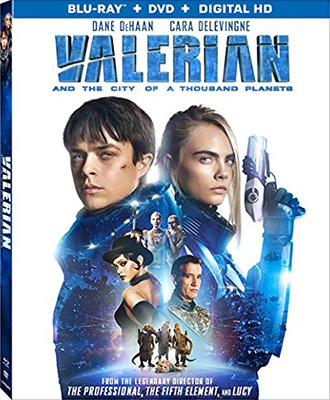
Valerian and the City of a Thousand Planets

BLU-RAY REVIEW:

Lionsgate;
Sci-Fi;
Box Office $41.19 million;
$29.95 DVD, $39.99 Blu-ray, $42.99 UHD BD;
Rated ‘PG-13’ for sci-fi violence and action, suggestive material and brief language.
Stars Dane DeHaan, Cara Delevingne, Clive Owen, Rihanna, Ethan Hawke, Herbie Hancock, Kris Wu, Rutger Hauer.

Writer-director Luc Besson’s Valerian has the same elaborate world-building and goofy sci-fi charm as his 1997 film The Fifth Element. Indeed, one might assume this were a sequel to the previous film if they weren’t set 500 years apart. A shared universe, perhaps?

Valerian and the City of a Thousand Planets is based on “Valérian and Laureline,” a French comic strip popular in Besson’s home country when he was growing up. Subtly or overtly, the relatively obscure source material has inspired numerous sci-fi properties since its debut in 1967, and may even have inspired Besson as he was creating Fifth Element. Certainly, like John Carter before it, the film may seem to evoke better-known properties if only because the source material was so influential to begin with.

Dane DeHaan (The Amazing Spider-Man 2) stars as Valerian and Cara Delevingne (Suicide Squad) plays Laureline, soldiers in a 28th century federation. Their mission to retrieve a rare creature gets them involved in a grander conspiracy.

The film begins with an engrossing hook, as the early years of humanity’s space exploration yields leads to encounters with aliens on an ever-growing International Space Station, which after several decades becomes too large to remain in Earth orbit and is set adrift into deep space. As more creatures visit and add to the station over the centuries that pass, it becomes the enormous multicultural city of the film’s title.

Eventually, Valerian and Laureline make their way to the city for a series of spectacular chases that will yield answers to the mysteries at hand. But first, they visit a grand bazaar on a desert world, ingeniously rendered via a multi-dimensional plane requiring shoppers to wear special glasses to inspect merchandise that is slightly out of phase with our reality (special boxes exist to transfer items from one dimension to the next).

The film is a visual spectacle, no doubt, and every bit as colorful and out there as one would expect from the filmmaker responsible for The Fifth Element, Lucy and Arthur and the Invisibles.

The Blu-ray includes several lengthy featurettes detailing Besson’s vision and the making of the film.

Flixster Video Shutting Down

Flixster Video announced it will be shutting down its website and discontinuing all related operations in the United States as of Feb. 20, 2018.

In a note to users Dec. 21, Flixster Video reminded users they could redeem digital codes and watch their videos at Vudu.com, and encouraged users to create or sign-in to a Vudu.com account and link to UltraViolet. The message also promoted new digital locker service Movies Anywhere, which links to Vudu, iTunes, Amazon Video and Google Play.

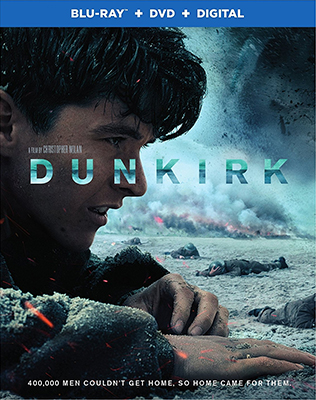
Dunkirk

BLU-RAY REVIEW:

Street 12/19/17;
Warner;
Drama;
Box Office $188.05 million;
$28.98 DVD, $35.99 Blu-ray, $44.95 UHD BD;
Rated ‘PG-13’ for intense war experience and some language.
Stars Fionn Whitehead, Tom Glynn-Carney, Jack Lowden, Harry Styles, Aneurin Barnard, James D’Arcy, Barry Keoghan, Kenneth Branagh, Cillian Murphy, Mark Rylance, Tom Hardy.

Christopher Nolan is the kind of filmmaker who doesn’t stick to a particular genre or subject matter. Rather, when he delves into a project, he leaves an indelible mark on it that immediately sets it apart from other films that would aim to cover similar ground. Indeed, at those times when Nolan’s vision can even be classified as one thing or another, his films, such as Kubrick’s before him, stand apart as his own unique take on the genre. Much as Insomnia was Nolan’s murder mystery, Inception was his heist film, and Interstellar his science-fiction film, Dunkirk is unmistakably Nolan’s “war film.”

Told through stunning visuals with minimal dialogue, Dunkirk relates the soldier’s experience of the 1940 evacuation of the eponymous French town, where during the early years of World War II Allied troops were surrounded by Nazis and had to be evacuated from the beach. With time of the essence, the British even called upon civilian ships to save as many troops as possible, so they could regroup and hold off further German advances until the Americans were ready to enter the war.

The film relates the evacuation through three storylines covering three different time frames. In one, a group of grunts scours the beaches, desperate to find room on any ship to flee the impending doom to come. In the second, a civilian yacht is commissioned to head to Dunkirk, and encounters several soldiers adrift at sea. In the third, a Royal Air Force fighter squadron races to the beach to provide cover from German air raids against the exposed crowds of British soldiers waiting for a ride home.

The three time frames occasionally overlap, as events from one are foreshadowed in another. The film is generally cut together to cross between the time frames to give a sense of the shared experiences of the men involved, even those who never meet each other. Some find courage in their duties. Others seek only to outrun their fears.

Nolan shot much of the film with Imax cameras, allowing it to pull the audience in with its immersive framing, letting viewers absorb the details of a wide picture. Needless to say, the larger the screen, the more impactful the images will be.

To achieve his vision, Nolan and his crew had to innovate many new filmmaking techniques in order to place the Imax cameras in places they were never intended to be. Much of this is covered in the bonus material, showing how Nolan pushed the boundaries of aerial photography by mounting cameras on both ends of a plane that could keep up with and maneuver with the fighter planes during the dogfight scenes.

Rather than a series of disparate bonus materials, the Blu-ray extras are contained on a single bonus disc and consist solely of a series of behind-the-scenes featurettes that can be played separately or as a whole documentary that runs nearly two hours.

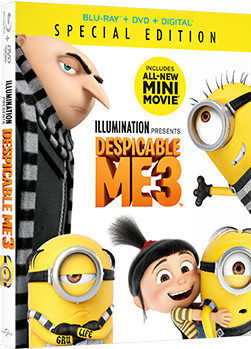
Despicable Me 3

BLU-RAY REVIEW:

Universal;
Animated;
Box Office $264.55 million;
$29.98 DVD, $34.98 Blu-ray, $39.98 UHD BD;
Rated ‘PG’ for action and rude humor.
Voices of Steve Carell, Kristen Wiig, Trey Parker, Miranda Cosgrove, Dana Gaier, Nev Scharrel, Pierre Coffin, Steve Coogan, Jenny Slate, Julie Andrews.

The “Despicable Me” franchise has always tried to have its cake and eat it too. The original film wanted to put a James Bond-type supervillain at the center of its story, yet couldn’t make him outright evil for fear of losing the sympathy of the audience. So that first story was all about humanizing the scheming Gru (Steve Carell) by having him adopt three girls and softening up a bit. And by the end of the second movie he was practically a full-fledged crimefighter after falling in love with agent Lucy (Kristen Wiig) of the Anti-Villain League.

And thus, like “Shrek” before it, an animated franchise begins to expand with more characters, and must find storylines to give them all something to do, while also giving popular minor characters more exposure as well (though the less said about the Minions spinoff, the better).

Despicable Me 3 hits upon a clever if shop-worn premise to at least return the franchise to the spirit of its roots going forward, by introducing a long-lost twin brother of Gru, named Dru who grew up to be something of a goody two-shoes.

It seems Gru’s parents split up with the twins were born, with each taking one. Gru’s mom expresses resentment toward her former criminal son, claiming she got the “second pick.” But in a twist, Dru claims that their recently deceased supervillain dad was more proud of Gru’s villainous exploits than Dru’s pampered lifestyle.

Now, with access to daddy’s lair and arsenal, Dru dreams of breaking bad. Hoping to steer these tendencies toward something positive, Gru enlists his help in tracking down the elusive mastermind Balthazar Bratt (voiced by Trey Parker of “South Park.”)

Bratt is a former child star who resents the world for abandoning him once he hit puberty. He’s a fun bad guy who loves the ’80s and provides a nice excuse for some wry commentary about commercialization and the exploitation of Hollywood, even if it ends up, like in the Minions movie, with another battle involving a giant version of a character rampaging through a city.

Meanwhile, the Minions, looking to return to villainy, leave Gru and end up in jail, setting them up in a side adventure to break out. And Gru’s girls search for a real unicorn while trying to accept Lucy as their mother.

It all adds up to an entertaining bit of fluff that should satisfy fans of the previous movies while being a lot more tolerable to older viewers than the Minions prequel. The film sets up an intriguing fourth chapter should they continue to explore the brothers’ storylines through their logical continuation.

Accompanying the home video release of the film is the new mini-movie The Secret Life of Kyle, a short about Gru’s weird mutant pet thing falling in love with a neighbor’s dog.

Other extras include sing-alongs, a deleted scene, more Minion moments, character profiles, in-universe infomercials and a number of behind-the-scenes videos.

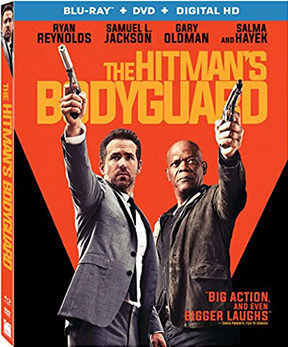
The Hitman’s Bodyguard

BLU-RAY REVIEW:

Lionsgate;
Action Comedy;
Box Office $75.47 million;
$29.95 DVD, $39.99 Blu-ray, $42.99 UHD BD;
Rated ‘R’ for strong violence and language throughout.
Stars Ryan Reynolds, Samuel L. Jackson, Gary Oldman, Salma Hayek, Élodie Yung, Joaquim de Almeida, Kirsty Mitchell, Richard E. Grant.

Advertising for The Hitman’s Bodyguard promoted a riotous comedy akin to Deadpool, which makes sense given the Ryan Reynolds connection. The movie we got, on the other hand, turned out to be a pretty hardcore action flick peppered with moments of irreverent humor and some otherwise dark overtones.

The story involves a disgraced private bodyguard (Reynolds) being hired by a former lover (Élodie Yung of Netflix’s “Daredevil”) working for Interpol to escort an international hitman (Samuel L. Jackson) to a high-profile war crimes trial involving a European dictator (Gary Oldman), after other witnesses turn up dead due to a suspected mole in the agency.

On cue, assassins get wind of the duo of Reynolds and Jackson and hunt them down with furious gunfire through car, motorcycle and boat chases. The movie gets by mostly due to the chemistry of its two leads, but otherwise shouldn’t disappoint too many fans of buddy action movies. Besides, with Jackson (Nick Fury in the “Avengers” movies), Reynolds (Deadpool himself) and Yung (Elektra on Marvel’s Netflix shows), it’s practically a Marvel Comics crossover. (Oldman was Commissioner Gordon in Christopher Nolan’s Batman movies, but that’s on the DC Comics side of the ledger so we’ll have to leave him out.)

The Blu-ray includes a ton of good extras, such as deleted scenes, some typical behind-the-scenes featurettes and a commentary from director Patrick Hughes, himself no stranger to action after helming The Expendables 3.

Election

BLU-RAY REVIEW:

Street 12/12/17;
Criterion;
Comedy;
$29.95 DVD, $39.95 Blu-ray;
Rated ‘R’ for strong sexuality, sex-related dialogue and language, and a scene of drug use.
Stars Matthew Broderick, Reese Witherspoon, Chris Klein, Jessica Campbell, Mark Harelik, Phil Reeves, Molly Hagan, Delaney Driscoll, Colleen Camp.

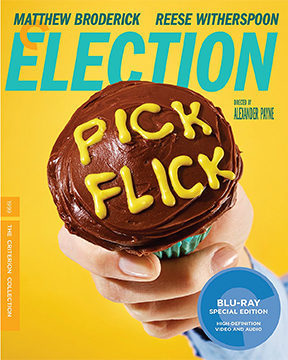
The novel upon which Alexander Payne’s Election is based drew its inspiration from the 1992 presidential election, and the disruption Ross Perot’s third-party bid brought to the two-party routine.

Now, it would be one thing if Tom Perrotta’s book simply translated that race into a high school analog. But that’s not quite what he did. The beauty of politics, at least from a storytelling perspective, is that when used as a storytelling template it can inspire any number of archetypal characters who can be identifiable in any era. Using a high school student body presidential election is just the brilliant metaphor that makes the story a timeless one, providing the foundation for a film that, if anything, might seem more relevant today than it did two decades ago.

Even in the first few years after the film’s release, people were drawing comparisons between its ambitious go-getter Tracy Flick (Reese Witherspoon) and Hillary Clinton. At one point, Flick even narrates a bitter monologue expressing her outrage that anyone else would work to usurp what she has worked so hard to achieve.

In the film, Tracy initially begins her presidential campaign unopposed. But then the teacher overseeing the election, Mr. McAllister (Matthew Broderick), takes umbrage with her sense of entitlement, and believes she must be stopped before her ambition is unleashed on the world. He also wouldn’t mind exacting a bit of revenge against Tracy for having an affair with another teacher that led to said teacher being fired.

Thus, Mr. M (having a bit of inspiration while watching a football-themed porno) convinces popular jock Paul (Chris Klein) to run for president as the best chance to defeat Tracy.

The only wrench in Mr. M’s plan is Paul’s lesbian sister, Tammy, whose girlfriend dumps her in favor of Paul, inspiring Tammy to run for president on a nihilistic platform to get back at him.

The three-way race inspires all sorts of hilarious campaign tricks and confrontations on the way to a bizarre resolution.

Many of the bonus materials point to comparisons with the 2008 election, with Tracy as Hillary Clinton and Obama as the upstart seeking to take away what she feels she has earned.

However, it’s hard to deny that there may be even more parallels with the 2016 race, which is what makes this excellent Criterion Blu-ray edition so timely. With Tracy again serving as the Hillary analog, a large swath of viewers will no doubt find parallels between Donald Trump and Paul, the rich kid who decided to run just because he could. Certainly some of Tammy’s open antagonism toward the system could be attributed to Trump as well. The sense of the outsider swooping in to steal Tracy’s/Hillary’s thunder could also apply to Bernie Sanders. And that the film’s election involves allegations of cheating only strengthens the connections.

Of course, none of this would have been known to Payne or Perrotta so long ago, which is what makes this film so intriguing as time goes on. I suspect the film will be just as interesting when seen through the lens of 2040 or some other future election, much in the same way we might draw parallels from Mr. Smith Goes to Washington to our politics of today.

What really drives the comedy home, though, might be the way the narrative is divided to spotlight the unique perspectives of all the key players, in contrast to what the audience can see is actually going on. Paul may be a dumb jock, for example, but he doesn’t know that.

It’s in this regard that Broderick really shines as the hapless Mr. M, who constantly attributes profound significance to his mundane existence, which comes across as either hopelessly optimistic or extremely delusional (such as when, after being caught having an affair with the fired teacher’s wife and kicked out of his house, he considers it a chance at a fresh start. If only).

Interestingly enough, Perrotta’s manuscript went unpublished for several years until the film rights focused renewed interest on it, allowing its publication in 1998 just as the film was going into production.

The Blu-ray includes a good mix of vintage and fresh bonus material to really give a nice view of the picture.

There’s Payne’s commentary from the 1999 DVD, his 1990 UCLA thesis film, and a local Omaha newscast about the film’s production.

True retrospectives are offered in a new interview with Witherspoon, who looks fondly upon one of her earlier roles but also laments how it typecast her; and “Tru Inside: Election,” a 2016 TV documentary that really explores the impact the film has had so many years later, with interviews with several cast members and filmmakers. This documentary is also the only place on the disc to see footage from the film’s lackluster original ending, which was more in line with the book but which filmmakers felt negated all the bite the film had up to that point.

Hans Zimmer: Live in Prague

BLU-RAY REVIEW:

Eagle Vision;
Music;
$19.99 DVD, $24.99 Blu-ray;
Not rated.

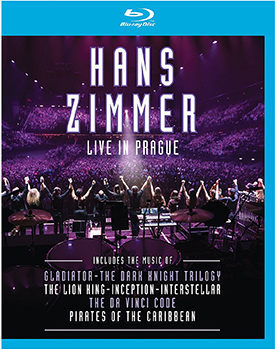
Concerts of film music conjure visions of orchestras performing a variety of pieces not unlike classical music. Indeed, the maestro John Williams often fills the Hollywood Bowl with performances of his classic movie themes.

A Hans Zimmer concert, on the other hand, is an entirely different experience. Zimmer’s touring show offers an eclectic blend of symphony and rock concert, befitting a composer whose sensibilities often eschew the traditional in favor of experimental sounds that often define his scores.

The concert featured on this Blu-ray, recorded May 7, 2016 in Prague during Zimmer’s European tour last year, offers a set list that is pretty typical for his live shows the past few years.

Zimmer offers a fair mix of his greatest hits, from a medley from his Oscar-winning The Lion King score, to selections from his collaborations with Christopher Nolan, including The Dark Knight, Interstellar and Inception.

He also offers his Superman theme from Man of Steel, though this performance predates when he started including his Wonder Woman theme alongside it, as he did during his 2017 American performances.

Many of his pieces are designed to showcase the talents of particular vocalists or musicians, with pieces such as a Gladiator medley providing an emotional respite in the build-up to a rocking the stage with an all-out performance of upbeat music from the “Pirates of the Caribbean” films.

Of course, just as he is often criticized for in his film scores, Zimmer wouldn’t be Zimmer without taking his personal indulgences a bit too far in some cases. Here, it’s the bizarre decision to present his atonal Electro theme from The Amazing Spider-Man 2, which was designed to emulate a cacophony of madness in the film, and certainly plays like it on stage. While Zimmer has earned his fair share of fans who admire his willingness to push the boundaries of his art, and a number of whom no doubt enjoy this track for its eccentricities, this is a piece that simply doesn’t hold its own against the majesty of his “Da Vinci Code” music or the whimsy of a Driving Miss Daisy.

Still, this is a concert that provides a great showcase for Zimmer’s talents as a musician and is highly recommended to anyone who appreciates the modern age of film scoring.

The Crown: Season One

BLU-RAY REVIEW:

Sony Pictures;
Drama;
$45.99 DVD, $55.99 Blu-ray;
Not rated.
Stars Claire Foy, Matt Smith, Vanessa Kirby, Eileen Atkins, Jared Harris, John Lithgow.

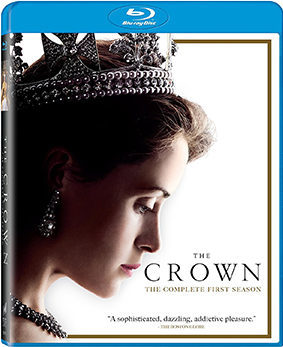
The excellent first season of Netflix’s “The Crown” highlights the often tumultuous lives of Britain’s royal family and their role in a government that has no practical need for them yet still turns to them for a sense of national identity, continuity and unity — rendering their role as symbolic enough to be essentially powerless, yet demanding of them a piety that may as well strip them of their humanity.

The show was created by Peter Morgan, who previously wrote 2006’s The Queen, in which Helen Mirren played Elizabeth II in 1997 around the time of Princess Diana’s death. Many of the themes and settings touched upon in that film are expanded upon here.

“The Crown” starts almost like a sequel to The King’s Speech, with Jared Harris (“Mad Men”) playing King George VI, who was played by Colin Firth in the film that depicted his own early reign. The show picks up in 1947, with the wedding of Elizabeth (Claire Foy) and Philip (Matt Smith of “Doctor Who” fame).

Of course, Elizabeth doesn’t become Queen until 1952, so there’s plenty of time to introduce the family dynamics that will come to define the show. Philip, for example, begins to resent being subservient to his wife, to the point where he can’t even give his last name to his children (not that Philip really had a last name, since he was basically an exiled Greek prince who grew up in Germany and the United Kingdom and adopted the surname of an English relative so he could marry Elizabeth to begin with). Her status as the future monarch is, understandably, more important to the stuffy English bureaucrats who surround the palace than any concerns he may have.

There’s also Princess Margaret, who while technically is second in line for the throne (before Elizabeth’s children are born) is basically treated as a disposable royal, which contributes to her having somewhat of a rebellious attitude, as she is expected to project the prim and proper air of royalty without being allowed to take advantage of its trappings (aside from fabulous wealth and life in castles, that is). This comes into play when she is blocked from marrying her lover, a divorced pilot whose involvement with the princess is frowned upon for both religious and social reasons.

Margaret’s romantic troubles tie her, at least thematically, to her uncle, the former King Edward VIII (Alex Jennings), who famously abdicated the throne in 1936 over his love for a woman the government and family disapproved of (paving the way for his brother, George VI, and eventually Elizabeth II, to rule). Now several years removed from the throne and enjoying the social engagements of a worry-free life, Edward complains about being shut out from the family while demanding more money to maintain his lifestyle.

To the family, Edward choosing love over duty is seen as incredibly selfish, drawing the ire of his mother, Queen Mary, for putting too much stress on her younger son in carrying out his duties as king, a destiny he was not faced with until much later in life. (Being forced to serve in the role during World War II didn’t help, though more details on that unfold in the second season.)

As a result, George VI has turned to chain smoking, leading to lung cancer and an early death. The show doesn’t shy away from his deterioration, including the depiction of a surgery to remove a lung ravaged by the disease, with doctors setting up an ad hoc surgical bay in the palace.

One aspect the show nails is the fine line the royals must walk between their duties as government figureheads and trying to maintain their humanity and dignity through it all. This is especially true during the transition between George to Elizabeth, who is on an African safari when she receives the news that she is now the queen. On the one hand, she’s a 25-year-old woman whose father has just died, and her grief is understandable. But how much of her ability to mourn is subsumed by the relenting pressures from parliament and tradition to carry on and put on a show for her subjects? This is an issue that almost every monarch must deal with.

Elizabeth’s youth, then, leans into the central contrast of the season, as her first prime minister is the aging Winston Churchill (John Lithgow) in the waning years of his political life. “The Crown” clearly admires Churchill’s political skills, and in many ways his stature has made him just as much a symbol of Britain as its monarchy, though the show is certainly not willing to canonize him. He is depicted as arrogant and aloof in his later years, showing little concern for the plight of citizens during a deadly smog attack on London, and becoming especially difficult when asked to pose for a formal portrait to commemorate his many years of service. Lithgow is outstanding in the role and his Emmy for it comes as little surprise.

The plan for the show is reportedly to spend six seasons depicting the reign of the queen, with new actors in the key roles every two years as the characters are aged up. The recently released second season (on Netflix) would thus conclude the run of the original cast, and their replacements for season three are already being announced. While it’s still early to look toward the final years of the show, it will be interesting to see if they can lure Mirren back into the role to bring the queen’s story full circle.

From Around the Web