



STREAMING REVIEW:
Netflix;
Documentary;
Not rated.
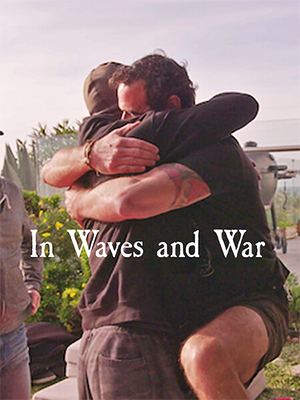
The men who comprise the Navy SEALs are defined by an elite, almost superhuman physical standard. Yet the documentary In Waves and War — directed by the award-winning team of Jon Shenk and Bonni Cohen — reveals the hidden cost of that excellence. Now streaming on Netflix, the film follows these soldiers on a mission to find relief from the pain of traumatic brain injury and PTSD.
Shenk and Cohen, known for their Emmy-winning and Oscar-nominated work like Athlete A and Lead Me Home, were hand-selected for this project in 2019 by the late Diane Weyermann of Participant Media. Weyermann was profoundly moved by the story of the Navy SEAL’s Capone family and believed the directors’ history of navigating dark, sensitive subjects made them the perfect fit.
Beyond the scars of combat lies a near-addiction to the adrenaline of the mission, leaving many of the featured soldiers struggling with behavioral issues they’ve long attributed to the fog of war and the unknown of multiple tours of duty. It is a cycle of “drug cocktails” and standard military recovery that offers little more than a temporary bandage, until Amber Capone pushed her veteran husband, Marcus, to seek a radical alternative: ibogaine.
Ibogaine is a powerful alkaloid derived from the Tabernanthe iboga shrub, used for centuries in Central African spiritual rites. Its potential was discovered by the West in 1962 by Howard Lotsof, who found it ended his heroin withdrawal. Despite its perceived benefits as a tool for neuroplasticity — allowing the brain to “unlock” and process deep-seated trauma — it remains illegal in the United States. Placed on Schedule I in 1970 due to cardiac risks, specifically its ability to interfere with the heart’s electrical signaling, it forced the film’s subjects to seek treatment at the Ambio Life Sciences clinic in Baja California, Mexico.
This journey caught the attention of Dr. Nolan Williams, director of the Stanford Brain Stimulation Lab. Dr. Williams initiated an observational study to monitor these men before and after their treatment. By partnering with the Capones’ nonprofit, VETS (Veterans Exploring Treatment Solutions), they tracked 30 veterans through a protocol that combined ibogaine with magnesium to protect the heart. The results were dramatic, with researchers seeing an 88% reduction in PTSD symptoms and a total elimination of suicidal ideation.
As the film progresses and the men describe being “unlocked,” a startling common thread emerges. The primary breakthrough for these soldiers isn’t the trauma caused by war, but the childhood trauma they each recognize during the treatment process. This realization prompts a deeper, more uncomfortable question: Does childhood trauma draw these men to the SEAL program in the first place? For those of us who have endured our own childhood trauma and the resulting difficulties with relationships and addictive behaviors, it’s hard not to see a pattern. It suggests that the “elite” path might actually be a form of avoidance — a way to replace internal chaos with a high-stakes external “reprogramming” that provides the high degree of excitement needed to drown out old ghosts.
Perhaps the most jarring element of the film is watching this rigid military machismo break down. These men have been conditioned to be ultimate instruments of stoicism, but as they enter the process, the “tough guy” armor doesn’t just crack, it dissolves. They become incredibly emotional, confronting the very vulnerability they were trained to suppress. The ibogaine acts as a chemical sledgehammer to the ego, forcing a breakdown of the hyper-masculine facade to reveal the wounded child underneath.
While the film is emotionally resonant, it is not without its flaws. As a piece of storytelling, it can be confusing to identify the couples or keep them straight as it’s happening, as appearances in childhood photos and combat flashbacks vary significantly from current-day interviews. The directors cleverly use flowing animation to depict the involuntary, internal hallucinations of ibogaine journeys, offering a vivid window into their recollections of the experience, into their minds. While the point is effectively made that the drug “works,” the narrative stays focused on the chemical jolt. It offers very little insight into the intensive therapy and the grueling daily work required to maintain that progress once the initial effect wears off. It is a powerful look at a “miracle” cure, but it leaves the viewer wondering about the long, quiet struggle of recovery, self-discovery, and the healing that must follow.