STREAMING REVIEWS:
Netflix;
Drama;
Rated PG-13 for some violence and sexuality.
Stars Joel Edgerton, Felicity Jones, Kerry Condon, William H. Macy, Nathaniel Arcand, John Diehl, Paul Schneider, Clifton Collins Jr., Will Patton.
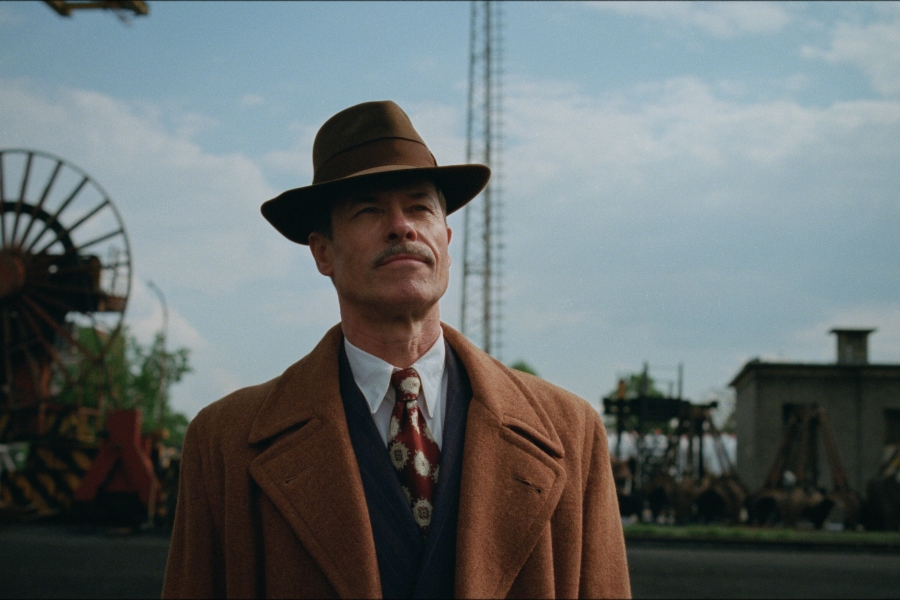
Clint Bentley’s Train Dreams is not a film that moves with the frantic pulse of modern cinema, but rather one that breathes with the slow, deliberate respiration of the Earth itself. Adapted from Denis Johnson’s 2011 novella, the movie serves as an ode to a lost American era, centering on the life of Robert Grainier, a man whose existence is defined by the very landscape he helped scar and settle. The production design at times feels a bit too “magic hour” and curated for a period known for its documented grit, but there is an undeniable, haunting power in its aesthetic. It presents the Idaho Panhandle not as it strictly was, but as it remains, in the haze of a long-lived memory: a cathedral of timber and ghosts.
This approach evokes the spirit of Robert Redford’s 1992 A River Runs Through It. Much like that film, which earned an Academy Award for best cinematography, Train Dreams uses the natural world as a primary character. However, where Redford’s Montana was a place of grace and familial bonding, Bentley’s Idaho and Oregon are landscapes of brutal isolation. The cinematography by Adolpho Veloso captures the vastness of the Pacific Northwest through a naturalist lens, making the human figures within it look almost fragile and temporary. The panoramas of the Columbia River Gorge and the dense, claustrophobic groves of the Panhandle create a visual tension between the beauty of the wilderness and the violence required to “tame” it for the railroad.
Joel Edgerton delivers a performance of profound quiet as Grainier, an itinerant laborer. We meet him in a rugged world of “misery whip” saws and horse-drawn sleds, where the physical cost of progress is measured in the broken bodies of men like Arn Peeples. Played with a sharp, philosophical wit by William H. Macy, Arn is the camp’s resident intellectual until a falling tree branch — a “widow-maker” — clocks him into a tragic mental decline. Watching Macy transition from a man who muses that “the dead tree is as important as the living one,” to a shell-shocked dimwit whose presence quickly vanishes from the camp, is a stark reminder that while the railroad was building a nation, it was simultaneously discarding the men who laid its tracks.
The film pivots on the Great Fire of 1910, a historical “palisade of flame” that remains one of the most destructive events in American history. In reality, the “Big Burn” consumed three million acres — an area the size of Connecticut — in a mere two days, killing 87 people and leaving behind a charred landscape. In the film, this fire consumes Grainier’s home and his family. Felicity Jones brings a luminous, fleeting warmth to the role of Gladys, Grainier’s wife. Their love is portrayed through brief, tender domesticities — planning where a bed might sit in a cabin not yet built — which makes the forest’s subsequent silence all the more deafening. When the fire roars through, sounding like a thousand freight trains, it robs Grainier of his wife and their young daughter, Kate. This loss turns the film into a psychological study of grief, where the scenery begins to mirror Grainier’s fractured mind.
Between these moments of tragedy are quiet men gathered around campfires, where the movie attempts to grapple with an environmental angle. Here, the laborers speak of the “murder” of the forest for the growth of the railroad and the nation. While these dialogues are beautifully written, they feel disconnected from the characters’ reality. It is difficult to believe that hardened laborers in the early 1900s, struggling for survival in a “pre-OSHA” world, would possess such modern, eco-conscious sensibilities. This choice feels like a contemporary perspective forced into a historical context. The men were surely aware of the destruction, but the way they philosophize about it feels more like the voice of a 21st-century screenwriter than a 20th-century logger.
The movie continues to challenge our imagination through its depictions of the mystical. In a haunting sequence, Grainier encounters wolf howls followed by a feral child, played with startling, animalistic intensity by Zoe Rose Short. In the film’s literal eye, she is a girl raised by the wild, but I interpreted this encounter as a profound hallucination born of long-term isolation. To me, Grainier was caring for an injured wolf, his mind so warped by sorrow that he projected the image of his lost daughter onto the beast. When he wakes to find the “girl” gone and the window open, it feels less like a child has run away and more like the wild has reclaimed a memory he was never meant to keep, a form of grieving that transcends words.
As the story progresses over its concise yet weighty 1 hour and 45 minutes, Grainier’s subtle aging mirrors the West’s modernization. It took me a beat to realize that the world had shifted until the horse was replaced by the automobile and the hand-saw by the introduction of the chainsaw. Grainier, now too old for the dangerous work, becomes a relic. The film relies heavily on Will Patton’s narration, whose gravelly, rhythmic cadence provides the necessary “clocks” for this journey. While I prefer a film to show its story visually rather than rely on a voiceover, Patton’s performance is the exception, his voice feeling as though it were pulled directly from the bark of the trees.
Subscribe HERE to the FREE Media Play News Daily Newsletter!
Train Dreams played in select “arthouse” cinemas in major U.S. cities (such as New York, L.A. and Chicago) and across regions of the Pacific Northwest (Spokane and Seattle), where it was filmed. Now it’s widely available on Netflix, where it has found a second life in streaming, reaching a global audience that can appreciate its slow-burn intensity from home.
In the final act, we encounter a Department of Forestry worker, Claire, who lives in a watchtower overlooking the expanse. She speaks of loss and how the forest returns from fire with surprising speed. It is a provocative thought: that nature is indifferent to human tragedy. This is punctuated by the closing image of Grainier finally riding a train, looking out the window at the land he once walked on foot. He is a passenger now, a man who lived to see his world finally fold into history. This is a moving, atmospheric work that honors the unremembered laborers of history. It reminds us that beneath every modern vista lies a palisade of flame and the quiet, haunted dreams of those who stood before it.