Train Dreams

STREAMING REVIEWS:

Netflix;
Drama;
Rated PG-13 for some violence and sexuality.
Stars Joel Edgerton, Felicity Jones, Kerry Condon, William H. Macy, Nathaniel Arcand, John Diehl, Paul Schneider, Clifton Collins Jr., Will Patton.

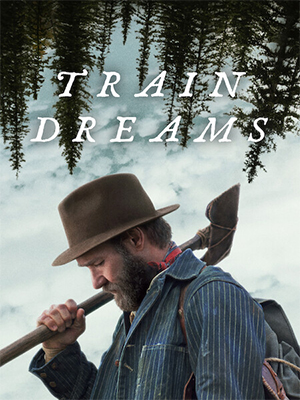
Clint Bentley’s Train Dreams is not a film that moves with the frantic pulse of modern cinema, but rather one that breathes with the slow, deliberate respiration of the Earth itself. Adapted from Denis Johnson’s 2011 novella, the movie serves as an ode to a lost American era, centering on the life of Robert Grainier, a man whose existence is defined by the very landscape he helped scar and settle. The production design at times feels a bit too “magic hour” and curated for a period known for its documented grit, but there is an undeniable, haunting power in its aesthetic. It presents the Idaho Panhandle not as it strictly was, but as it remains, in the haze of a long-lived memory: a cathedral of timber and ghosts.

This approach evokes the spirit of Robert Redford’s 1992 A River Runs Through It. Much like that film, which earned an Academy Award for best cinematography, Train Dreams uses the natural world as a primary character. However, where Redford’s Montana was a place of grace and familial bonding, Bentley’s Idaho and Oregon are landscapes of brutal isolation. The cinematography by Adolpho Veloso captures the vastness of the Pacific Northwest through a naturalist lens, making the human figures within it look almost fragile and temporary. The panoramas of the Columbia River Gorge and the dense, claustrophobic groves of the Panhandle create a visual tension between the beauty of the wilderness and the violence required to “tame” it for the railroad.

Joel Edgerton delivers a performance of profound quiet as Grainier, an itinerant laborer. We meet him in a rugged world of “misery whip” saws and horse-drawn sleds, where the physical cost of progress is measured in the broken bodies of men like Arn Peeples. Played with a sharp, philosophical wit by William H. Macy, Arn is the camp’s resident intellectual until a falling tree branch — a “widow-maker” — clocks him into a tragic mental decline. Watching Macy transition from a man who muses that “the dead tree is as important as the living one,” to a shell-shocked dimwit whose presence quickly vanishes from the camp, is a stark reminder that while the railroad was building a nation, it was simultaneously discarding the men who laid its tracks.

The film pivots on the Great Fire of 1910, a historical “palisade of flame” that remains one of the most destructive events in American history. In reality, the “Big Burn” consumed three million acres — an area the size of Connecticut — in a mere two days, killing 87 people and leaving behind a charred landscape. In the film, this fire consumes Grainier’s home and his family. Felicity Jones brings a luminous, fleeting warmth to the role of Gladys, Grainier’s wife. Their love is portrayed through brief, tender domesticities — planning where a bed might sit in a cabin not yet built — which makes the forest’s subsequent silence all the more deafening. When the fire roars through, sounding like a thousand freight trains, it robs Grainier of his wife and their young daughter, Kate. This loss turns the film into a psychological study of grief, where the scenery begins to mirror Grainier’s fractured mind.

Between these moments of tragedy are quiet men gathered around campfires, where the movie attempts to grapple with an environmental angle. Here, the laborers speak of the “murder” of the forest for the growth of the railroad and the nation. While these dialogues are beautifully written, they feel disconnected from the characters’ reality. It is difficult to believe that hardened laborers in the early 1900s, struggling for survival in a “pre-OSHA” world, would possess such modern, eco-conscious sensibilities. This choice feels like a contemporary perspective forced into a historical context. The men were surely aware of the destruction, but the way they philosophize about it feels more like the voice of a 21st-century screenwriter than a 20th-century logger.

The movie continues to challenge our imagination through its depictions of the mystical. In a haunting sequence, Grainier encounters wolf howls followed by a feral child, played with startling, animalistic intensity by Zoe Rose Short. In the film’s literal eye, she is a girl raised by the wild, but I interpreted this encounter as a profound hallucination born of long-term isolation. To me, Grainier was caring for an injured wolf, his mind so warped by sorrow that he projected the image of his lost daughter onto the beast. When he wakes to find the “girl” gone and the window open, it feels less like a child has run away and more like the wild has reclaimed a memory he was never meant to keep, a form of grieving that transcends words.

As the story progresses over its concise yet weighty 1 hour and 45 minutes, Grainier’s subtle aging mirrors the West’s modernization. It took me a beat to realize that the world had shifted until the horse was replaced by the automobile and the hand-saw by the introduction of the chainsaw. Grainier, now too old for the dangerous work, becomes a relic. The film relies heavily on Will Patton’s narration, whose gravelly, rhythmic cadence provides the necessary “clocks” for this journey. While I prefer a film to show its story visually rather than rely on a voiceover, Patton’s performance is the exception, his voice feeling as though it were pulled directly from the bark of the trees.

Subscribe HERE to the FREE Media Play News Daily Newsletter!

Train Dreams played in select “arthouse” cinemas in major U.S. cities (such as New York, L.A. and Chicago) and across regions of the Pacific Northwest (Spokane and Seattle), where it was filmed. Now it’s widely available on Netflix, where it has found a second life in streaming, reaching a global audience that can appreciate its slow-burn intensity from home.

In the final act, we encounter a Department of Forestry worker, Claire, who lives in a watchtower overlooking the expanse. She speaks of loss and how the forest returns from fire with surprising speed. It is a provocative thought: that nature is indifferent to human tragedy. This is punctuated by the closing image of Grainier finally riding a train, looking out the window at the land he once walked on foot. He is a passenger now, a man who lived to see his world finally fold into history. This is a moving, atmospheric work that honors the unremembered laborers of history. It reminds us that beneath every modern vista lies a palisade of flame and the quiet, haunted dreams of those who stood before it.
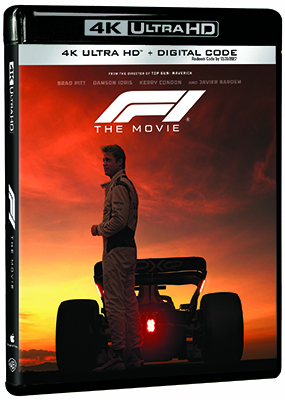
 

F1: The Movie

4K ULTRA HD BLU-RAY REVIEW:

Warner/Apple;
Drama;
Box Office $189.53 million;
$30.99 DVD, $38.99 Blu-ray, $46.99 UHD, $58.99 UHD BD Steelbook;
Rated ‘PG-13’ for strong language, and action.
Stars Brad Pitt, Damson Idris, Kerry Condon, Tobias Menzies, Kim Bodnia, Sarah Niles, Will Merrick, Callie Cooke, Javier Bardem.

Meet Sonny Hayes, auto racing’s version of a gun for hire.

In the 1990s, young Sonny washed out of Formula One after a horrific crash that nearly killed him. As he drifted through life in the years that followed, he would take on any opportunity to race again just because he missed the adrenaline rush of being behind the wheel.

As played by Brad Pitt, Sonny is essentially Cliff Booth as a racecar driver, echoing his Oscar-winning character from Once Upon a Time in Hollywood.

Coming off a win at the 24 Hours of Daytona, Sonny is recruited by his old buddy Rubén (Javier Bardem) to take over the second car of his flailing F1 team, APXGP. Deeply in debt, Rubén desperately needs one of his cars to win one of the final nine races of the season or his board of directors could force him to sell the team.

As the racing world questions the sanity of putting an older driver behind the wheel of a high-performance speed machine, Sonny quickly puts his veteran instincts to good use, finding loopholes in the rules to move his team up the leaderboard, even as he comes into conflict with the team’s other driver, a cocky rookie named Joshua Pearce (Damson Idris). Though his own career is threatened with an abrupt end if the team is sold, Joshua is hesitant to take the advice of a teammate he considers past his prime.

Sonny also strikes up a flirtatious banter with the team’s technical director (Kerry Condon) as he helps redesign the team’s cars to gain enough maneuverability to achieve a position advantage on tricky corners of the F1 circuit’s tracks.

With their time quickly running out, the group must learn to work as a true team to keep their dreams alive.

While the story is pretty typical for a sports drama, what elevates the film, aside from its generally likable characters and solid performances, is director Joseph Kosinski’s technical mastery of visual storytelling. Kosinski’s cameras plunge the audience into every race, overwhelming any screenplay concerns with a thrilling display of racing action (capturing so much detail they had to put an epilepsy warning on the box over flashing lights).

A main reason the racing sequences are so good is that Kosinski committed to shooting most of them practically, collaborating so closely with the Formula One governing body — FIA — that the production was allowed to field their own racing team to shoot at actual races. In addition to cameos from several actual drivers, including seven-time world champion Lewis Hamilton (who also serves as a producer on the film), there’s even a blink-and-you’ll-miss-it appearance by Chris Hemsworth, who starred in Ron Howard’s 2013 F1 docudrama Rush, attending one of the climactic races with his brother Liam.

Refining the techniques he previously used on Top Gun: Maverick, Kosinski shot F1 with a multitude of large-format cameras attached to the cars. While such immersion enhances the visceral experience of the film, it also amplifies observations that F1 is just a racing version of Maverick, both films dealing with aging speed junkies imparting their wisdom and influence upon a new generation while unwilling to ride into the sunset.

The obvious relationship between the two films under the same director offers a fascinating parallel with how Tom Cruise reteamed with director Tony Scott after the original Top Gun to make Days of Thunder, which even back in 1990 was likened to a car racing version of the fighter jet actioner.

Though the big difference here is the absence of Cruise in F1, the basic formula shines through, even down to the tacked-on love story. (Some might argue that Condon is a step down on the hotness meter from Nicole Kidman in DOT, but at least she’s more believable as a car designer than Kidman was as a neurosurgeon.)

One can almost imagine that with a few tweaks F1 could have been a sequel to Days of Thunder as well. And it still could be. Amid rumors of a proper Days of Thunder sequel being in development, Kosinski told GQ UK he would be interested in making a Days of Thunder/F1 crossover movie, reuniting Cruise and Pitt for the first time since 1994’s Interview With the Vampire.

While F1’s racing sequences give the film an air of authenticity, the primary issue with the credibility of the plot is the way Sonny continues to get away with his shenanigans, a notion to which the screenplay gives a passing nod.

Sonny’s unorthodox racing strategy is based on the real-life Crashgate incident at the 2008 Singapore Grand Prix, when the Renault team ordered one of its drivers to deliberately crash in order to trigger deployment of the safety car, allowing their other driver to win the race.

Under the actual F1 penalty structure, Sonny wouldn’t have lasted two races before being tossed off the circuit. F1: The Movie is able to get away with hand-waving over the rules because it doesn’t take much time to explain them to a general audience that probably isn’t too familiar with them anyway, preferring instead to fill in key plot points with exposition dumps from an off-camera play-by-play announcer when needed.

The lackadaisical approach to such technical details supposedly caused a bit of a divide on opinions of the film between general audiences who enjoy it quite much, and racing enthusiasts who are less enthralled with the depiction of their favorite sport.

A secondary concern involves the home video editions of the film and their lack of any variable aspect ratio to take advantage of the fact that the film was shot for Imax. Instead of filling up home screens with the larger image to give the racing scenes extra zip, the at-home presentation for F1 is locked into the standard theatrical ratio of 2.39:1 on both the disc and digital versions.

It should also be noted that the digital copy code included with the film’s Blu-ray and 4K disc editions is redeemable only through Apple TV, and doesn’t sync to other retailers via Movies Anywhere as most Warner-distributed titles do.

Bonus material included with the home entertainment presentation consists of nine good featurettes that provide more than 50 minutes of behind-the-scenes insights. These are available on both the 4K and Blu-ray disc versions (offered separately or in a Steelbook combo pack), and digital copies.

Up first is the five-minute “Inside the F1: The Movie Table Read,” in which the cast and filmmakers gather at the United Kingdom’s Silverstone Circuit in June 2023 to pore through the screenplay together. Subsequently, the five-minute “Making It to Silverstone” allows the participants to reflect upon the experience of filming racing scenes at the famed venue.

The level of cooperation between the production and the real-life Formula One organization is covered in the nine-and-a-half minute “APXGP Sets and Locations Around the World” and the five-minute “Lewis Hamilton: Producer,” while the six-minute “APXGP and F1: How it Was Filmed” and the five-and-a-half-minute “APXGP Innovations” detail many of the filming techniques used during the races.

Other featurettes include the six-and-a-half-minute “The Anatomy of a Crash,” which details the visual effects techniques used to film a pivotal crash sequence in the film, and the five-minute “Getting Up to Speed,” which focuses on the training needed to become an F1 driver and the challenges of achieving a similar level of dedication for the film.

Rounding out the package is the five-minute “Sound of Speed,” which delves into the film’s cutting-edge sound design and the contributions of composer Hans Zimmer, whose musical sensibilities have redefined the art of film scoring since the bygone era of traditionalists such as James Horner and John Williams. For the record, this is Zimmer’s third score for a car-racing movie, after the aforementioned Days of Thunder and Rush

Subscribe HERE to the FREE Media Play News Daily Newsletter!

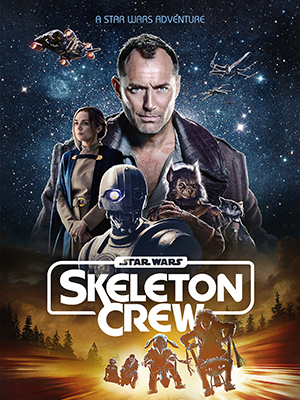
Star Wars: Skeleton Crew

Star Wars: Skeleton Crew

STREAMING REVIEW:

Disney+;
Sci-Fi;
Not rated.
Stars Jude Law, Ravi Cabot-Conyers, Ryan Kiera Armstrong, Kyriana Kratter,
Robert Timothy Smith, Tunde Adebimpe, Kerry Condon, Nick Frost.

It’s about time “Star Wars” had a sense of fun again, and “Skeleton Crew” delivers.

Inspired by 1980s kid-centric movies from Amblin Entertainment such as “E.T.” and “The Goonies” in story, tone and visual presentation, the eight-episode “Skeleton Crew” follows the adventures of four pre-teen kids as they discover a spaceship that crashed in the woods near their house long ago. When they accidentally reactivate it, the ship blasts off into deep space, leaving them uncertain how to return home.

It turns out when the ship crashed it was controlled by space pirates, who left behind a droid that takes the kids to a pirate port to ask for help. There, they meet Jod Na Nawood (Jude Law), who promises to help the children when he learns of their plight.

However, Jod turns out to be a former pirate captain whose crew committed mutiny to be rid of him after two many plunder attacks didn’t pay off. He comes to believe the children are from a mythical planet of ancient treasure that, if found, would restore his reputation among his former crew.

One of the more intriguing aspects of the season is the mystery of the kids’ home planet, which has been locked behind a seemingly impenetrable barrier to remain hidden from the rest of the galaxy, to the point where its resident, who live in a sort of perpetual state of Spielberg-esque suburbia, weren’t even aware of the rise and fall of the Empire.

It’s refreshing that “Skeleton Crew” doesn’t try to insult the audience’s intelligence with overly complicated story arcs and bogus surprises. The series, from the Spider-Man: Homecoming creative team of Jon Watts and Christopher Ford, aided by fantastic music from Mick Giacchino, is presented from the point of view of the children, which both creates anticipation in viewers who are naturally more familiar with “Star Wars” lore than the characters are, while also re-framing the canon from that new perspective.

While this will undoubtedly put a smile on the face of the inner kid in most long-time fans, the end result is a well-told tale that can be appreciated by viewers of all ages.

Subscribe HERE to the FREE Media Play News Daily Newsletter!

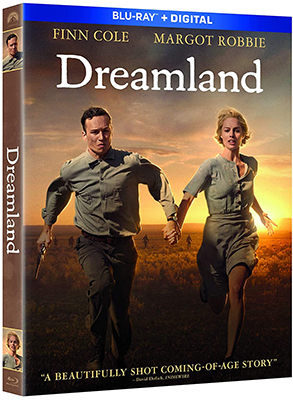
Dreamland

BLU-RAY REVIEW: 

Street Date 1/19/21;
Paramount;
Drama;
$19.99 DVD, $22.99 Blu-ray;
Rated ‘R’ for some violence, language and sexuality/nudity.
Stars Finn Cole, Margot Robbie, Travis Fimmel, Kerry Condon, Darby Camp.

If it weren’t for the involvement of Margot Robbie, Dreamland would seem like a run-of-the-mill direct-to-video gangster drama.

The film focuses on a young man named Eugene (Finn Cole), who lives on his family’s farm during the Great Depression. His stepfather, a local sheriff’s deputy, is caught up in a manhunt Allison Wells (Robbie), the female half of a Bonnie & Clyde-style team on the run after a botched bank robbery.

One night, Eugene discovers an injured Allison hiding in the family’s barn, bleeding out from a gunshot wound. Claiming she’s not as bad as the press makes her out to be, she explains her partner was killed and convinces him to help her heal. In the process he ends up falling in love with her because she’s a rebellious teenager and she’s Margot Robbie.

When Eugene’s little sister, who narrates the story, starts to suspect he’s hiding something in the barn, he and Allison steal the family truck with a plan to escape to Mexico. With his stepfather leading a posse after them, Eugene begins to question Allison’s sincerity as she tries to steer him away from a life of crime.

The Blu-ray is presented with no extras.

Subscribe HERE to the FREE Media Play News Daily Newsletter!

Dean Devlin Thriller ‘Bad Samaritan’ Due on Digital Aug. 3, Disc Aug. 14

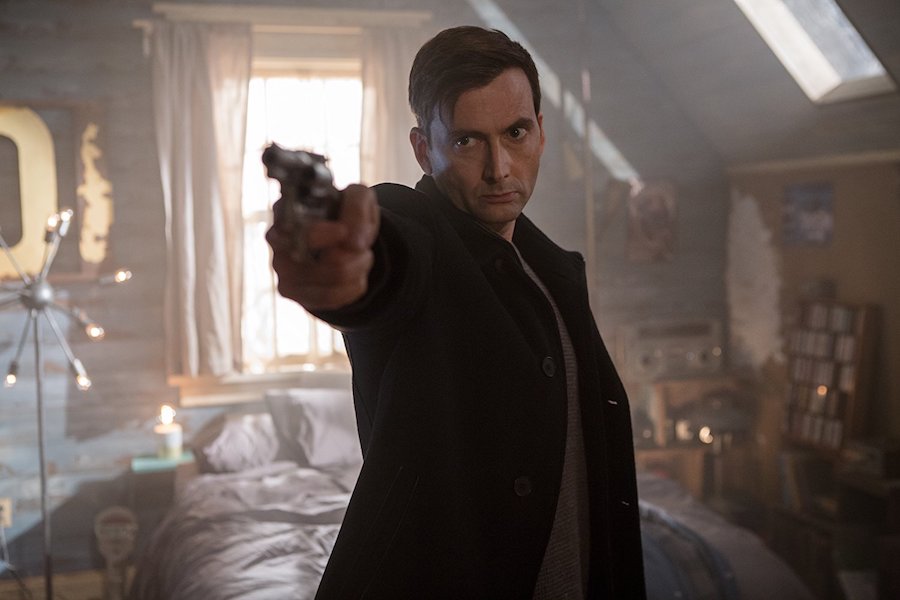
The thriller Bad Samaritan debuts Aug. 3 on digital from Electric Entertainment and Aug. 14 on Blu-ray and DVD from Sony Pictures Home Entertainment.

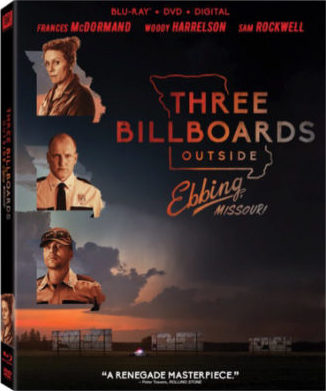
Directed by Dean Devlin (Geostorm), the film stars David Tennant (“Doctor Who,” “Jessica Jones”), Robert Sheehan (The Mortal Instruments: City of Bones), Carlito Olivero (“The X Factor”), Kerry Condon (Three Billboards Outside Ebbing, Missouri) and (Ordinary Days). The story follows two thieves who uncover more than what they bargained for when breaking into a house they thought would be an easy score. After making a shocking discovery, they must choose to run and hide, or face the killer whose dark secrets they have exposed.
Bonus content includes deleted scenes.

Three Billboards Outside Ebbing, Missouri

BLU-RAY REVIEW:

Fox;
Drama;
Box Office $53.35 million;
$29.99 DVD, $34.99 Blu-ray, $39.99 UHD BD;
Rated ‘R’ for violence, language throughout, and some sexual references.
Stars Frances McDormand, Sam Rockwell, Woody Harrelson, Zeljko Ivanek, Caleb Landry Jones, Kerry Condon, Abbie Cornish, Peter Dinklage, John Hawkes, Amanda Warren, Clarke Peters.

Writer-director Martin McDonagh’s Three Billboards offers an intense, character-driven examination of the relationship between small-town police and the residents they serve.

Frances McDormand gives a powerhouse performance as Mildred, whose bitterness over the stalled investigation into her daughter’s murder motivates her to rent space on the billboards of the title excoriating the cops for their lack of progress.

This naturally raises tensions in the town, as supporters of the police demand she take the signs down while putting pressure on her friends and family to force her hand.

The police chief (Woody Harrelson), has his own issues to deal with, not the least of which is an alcoholic deputy named Dixon (Sam Rockwell), who is accused of torturing a black suspect in custody during an incident that allegedly happened before the start of the film’s story.

Three Billboards takes a multi-faceted view of cops’ racial attitudes in small-town America, and presents them as people and not as the caricatures some knee-jerk critics of the film would insist upon. Certainly the department must confront its troubled history of race relations, but the situation with Mildred might suggest they’re not great cops in general, or at the very least in over their head on some things.

Dixon, for example, has bigger dreams but little self-awareness, and his racism goes hand in hand with a general attitude of superiority about everyone, no doubt fueled by the toxic influences of his mother. His violent streak even extends to the white kid who sold the signs to Mildred and becomes the subject of a brutal beating in one of the film’s signature sequences — a single take of Dixon walking from the police station across the street to the advertising shop, up the stairs and back to admire the chaos of his handiwork.

Mildred and Dixon represent the opposing forces in the firestorm at the heart of the film, so it comes as little surprise that McDormand and Rockwell were among the most recognized performers of awards season.

The Blu-ray includes five deleted scenes running about seven minutes total that aren’t vital to the storylines but do offer some interesting additional character insights.

Also included is a comprehensive half-hour behind-the-scenes documentary in which McDonagh relates how seeing similar billboards on a tour of the American South inspired him to make the film. The featurette also includes a lengthy look at the making-of the single-take fight scene at the center of the film.

Finally, the disc offers McDonagh’s unrelated half-hour 2004 short film Six Shooter, which won the Oscar for Best Live-Action Short. The short stars Brendan Gleeson as a man on a train confronted with mortality and the foibles of the human condition.

From Around the Web