


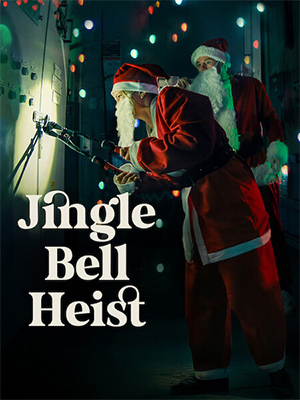
Jingle Bell Heist

STREAMING REVIEW:

Netflix;
Comedy;
Not rated.
Stars Olivia Holt, Conner Swindells, Lucy Punch, Peter Serafinowicz, Poppy Drayton.

Jingle Bell Heist is Netflix’s latest offering in the holiday rom-com genre, but with a welcome twist: it’s a Christmas caper. Directed by Michael Fimognari (of the “To All the Boys” trilogy), the film wisely grounds itself in the very real, very un-Hallmark-like city of London, which ends up being one of its biggest strengths. The movie stars Olivia Holt as Sophie, an American retail worker whose mother is British. Sophie moved her mother back to the U.K. specifically to access the public healthcare system for her cancer treatment, hoping it would be better than the U.S. system. However, the doctor informs her that the public system has a long waiting list for the treatment she needs, forcing Sophie to pay out of pocket and go private — putting her right back where she started. This financial crisis drives her entire character arc, lending the film its sharp social commentary on healthcare.

Sophie’s desperation brings her into contact with Nick (Connor Swindells), the film’s true hero and a desperate father. Nick is a jaded British ex-security consultant who not only lost his job but served time by pleading guilty to the crime the corrupt store owner, Maxwell Sterling (Peter Serafinowicz), framed him for. Now he’s either estranged or divorced from his wife, and she is threatening to move to Birmingham with their young daughter. Nick’s whole motivation for the heist is to secure cash for a two-bedroom apartment to stabilize his life, obtain visitation rights, and keep his daughter close in London. Swindells, who you might remember as Adam Groff from “Sex Education,” brings a nice, familiar British groundedness to the role. When Nick catches Sophie making petty thefts, he blackmails her into a larger scheme to rob the luxury Sterlings London Department Store, less for the cash and more for revenge.

The movie is certainly overstuffed, meaning it tries to cram too many disparate plots —like a heist, a romance, a social commentary and a family secret — into a single, short runtime.

While I found the film entertaining, it does suffer from the usual contrivances — though I would say this film is way less contrived than The Merry Little Ex-Mas. The production design, which relies heavily on interior sets and very little outdoor space, attempts to capture a posh London look, clearly styled after a Harrods-type department store to evoke that exclusive Knightsbridge neighborhood feel. While the exterior locations were actually shot in South London neighborhoods like Brixton, I personally didn’t notice the difference. And honestly, for most U.S. audiences, that distinction won’t even register, allowing the atmosphere to work despite the slightly artificial look.

Furthermore, the movie tells us that Sophie works at the department store and as a bartender at night, but that exhausting reality is barely developed. This constant rushing contributes to continuity errors such as having Sophie perform an activity the day before that didn’t make any sense in the timeline. It’s a minor thing, but it interrupts the flow when the movie is rushing through its plot points.

Despite its faults — including the fact that while the romance itself is fairly believable given the shared, desperate circumstances, the on-screen chemistry between the leads is just okay — Jingle Bell Heist is a streaming success, having topped the Netflix charts globally. The key to its watchability is simple: discipline. The film’s success is also due to good acting, visual appeal and a fairly decent story with some teeth, but its primary flaw is apparent: Strong ideas are sacrificed for execution and development to squeeze all its genres and twists into that tight 1 hour and 36 minutes. The runtime (including the running footage in the credits) is a perfectly bite-sized seasonal treat. Had it been any longer, those thin plot points and the lack of truly sizzling chemistry would have become fatal flaws. It is a worthwhile, family-friendly view if you are looking for background cheer and a low-stakes escape. But let’s be clear: This film will not be a Christmas classic by any stretch. It’s a pleasant, disposable distraction for a cozy night when you can’t find anything better to watch this holiday season.

Subscribe HERE to the FREE Media Play News Daily Newsletter!
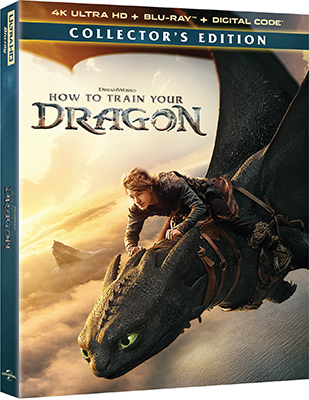
How to Train Your Dragon (2025)

4K ULTRA HD BLU-RAY REVIEW:

Universal;
Fantasy;
Box Office $262.77 million;
$24.98 DVD, $29.98 Blu-ray, $34.98 UHD BD, $53.99 UHD Steelbook;
Rated ‘PG’ for sequences of intense action, and peril.
Stars Mason Thames, Nico Parker, Gabriel Howell, Julian Dennison, Bronwyn James, Harry Trevaldwyn, Peter Serafinowicz, Nick Frost, Gerard Butler.

There are a few ways to approach the making of a live-action version of How to Train Your Dragon.

One option would be a more faithful adaptation of Cressida Cowell’s original book; another could be a more serious depiction of the Vikings. The direction the filmmakers decided to take was a near shot-by-shot remake of the 2010 animated film.

It’s such a faithful re-creation that the animated movie now seems almost like a storyboard reel for the live-action film, especially if one hadn’t seen the original and watched the new film first.

The new version was even written and directed by Dean DeBlois, who was one of the co-writers and co-directors of the 2010 film. And the music was again by John Powell, who maintains the terrific themes from the first film while bolstering the score with the maturity and gravitas befitting a live-action fantasy epic.

Despite such fidelity, or perhaps because of it, the remake delivers a rousing adventure that should entertain all audiences.

Coincidentally, DeBlois was also one of the co-creators of another recent animation-to-live-action convert, Disney’s Lilo & Stitch, though he wasn’t involved in that remake, which changed up the source material a bit more than Dragon did.

Some additional factors might shed some light on why Dragon and Stitch are among the better examples of the live-action remake trend. Both are based on relatively recent films (released in the 21st century), as opposed to the handful of classics that have had more time to have a more iconic impact on the pop culture landscape. There may also be something to be said about the animation style, and whether a traditional hand-drawn style is just considered more intrinsically artistic than modern CGI, and thus more revered in the minds of viewers when it come to re-framing them in a modern context (an issue that doesn’t have much impact on the original Dragon movie, which was released just 15 years ago).

The most notable change to the live-action Dragon is that the cast is considerably more multi-cultural, explained away as the Vikings bringing warriors from across the globe to the Isle of Berk to train them to fight dragons.

Other than that, the story is identical to the 2010 film. Young Hiccup (Mason Thames), son of Stoick (Gerard Butler, revising the role he voiced in the original), the island chieftan, is relegated to being a blacksmith’s apprentice despite dreaming of become a dragon-slayer. His attitudes shift when one of his gadgets injures a dragon during an attack. He finds it helpless in the woods, unable to escape, and befriends it while nursing it back to health, naming it Toothless.

Meanwhile, his father relents to slayer training for Hiccup, who excels in the arena thanks to knowledge about the dragons he learns from working with Toothless. What Hiccup ultimately discovers about the nature of dragons could end up changing the culture of Berk forever.

The home viewing experience of How to Train Your Dragon has a different impact depending on the disc or digital version. On Blu-ray and 4K Ultra HD disc, the aspect ratio changes for the major action scenes, expanding from 2.39:1 to 1.90:1 to better fill up HDTV and 4K screens. The presentation from digital retailers maintains a constant 2.39:1.

Extras for both disc and digital are mostly the same. They include an insightful commentary from DeBlois who discusses in great detail the process of transforming the animated film into live-action. He also introduces two deleted scenes that run a total of about five minutes and cover sequences that were part of the animated movie but removed from the live-action version for pacing reasons (despite covering the same material, the live-action version is still almost a half-hour longer than its animated counterpart).

There’s also a three-minute gag reel, and two sequences presented without visual effects. The raw sequences are introduced by DeBlois and showcase some of the puppetry and visual effects prep-work needed to bring the scenes to life.

Rounding out the extras are four behind-the-scenes featurettes. The 46-minute “Love and Legacy: Making How to Train Your Dragon” covers the production in general; the eight-and-a-half-minute “Dreaming Up the Dragons” delves into how the animated dragons from the original film were made more lifelike with CGI while still maintaining their familiar look (though some of them, particularly Toothless, still look a bit cartoony); the eight-minute “Building Berk” looks at the creation of the Viking sets; and the five minute “Fit for a Viking” deals with the costuming and performances.

Digital versions of the film also includes the two-minute “Exploring the Isle of Berk at Epic Universe,” a promotional video showcasing the land at Universal’s new theme park in Orlando.

Subscribe HERE to the FREE Media Play News Daily Newsletter!


From Around the Web