Cineverse Feb. 12 announced the acquisition of IndiCue, a connected-television monetization platform the Los Angeles-based distributor and streaming video platform operator plans to incorporate in its ad-tech infrastructure, including Matchpoint and C360 platforms.
The transaction is valued at $22 million, which includes $12.8 million in cash at closing and $9.2 million in either cash or common stock on the first anniversary.
IndiCue provides infrastructure for media owners and streaming platforms to manage advertising revenue through server-side ad insertion technology, custom monetization and ad formats, including real-time ad pod building.
To fund the acquisition, Cineverse raised $13 million through the sale of convertible notes. This acquisition follows Cineverse’s recent purchase of Giant Worldwide in January.
In the fiscal disclosure announcing the acquisition, Cineverse disclosed that it expects to post an undisclosed fiscal loss on revenue of upwards of $17 million in the fiscal third quarter, ended Dec. 31, 2025.
Live sports have been steadily moving to streaming, but Feb. 8 may mark a decisive shift. On that day, NBC and Peacock will broadcast both Super Bowl LX and the 2026 Milano Cortina Winter Olympics. For an industry that has long debated whether streaming can support the biggest live sporting events at scale, this month will serve as a real-world, high-stakes test.
Francesca Pezzoli
For Peacock, this moment represents more than a programming milestone; it is an opportunity to validate its ambitions in live sports.
The stakes are high. Live sports viewers are less forgiving than on-demand audiences; even minor issues with access, discovery or technical performance can quickly erode trust. However, the rewards are substantial if Peacock delivers a seamless experience.
Success will not be measured only by subscriber growth or viewing time. It will be defined by visibility, consistency and execution: how often Peacock appears on the home screen, how effectively it surfaces live moments, and how intuitively it guides viewers between events, highlights and replays. In a crowded streaming environment, winning sports isn’t just about having the rights; it’s about owning the digital shelf.
CTV: The New Battleground for Attention
Connected TV (CTV) is becoming increasingly important as live sports viewing shifts to this platform. Currently, 80% of U.S. CTV users stream live sports, according to the “LG Ad Solutions report: Stadium to Screen,” making the TV home screen a critical gateway to reach fans.
On Feb. 8, the competition will extend beyond Peacock versus other streaming services. It will be a visibility contest across Roku, Fire TV, Samsung, LG, and other platforms, where device-level discovery determines which audiences see first. Which apps and live events are featured on home screens, and which platforms successfully convert viewer intent into action, will ultimately determine success.
For viewers, the experience will feel simple: turn on the TV and watch. Behind the scenes, however, the CTV merchandising strategy will play a disproportionate role in determining who wins attention during one of the most competitive live sports days of the year. This is the turning point where home-screen visibility becomes as valuable as the rights themselves.
The Paris 2024 Olympics set viewership records across linear, digital and social platforms. The 2026 Winter Olympics are expected to be even more multichannel. Fans will move between live broadcasts, streaming apps, highlights, social clips and second-screen experiences. For Peacock, this means alignment across content strategy, CTV execution and device-level partnerships.
Last year’s Super Bowl on Fox and Tubi was the most-watched Super Bowl and telecast in U.S. history. Tubi provided a top-tier streaming experience for free, a key message highlighted in their most prominent placements across Samsung TV, LG TV and Google TV.
To achieve success this year, Peacock needs to secure premium advertising environments, establish dominant home-screen placements, and ensure effective promotion across CTV devices, including Roku, Amazon Fire TV, and smart TVs.
Why This Matters
February will be an important case study for sports streaming. In addition to the Super Bowl and Olympics, Peacock will air the 2026 NBA All-Star weekend. It will show how audiences behave when major live events are available on streaming platforms, how well CTV environments facilitate discovery, and whether the execution can meet expectations under such demanding live conditions.
Francesca Pezzoli is VP of marketing at Looper Insights, a company that helps major Hollywood studios, global streamers, local broadcasters, and entertainment platforms understand how content is promoted across connected TV and digital storefronts and how that visibility translates into audience engagement and viewership.
Recent headlines about Warner Bros. Discovery, from the accepted deal with Netflix to a hostile bid by Paramount, have focused on libraries, IP valuation, and the future of individual services. But here’s the question almost no one is asking: if Netflix controls the IP, does that automatically translate to more visibility for Warner Bros. titles across the CTV home screen?
Francesca Pezzoli
Underneath the deal speculation lies a more consequential battle: who owns the digital shelf where that content is merchandised in the CTV ecosystem?
In a linear world, owning a studio meant owning a catalog, and distribution followed a relatively predictable path. In today’s CTV-dominated landscape, control is far more fragmented and arguably more valuable. With streaming, what matters is not simply what you own, but who controls the “front door” of discovery across devices, platforms, and operating systems.
The New Home Screen Power Brokers
Smart TV platforms and connected TV operating systems, including Roku, Fire TV, Google TV, Samsung and LG, now control access to audiences at the moment of choice. They determine which title is promoted, where it appears on the home screen, which carousel it surfaces in, and which franchises receive premium placement.
Owning the IP is one aspect; managing visibility is an entirely different challenge. Owning HBO doesn’t automatically translate into owning the HBO slot on Samsung. Even if Netflix were to acquire Warner Bros. Discovery, the visibility of their titles on Samsung devices or Fire TV homepages would still need to be negotiated inside the merchandising economics of those platforms.
The High Stakes of Premium Real Estate
Premium placements on home screens are already dominated by a small number of global players. Independent CTV visibility data shows that week after week, the same companies capture a disproportionate share of high-impact merchandising slots. This imbalance is likely to grow, not shrink, as consolidation increases.
In that context, the Netflix-WBD deal is about more than bringing beloved franchises under one roof. It’s about controlling more opportunities to surface that content across third-party operating systems, especially as those platforms continue to build their own advertising, promotion and merchandising businesses.
Why This Matters
Even the biggest studios today do not control their promotional destiny across the CTV ecosystem. They depend on platform relations teams, merchandising spend, and retail-style negotiations to secure shelf space.
And that’s what makes the WBD case so interesting: studio ownership doesn’t guarantee on-screen visibility. Visibility is rented, not owned. No matter who controls the IP, the studio still has to compete for placement inside the merchandising architecture of Roku, Samsung, LG and others.
The Industry Question No One Is Asking Yet
As consolidation accelerates, the strategic question becomes: If content ownership shifts, does merchandising power shift with it? The short answer is: not automatically.
Owning a studio doesn’t necessarily mean owning the most valuable promotional real estate in the ecosystem. That belongs to the devices, the OS layer, and the merchandising engines that shape what audiences see first.
If WBD is acquired, the fundamental challenge remains the same: what percentage of the CTV shelf do they really own and at what cost?
If the future of streaming is being decided on the home screen, visibility is the currency everyone now has to measure. And as M&A reshapes the competitive landscape, the winners will be the companies that understand not just the value of their IP, but also its discoverability across the devices audiences use every day.
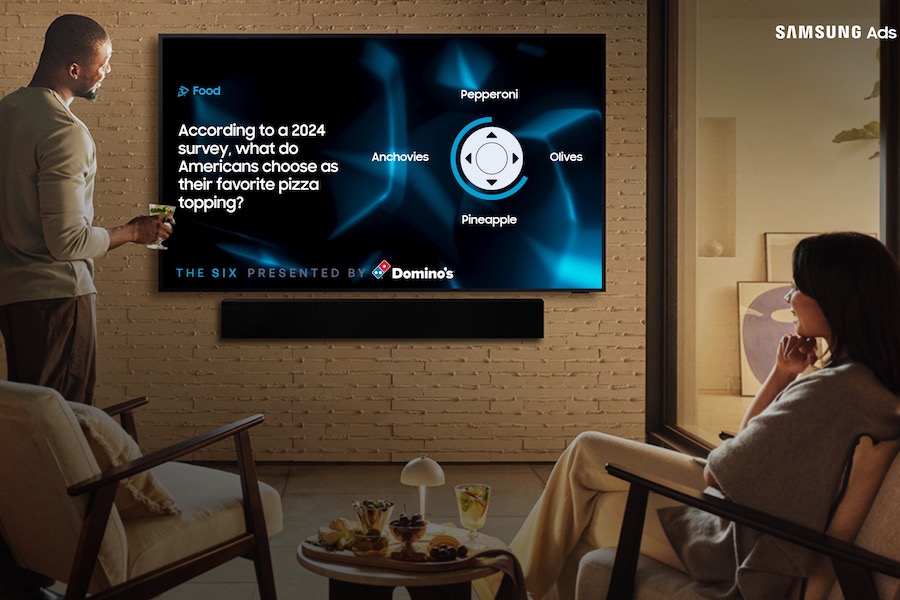
Samsung Ads, the advertising arm of Samsung Electronics’ media division, Domino’s Pizza and Havas have released results of the first European advertising campaign to use Samsung Ads’ GameBreaks ad unit, which replaces the conventional ad with a branded, remote control-powered trivia quiz or game. The campaign delivered an engagement rate of 3.84%, and a 31% uplift in brand consideration.
The Domino’s campaign presented viewers with a pizza-related trivia question: “According to a 2024 national survey, what do Americans choose as their favourite pizza topping?”, along with four possible answers. Viewers could select their answer using the TV’s remote control, with an onscreen message telling them if they were right or wrong (The answer was pepperoni). The quiz section was then followed by a 10-second section promoting Domino’s Ultimate Gunpower Chicken pizza, part of the Ultimate Indian Feast.
The results mirror those of an independent study of GameBreaks ads carried out by MediaScience in the United States, which found they deliver a 53% lift in unaided brand recall, outperforming standard video ads by 1.5 times. The study also found that 89% of viewers preferred GameBreaks over traditional commercial breaks.
GameBreaks launched earlier this year, initially in the United States and Canada, rolling out to the United Kingdom over the summer. Advertisers can customise trivia questions, themes, and design elements within GameBreaks ads to align with campaign goals.
“Domino’s has always been something of a crowd-pleaser and this impacts consideration which, in turn, impacts purchase intent,” Harry Packshaw, head of AV at Domino’s media agency, Havas, said in a statement. “There’s a lot of data to show how gamification moves the dial on brand metrics so it was no surprise to us to see that the campaign was so warmly received and performed so well.”
“Interactivity is at the heart of CTV, so there’s no reason why the ads should not also embrace the idea,” Lauren Barnett, head of U.K. sales at Samsung Ads, said in a statement. “We’re delighted, though not surprised, at the success Domino’s have seen with their GameBreaks campaign and we look forward to working with them on more in the future.”
Tubi, Fox Corp.’s free ad-supported streaming service, has expanded its agreement with Viant, a CTV and AI-powered programmatic advertising facilitator, to better assist marketers targeting the ad-supported VOD service’s 100 million monthly active users across more than 300,000 movies and TV episodes.
Viant, which recently acquired IRIS.TV, a provider of contextual and emotional data for streaming, is now applying the latter’s software to Tubi’s collection of content. These capabilities enable advertisers to engage audiences at the most relevant moments in premium programming, driving stronger outcomes and increased demand for Tubi’s supply, according to Viant.
“By combining Tubi’s extensive AVOD reach with Viant’s leadership in CTV, identity and measurement, advertisers achieve greater transparency and performance, at scale,” Tom Wolfe, SVP of business development at Viant, said in a statement.
This collaboration extends Viant’s ad server integration with Tubi, which aims for efficient campaign delivery and accurate attribution. By reducing reliance on intermediaries, Tubi and Viant hope to ensure that media ad dollars drive stronger performance and measurable results.
“As a pioneer in ad-powered streaming, we continue to expand our partnerships to ensure advertisers can maximize the performance of their CTV campaigns,” added Vijay Rao, SVP of partnerships at Tubi.
Roku has announced a partnership with AppsFlyer to provide third-party marketers enhanced capabilities for measuring, optimizing, and scaling their streaming campaigns on the Roku platform, offering improved accuracy and transparency across connected TVs and mobile platforms.
The integration spans the full breadth of the Roku platform, including Roku Ads Manager, endemic placements such as the Roku Home Screen and search, and in-stream video ads across The Roku Channel.
“Today’s consumers move across TV, mobile, and digital touchpoints, but marketers have struggled to connect the dots across channels to the broader user journey,” Alex Yip, director of product strategy at AppsFlyer, said in a statement.
With Roku reaching more than 90 million streaming households globally, the partnership aims to empower advertisers to confidently invest in streaming campaigns while measuring impact with industry-leading methodologies.
“We see marketers running to CTV as the next great performance channel, but they expect similar transparency, control, and measurable outcomes they get from mobile,” added Peter Hamilton, head of ad Innovation at Roku, in a statement. “This integration was among the most requested by mobile apps and games, and with it, I’m excited to see how marketers take performance in CTV to the next level.”
Roku has inked a deal with Amazon Ads that it claims will give the platform the largest authenticated connected-TV (CTV) footprint in the U.S. The new collaboration is said to reach an estimated 80 million U.S. (CTV) households, representing more than 80% of U.S. CTV households, according to Comscore data.
The partnership will include major streaming apps, including The Roku Channel, Prime Video, and other streaming services on Roku and Fire TV operating systems such as Disney+, Paramount+, Tubi, and Warner Bros Discovery’s HBO Max, among others.
Roku says advertisers using this new solution reached 40% more unique viewers with the same budget, and reduced how often the same person saw an ad by nearly 30%, enabling advertisers to benefit from three times more value from their ad spend.
“Our exclusive partnership with Roku is a giant leap for advertisers,” Paul Kotas, SVP of Amazon Ads, said in a statement.
Kotas says the collaboration enables agencies and brands that use Amazon DSP will benefit from greater efficiency and higher performance.
“By combining our technologies, advertisers can now drive full-funnel campaign outcomes — from awareness through conversion — while eliminating media waste across Amazon and Roku streaming audiences,” he said.
The integration allows Amazon DSP (demand-side-platform) to recognize logged-in viewers across the Roku OS and devices in the U.S. This capability enables advertisers to reach the same viewer deterministically across different streaming channels and devices, providing more accurate audience targeting and measurement than previously possible.
“With nearly half of all TV streaming time in the U.S. happening on Roku, and the power and depth of Amazon in retail and beyond, together we’re uniquely positioned to prove performance and differentiate DSP offerings for our shared advertisers and marketers,” added Charlie Collier, president of Roku Media.
BrightLine, a company facilitating interactive connected-TV advertising, has announced its latest offering, DynamicAI — an AI learning engine designed to optimize the performance of engageable CTV ads in real time.
The launch marks a breakthrough in CTV, applying AI for the first time to dynamically optimize product combinations within interactive ads, according to BrightLine.
“BrightLine’s goal in creating DynamicAI is directly tied to our long-held commitment and vision to maximize the effectiveness of TV-streamed ads by constantly improving the audience experience, as their expectations of TV continue to change,” Jacqueline Corbelli, co-founder and CEO of BrightLine, said in a statement.
Rolling out this fall, DynamicAI will launch within one of BrightLine retail carousel. This format appears as a frame overlay during the ad, allowing viewers to browse featured products on the carousel using their remote control.
“Given that the retail carousel is one of our most popular formats and featured in 30% of our campaigns, it was the ideal format to first apply AI-driven optimization, maximizing ad relevance and impact,” Corbelli said in a statement.
Powered by real-time engagement data, the DynamicAI engine continuously re-sequences product combinations, keeping the best-performing items front and center throughout the campaign, according to BrightLine.
“We already know interactive ads prove their value, as they deliver nearly 40% lift in brand recall. DynamicAI is our latest step in taking performance to the next level to better understand and engage with audiences,” said Rob Aksman, president and co-founder of BrightLine, said in a statement. “In an industry where AI is often more of a buzzword than a proven tool, we are focused on delivering real, meaningful outcomes. We’re committed to building a future where each of our engageable formats becomes smarter with every impression, delivering enhanced experiences for viewers and better results for brands.”
Future iterations of DynamicAI will incorporate an expanding set of data signals, such as time of day, genre, region, audience demographics, device type, and beyond, to further personalize and improve performance, according to BrightLine.
The ongoing migration of TV ad dollars from legacy broadcast to internet-connected television streaming got real this year when Amazon reportedly generated $1.8 billion in upfront marketing commitments for Prime Video — just nine months after it launched paid ads on the streaming platform.
In a Sept. 30 note, Bank of America reported that Prime Video, through events such as NFL “Thursday Night Football,” and the 59th Academy of Country Music Awards in May, among others, along with the default migration of all U.S. Prime Video subscribers to ad-supported access (unless opting out paying a higher monthly premium), could help the company generate upwards of $4 billion in ad revenue by 2025.
Prime Video is paying the National Basketball Association $1.9 billion a year to exclusively stream select games beginning in late 2025.
Wedbush Securities media analyst Michael Pachter, citing discussions with online advertising executive Sean Adams, whom the Wall Street firm hosted, contends that shifting live sports rights to streaming services has created valuable ad inventory, and is driving overall advertising from linear TV to CTV.
Pachter said he believes that CTV ad spending will remain in double-digit growth through 2027, before dropping to 10% growth in 2028.
“CTV ad spending will increase by more than 50% between 2024 and 2028,” Pachter wrote in an Oct. 1 note. “The emergence of an ad-supported Prime Video subscription tier will drive revenue growth above the 18.1% in 2023.”
Pachter wrote that among his covered stocks, Netflix’s ad delivery rates remain at the low-end, around four-to-five ads per hour, while the streamer’s CPMs have remained in the $40-$50 range. Citing Adams’ input, Pachter believes a seasonal uptick in CPM is likely in the fourth quarter, given typically seasonality coupled with Netflix’s exclusive Christmas Day NFL games in December.
Separately, next month’s presidential election continues to drive political advertising spending through the roof, with the positive scatter trends sure to boost Roku’s fiscal results as heavy political advertising shifts toward CTV.
“Roku’s Q3 results should reflect this positive momentum,” Pachter wrote. “Looking into Q4, our advisor thinks that generally advertisers will begin to tread carefully. However, ongoing political spending into Q4 and robust holiday ad budgets should offset that for Roku — and CTV.”
In the push to establish ad-supported streaming platforms, Netflix, Disney+ and Prime Video get most of the media attention due to their overall subscriber numbers. But new data from Comscore finds that Disney-owned Hulu, Google-owned YouTube, and Fox’s free ad-supported streaming TV service Tubi dominate all other streamers when it comes to ad views on connected televisions.
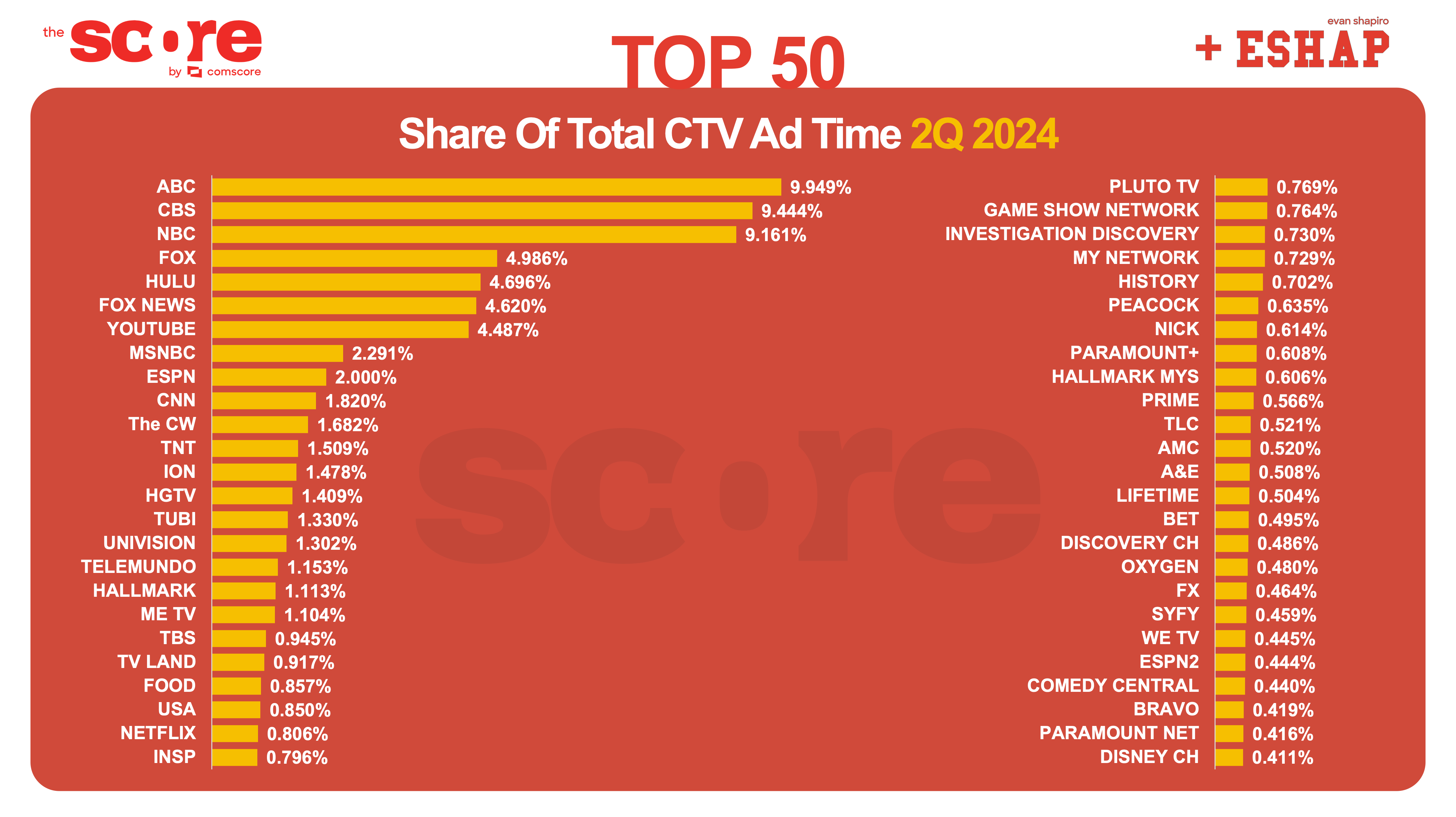
The data found that — while legacy pay-TV still dominates the total connected-TV ad time at 85.3%, with streamers’ market share approaching 15% (14.7%) based on second-quarter (ended June 30) data compiled across 22 million U.S. households — Hulu was No. 5 overall with 4.69% market share, followed by YouTube with 4.48%, and Tubi at 1.33% market share.
The tallies, which topped Netflix’s 0.8% share, Pluto’s 0.77%, Peacock’s 0.63% and Paramount+’s 0.6%, also topped pay-TV networks such as Univision (1.3%), Telemundo (1.15%), Hallmark Channel (1.11%), TBS (0.94%), and Food Network and USA Network at 0.85% each, among others.
Chart created by Comscore and Evan Shapiro
Netflix’s ad tier, which bowed about two years ago, did crack the 1% share in April when new series “Baby Reindeer” dropped and in May after the newest “Bridgerton” episodes were released.
Yet, Netflix, which has 33 million more U.S. subscribers than Hulu, reportedly averaged six times less ad viewing than Hulu. Prime Video, which launched a default ad tier in January, ended Q2 with 0.57% market share.
“Tubi’s share of ad voice in [Q2] was 65% higher than Netflix, and 135% bigger than Prime Video,” Evan Shapiro, a self-described “media universe cartographer,” wrote in a blog post.
Shapiro says that when combining ABC, Hulu, and ESPN, Disney’s total share of TV ads tops all other media companies with more than 20% of total share of the TV ad market.
“Seeing Netflix and Prime Video a distance behind competitors like Hallmark and ION, shows how early in their ad supported lives they are,” Shapiro wrote. “Conversely, Disney’s pole position, Google’s rising tide, and Fox’s Tubi speak to the increasing power of the streamers on CTV.”