Netflix May Buy the IP, But Who Owns the Digital Shelf?

Recent headlines about Warner Bros. Discovery, from the accepted deal with Netflix to a hostile bid by Paramount, have focused on libraries, IP valuation, and the future of individual services. But here’s the question almost no one is asking: if Netflix controls the IP, does that automatically translate to more visibility for Warner Bros. titles across the CTV home screen?

Francesca Pezzoli

Underneath the deal speculation lies a more consequential battle: who owns the digital shelf where that content is merchandised in the CTV ecosystem?

In a linear world, owning a studio meant owning a catalog, and distribution followed a relatively predictable path. In today’s CTV-dominated landscape, control is far more fragmented and arguably more valuable. With streaming, what matters is not simply what you own, but who controls the “front door” of discovery across devices, platforms, and operating systems.

The New Home Screen Power Brokers

Smart TV platforms and connected TV operating systems, including Roku, Fire TV, Google TV, Samsung and LG, now control access to audiences at the moment of choice. They determine which title is promoted, where it appears on the home screen, which carousel it surfaces in, and which franchises receive premium placement.

Owning the IP is one aspect; managing visibility is an entirely different challenge. Owning HBO doesn’t automatically translate into owning the HBO slot on Samsung. Even if Netflix were to acquire Warner Bros. Discovery, the visibility of their titles on Samsung devices or Fire TV homepages would still need to be negotiated inside the merchandising economics of those platforms.

The High Stakes of Premium Real Estate

Premium placements on home screens are already dominated by a small number of global players. Independent CTV visibility data shows that week after week, the same companies capture a disproportionate share of high-impact merchandising slots. This imbalance is likely to grow, not shrink, as consolidation increases.

In that context, the Netflix-WBD deal is about more than bringing beloved franchises under one roof. It’s about controlling more opportunities to surface that content across third-party operating systems, especially as those platforms continue to build their own advertising, promotion and merchandising businesses.

Why This Matters

Even the biggest studios today do not control their promotional destiny across the CTV ecosystem. They depend on platform relations teams, merchandising spend, and retail-style negotiations to secure shelf space.

And that’s what makes the WBD case so interesting: studio ownership doesn’t guarantee on-screen visibility. Visibility is rented, not owned. No matter who controls the IP, the studio still has to compete for placement inside the merchandising architecture of Roku, Samsung, LG and others.

The Industry Question No One Is Asking Yet

As consolidation accelerates, the strategic question becomes: If content ownership shifts, does merchandising power shift with it? The short answer is: not automatically.

Owning a studio doesn’t necessarily mean owning the most valuable promotional real estate in the ecosystem. That belongs to the devices, the OS layer, and the merchandising engines that shape what audiences see first.

If WBD is acquired, the fundamental challenge remains the same: what percentage of the CTV shelf do they really own and at what cost?

If the future of streaming is being decided on the home screen, visibility is the currency everyone now has to measure. And as M&A reshapes the competitive landscape, the winners will be the companies that understand not just the value of their IP, but also its discoverability across the devices audiences use every day.

Subscribe HERE to the FREE Media Play News Daily Newsletter!

TCL Announces Slate of 2025 QM6K TVs at Sizes Up to 98 Inches

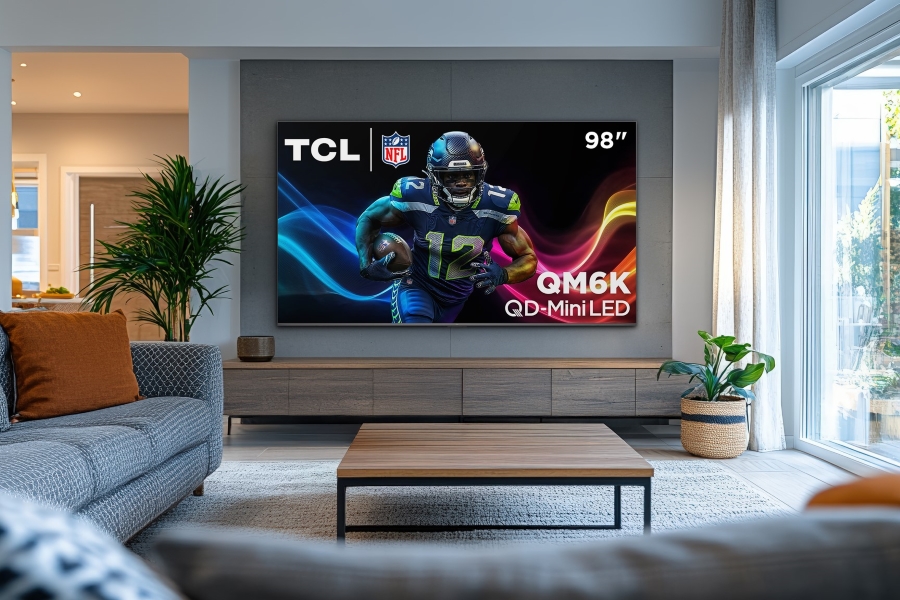
LAS VEGAS — TCL Jan. 6 announced its own new line of smarter smart TVs: the QM6K TV, featuring TCL’s enhanced QD-Mini LED system and powered by its new Halo Control Technology Suite of hardware and processing advancements.

Announced a day ahead of the official opening here of CES 2025, the QM6K will be available with a 50-inch screen size at a suggested retail price of $749.99, a 55-inch TV for $799.99, a 65-inch model for $999.99, a 75-inch unit at $1,299.99, an 85-inch TV for $1,999.99, and an XXL model with a 98-inch screen size for $3, 499.99.

The company is already accepting advance orders for the 65-, 76- and 96-inch big screens at www.tcl.com.  Each set will come with a complimentary TCL Q75H sound bar.

Noting that TCL has secured its position as the No. 2-selling TV brand for the sixth consecutive year, Chris Hamdorf, EVP of TCL North America, said, “On the heels of such a successful year … TCL will be doubling down on QLED, QD-Mini LED and XXL screen sizes, as we deliver even more premium options that meet consumer demand while still providing the unmatched value and quality we’re known for.”

Since China’s TCL entered the North American market, the brand introduced the world’s first big-screen Quantum Dot TV and Mini LED TV. TCL also developed its own powerful TCL AiPQ Processor.

TCL’s QD-Mini LED models stem from its own Pangu Lab — the world’s first full process Mini LED development center and the only one of its kind in China. Lab experts perform all stages of Mini LED backlight development, from concept and R&D to design and materials, as well as component creation and full system trial production.

For the coming year, the TCL Pangu Lab has developed the new Super High Energy LED Chip, which the company says increases brightness output by more than 53% while also increasing light efficiency by 10%. A brightness boost of this caliber needs to be perfectly focused, so the team also created a new Condensed Micro Lens, a highly upgraded version of the 2024 UWA Dual Arch Lens, utilizing specially formulated optical materials for enhanced stability and a narrower light path for more precise light control.

Subscribe HERE to the FREE Media Play News Daily Newsletter!

A redesigned backlight system further reduces optical distance, or OD, between the backlight and diffuser plate, creating the new TCL Micro OD. Minimized optical distance virtually eliminates any halo effect, also known as blooming, and creates clear, sharp edges, even between the brightest white and darkest black. TCL says this feature is crucial for creating truly premium Mini LED as, along with the new Lens, it helps provide a 143% improvement in backlight uniformity, and over an 18% improvement in blooming control.

TCL’s enhanced QD-Mini LED backlight technology works in conjunction with a high-contrast CSOT HVA Panel that has a better dark state to block out more of the light when the LCD closes, providing up to 7,000:1 static contrast. Furthermore, TCL has incorporated new Quantum Dot Technology with more vibrant Quantum Crystals to render over 1 billion colors, with up to 98%+ of DCI-P3 color gamut, providing 100,000 high-quality viewing hours. A new Color Optimization Algorithm has also been created to ensure that TCL’s new TVs better activate all of that rich color, according to the company, the company says.

TCL says it also is adding several new processing advancements for 2025. The first is Zero-Delay Transient Response, for virtually no lag between the input signal and backlight response. This feature helps create higher peak brightness without any after image. TCL has also upgraded to a Bi-directional 23-bit Backlight Controller, allowing granular control of over 65,000 levels of brightness for each LED.

In addition, TCL includes a new Dynamic Light Algorithm, which intelligently optimizes the incoming video signal so that SDR signals render at near HDR level, for consistently great picture quality, regardless of the content metadata. All of these hardware and processing advancements combine to create the new TCL Halo Control Technology Suite.

The QM6K is the first in TCL’s new Precise Dimming Series. 

Samsung Goes All in on AI with New Line of Smart TVs

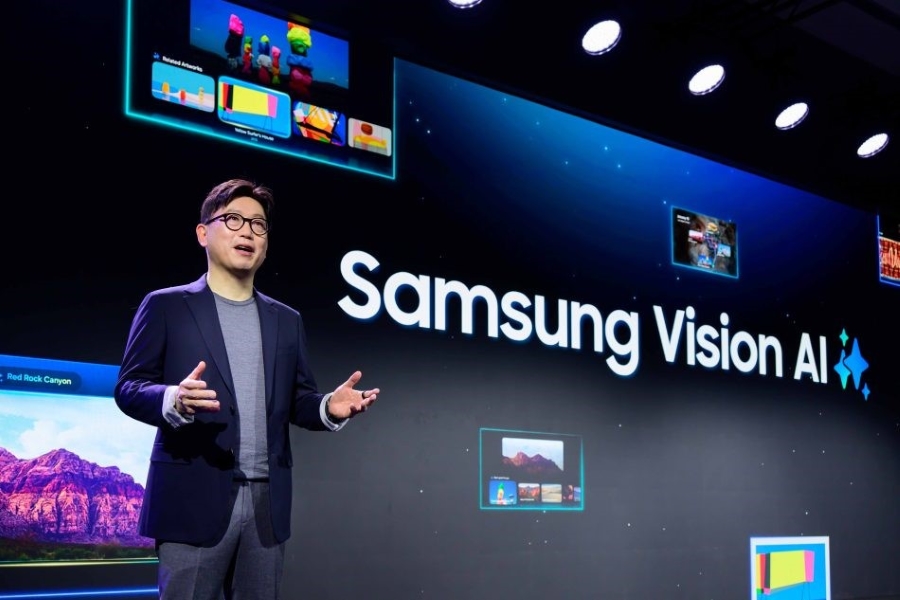
LAS VEGAS — Samsung Electronics America Jan. 5 unveiled Samsung Vision AI, a new intuitive technology that will be implemented across all Samsung AI-powered screens and devices, including the flagship Neo QLED 8K, Neo QLED 4K, and OLED models, as well as The Frame, the company’s slim, wall-mounted TV embedded into a picture frame.

“Samsung sees TVs not as one-directional devices for passive consumption but as interactive, intelligent partners that adapt to your needs,” SW Yong, president and head of the Visual Display Business at Samsung Electronics, said at Samsung’s pre-CES “First Look” event.

“With Samsung Vision AI, we’re reimagining what screens can do, connecting entertainment, personalization, and lifestyle solutions into one seamless experience to simplify your life,” he said.

Samsung Vision AI, the company says, makes the Samsung TV “aware of its surroundings, adaptive to your preferences, and autonomous in delivering intuitive features.”

At the core of Samsung Vision AI are its personalization features.

Click to Search offers instant information about what’s on the screen — whether identifying an actor or exploring displayed content — all without disrupting the viewing experience.

Live Translate, powered by an on-device AI translation model, eliminates language barriers with real-time subtitle translations on live broadcasts, allowing viewers to enjoy their content in up to seven languages.

Generative Wallpaper transforms screens into personalized art canvases, leveraging generative AI to create images tailored for any taste or occasion.

Subscribe HERE to the FREE Media Play News Daily Newsletter!

Beyond personalization, Samsung Vision AI positions screens as central hubs for smarter living through improved integration with the SmartThings ecosystem.

Home Insights provide real-time, mobile alerts about the household environment, including safety notifications and daily updates.

Pet and Family Care gives users the option to leverage the TV’s camera and speakers to detect unusual behaviors like falls or break-ins, and receive real-time updates and recorded events through the screen. Users can also choose to have this feature automatically recognize situations and adjust room settings, such as dimming the lights at bedtime.

Samsung Vision AI also delivers advancements in picture and sound quality. On-device AI picture and sound technologies analyze content and environmental factors in real time, dynamically adjusting visuals and audio for an optimized experience.

Samsung Vision AI features, such as Click to Search and Live Translate, along with cutting-edge products like the AI companion Ballie and the Smart Monitor M9 featuring Copilot, earned the company a 2025 CES Innovation Award.

Samsung Vision AI also offers collaborations with various AI partners. 

In collaboration with Microsoft, several 2025 Samsung smart TVs and smart monitors will feature Microsoft Copilot, allowing users to explore a wide range of Copilot services, including personalized content recommendations.

Samsung says it also plans to work closely with leading AI partners such as Google and others to expand what Samsung Vision AI can do.


Sleek, Smart & Connected: A New Generation of TVs Goes Direct With Consumers

The television has become more than a screen to watch and stream movies and TV shows.

It’s become a conduit for advertisers and consumers to connect directly with each other in real time.

With legacy linear television viewership declining, advertisers are switching to the internet to reach new and old-school TV couch potatoes with targeted marketing and programming.

A connected TV (CTV) is a newer “smart” TV embedded with a software operating system that allows it to link directly to the internet, or an older TV hooked up to the Web through streaming devices such as Roku, Fire TV or Google Chromecast; gaming consoles; cable boxes; or even Blu-ray Disc players.

Subscribe HERE to the FREE Media Play News Daily Newsletter!

The connected TV enables TV manufacturers such as Vizio, LG Electronics, Samsung, Sony/Google, TCL and Hisense to operate and market ad-supported streaming video content that can compete with a growing ecosystem of third-party ad-supported SVOD services, AVOD platforms and FAST channels.

With ad-supported content the new strategy embraced by media companies looking to generate profitability from their streaming business, CTV allows consumer electronics manufacturers to join the party.

Implementing strategies such as service bundling, content packages and promotional offers to bolster user retention and drive growth, the overarching goal among CTV players is advertising revenue and distribution.

CTV ad revenue is projected to double to $41.2 billion in 2028, from $20.5 billion in 2023, according to estimates from Pricewaterhouse-Coopers.

Retailers such as Walmart are testing “shoppable TV” advertising, making it possible for consumers to buy products directly from ads on television shows or streamed video content on a CTV.

“In the battle for ad dollars, CTV platforms are placing a strong emphasis on contextual and first-party data to target consumers with more-relevant ads, as well as leaning into creative ad optimization,” says Ally Appelbaum, VP of Enterprise Supply Partnerships at Nexxen, an advertising technology provider.

Targeting consumers directly underscores Walmart’s recent $2.3 billion purchase of Irvine, Calif.-based Vizio, one of the world’s leading manufacturers of TVs and a connected TV pioneer. The acquisition should help meld the huge discount retail chain’s online “Walmart Connect” platform with Vizio’s operating system to promote digital advertising, according to Seth Dallaire, EVP and chief revenue officer for Walmart U.S.

“We believe the combination of these two businesses will be impactful as we redefine the intersection of retail and entertainment,” Dallaire says.

Vizio’s TV ecosystem and proprietary ad-supported WatchFree+ streaming platform have generated more than 18 million active user accounts, up 400% since 2018. The company’s CTV platform business purports to have in excess of 500 direct advertiser relationships. The platform offers more than 300 channels, 15,000 on-demand titles, 10 curated channels programmed in-house, and expanded studio partnerships with Warner Bros. Discovery, Sony and Lionsgate, among others, in addition to paid services such as Netflix, Disney+ and Max, as well as free AVOD platforms such as Tubi and Pluto TV.

In August, WatchFree+ for the first time live-streamed The Women’s Cup Summer 2024 Soccer Tournament featuring professional teams and players from the U.S., South America, Europe, Asia and Africa not competing in the Paris Olympics.

“Bringing live sports to WatchFree+ is one way that we can … make world-class sports entertainment more accessible to everyone,” says Katherine Pond, group VP of platform content and partnerships at Vizio.

Proprietary Services

Consumer electronics companies, such as Vizio with its WatchFree+, are developing and bolstering their own proprietary streaming services to supplement paid services such as Netflix, Disney+, Max and others as well as established free ad-supported services such as Tubi and Pluto TV on their smart TVs.

South Korean CE giant Samsung has leaped into the CTV space with Samsung TV Plus, which features FAST and AVOD channels, and is the No. 1 free ad-supported app on Samsung smart TVs, according to the manufacturer, with more than 2,600 ad-supported linear channels available globally in 24 countries and more than 630 million active devices. The streaming platform is accessible on Samsung smart TVs beginning from 2016, Galaxy devices, Smart Monitors, Family Hub refrigerators, and the Web.

In May, Magnolia Pictures Home Entertainment announced a partnership with Samsung for access to the studio’s film catalog. CTV users will have access to more than 330 hours of ad-supported content across 160 titles. Magnolia movie titles available in the deal include the Academy Award-winning documentary Man on Wire, the Academy Award and Spirit Award-nominated Food Inc., the Oscar-nominated documentary RBG, Raoul Peck’s Academy Award-nominated and BAFTA-winning documentary I Am Not Your Negro, the BAFTA-nominated documentary Blackfish, and the Spirit Award and Gotham Award-nominated Support the Girls, among other content. Other titles include Lars Von Trier’s Melancholia, the actioner 13 Assassins, the “Ong Bak” trilogy and the space thriller Europa Report.

“As the home entertainment landscape continues to evolve … our partnership with Samsung allows Magnolia to build upon its growing presence in streaming and showcase an extensive library to a wider audience,” says Randy Wells, president of home entertainment at Magnolia Pictures.

Samsung also expanded a content deal with FilmRise, adding 600 hours of programming, including 19 TV series and more than 120 movies to up the platform’s portfolio of FilmRise content to 3,134 hours. Titles include “Heartland,” “Highway to Heaven,” “Hell’s Kitchen,” “Kitchen Nightmares” and “21 Jump Street,” among others.

LG Electronics in July announced the launch of “LG Channels Showcase.” The free ad-supported streaming platform features a range of studio films from Amazon MGM Studios, Lionsgate, Sony Pictures Entertainment and Shout! Studios.

The platform also features the series “LG Presents: The Rivalries,” featuring NCAA matchups in Division II and Division III sports. LG’s “Taste of Tennessee” series features author and host Matt Moore, joined by local Nashville restaurant owners and former NFL Tennessee Titans players.

China’s TCL has launched TCLtv+, rebranding its TCL Channel to include more programming as well as original AI content. The platform in July launched its first AI-powered sci-fi film short, Message in a Bot. TCLtv+ includes more than 330 FAST channels, as well as premium film and TV series.

The company also launched a content production studio dubbed “TCLtv+ Studios,” whose production team includes animators, VFX experts, AI engineers and writers to create episodic programming. A recent production included the AI generated short film Next Stop Paris, a romance that launched ahead of the Paris Olympics.

The company also has a content and technology pact with L.A.-based content/technology aggregator Cineverse, whose technology enables FAST channel operators to program and schedule their channels, while also providing programmatic ad and direct ad sales expertise.

Cineverse COO/CTO Tony Huidor says the TCL deal has helped expand the company’s FAST capabilities and upped backend support to OEM partners.

“We provide efficiencies and key backend support as TCL looks to scale and expand their position in the streaming entertainment ecosystem,” Huidor says.

Vizio’s WatchFree+ has also ventured into original programming with such shows as the lifestyle streaming series “@Home With Tori,” starring actress, author, and TV personality Tori Spelling.

Streamers Connecting With Ads

As streaming video platform choices grow, new TransUnion research found that while roughly two-thirds of households surveyed subscribed to two or more paid streaming services, about half of that group canceled or plan to cancel a service within the next year, citing cost and the availability of engaging content. As a result, CTV operators are focusing on AVOD and FAST options to attract price-sensitive viewers, while giving users data-driven personalization to seek out relevant content, as well as advertising tailored to their interests and behaviors. By leveraging user data, CTV platforms can create an environment where viewers feel recognized and understood, says Julie Clark, SVP of media and entertainment at TransUnion.

“CTV platforms have access to a wealth of data, enabling them to gain real insight into who’s watching what and when,” Clark says. “This data can power a recommendation engine that can take in several inputs — such as demographics, viewing times and device types — to serve up content that a user is most likely to watch.”

As consumers use the internet to access entertainment, the time spent consuming content on CTV is approaching parity with linear television.

New research from eMarketer found that time spent with CTVs by U.S. adults will top 2 hours and 3 minutes per day through 2024, compared with 2 hours and 48 minutes per day for linear TV.

The report suggests that as SVOD services such as Netflix, Peacock, Prime Video and Disney+ embrace ad-supported content, marketers are rethinking legacy TV advertising, focusing instead on the benefits CTV can have in reaching consumers through targeted content and advertising.

And consumers are responding.

Consumer research from Leichtman Research Group found that 87% of U.S. TV households have at least one internet-connected TV device, up from 80% in 2020. Overall, 46% of adults in U.S. TV households watch video daily on a connected TV, compared with 40% in 2020. Younger individuals are most likely to use connected-TV devices. About 62% of survey respondents between the ages 18 and 34 watch video on a TV via a connected device daily, compared with 54% among ages 35 to 54, and 24% among those 55 and older. The report found that 71% of TV households have at least one smart TV — up from 58% in 2020. About 50% of all TV sets in U.S. households are smart TVs, up from 39% in 2020.

Separate data from San Francisco-based AppsFlyer found 86% of consumers are willing to see ads on CTV, especially if they are relevant to them, but that 40% of viewers will stop watching CTV if there are too many ads. Most are willing to watch upwards of two ads per 30 minutes if the commercials are relevant.

Analyst Bruce Leichtman says there are now nearly 500 million connected-TV devices in the United States, up from 300 million in 2017.

“The percent of adults in the U.S. using CTV has significantly increased, growing from 25% to 46% in the past five years,” he says.

Connecting Through Entertainment

As the competition for viewer eyeballs heats up, CTV platforms are prioritizing exclusive content, upping licensed programming while implementing algorithms to reach viewers more effectively.

Take Roku, for example. The company is using its pioneering streaming video platform to engage with more than 80 million platform users is just the first step. The company says 120 million people access the platform on a daily basis.

In April, Roku announced a partnership with the NBA to launch the league’s first-ever NBA FAST channel, as well as the NBA Zone, showcasing games, highlights, documentaries, and original series.

“This partnership brings us a giant step further to make sports programming easy to find and engaging to watch,” says Joe Franzetta, head of sports at Roku.

Roku will also exclusively distribute more than 40 live NBA G League games on a national basis during the upcoming 2024-25 season.

Neala Gollomp, senior director of product management at Roku, says the company’s home screen has been revamped to help drive user engagement. The platform introduced a new personalized content row on the home screen that recommends relevant content based, in part, on their streaming habits.

Curated destinations on the home page include “All Things Food” and “All Things: Home” hubs, the NFL, NBA or MLB Zones, the Olympics Zone, and the Live TV Zone, among others.

“These one-stop-shop destinations offer our customers the ability to browse and discover new content within a genre they are specifically interested in,” Gollomp says.

Roku also updated its “What to Watch” zone with personalized recommendations, which includes a “Continue Watching” page and “Save List.” The platform added IMDb content ratings and made updates to its content detail pages to make them easier to use.

“We’re helping drive viewership to the most-popular streaming services across both SVOD and AVOD, including our own streaming service, The Roku Channel,” adds Gollomp. “Our platform offers reach and marketing capabilities that both SVOD and AVOD partners harness to drive audiences to their content, and we are able to promote our own programming with those marketing levers as well.”

Cablers Launch Connected Lifeline

With their legacy cable TV business in subscriber freefall, Comcast and rival cable operator Charter Communications joined forces to offer a line of connected Xumo TVs (manufactured by TCL) sold exclusively at Best Buy, in addition to offering their high-speed internet customers free access to the recently launched Xumo Stream Box joint venture.

The box includes access to third-party SVOD services, voice-activated content searching and uses both AI-driven personalization and an in-house editorial team for content recommendations. The device’s app includes 20-plus FAST channels. Additional features include a “currently playing” tile that shows what’s airing on the last channel the customer watched.

“[The box] helps simplify streaming,” says John Dixon, SVP of entertainment at Comcast.

Tracking CTV Data

With the proliferation of CTV usage, tracking user behavior via third-party sources remains a concern among some observers. To be sure, Nielsen is including The Roku Channel, Pluto TV and Tubi in its monthly TV consumption charts, but data on what viewers are actually watching is sometimes limited to the CTV operators.

“The problem … is that [viewership] is impossible to track, and there’s no way to see how offering free channels affects other paid services,” says Michael Pachter, media analyst with Wedbush Securities in Los Angeles.

TransUnion’s Clark says marketers, agencies and publishers are seeking alternative and complementary ways to track content performance across CTV. In some cases, the platforms themselves provide marketers access to usage data, allowing them to approach their ad campaigns by gaining visibility into metrics such as impressions, completion rates, watch time and ad interactions.

“Marketers can enhance this data with advanced measurement techniques like attention measurement via eye tracking or heat mapping to get a broader picture of how users interact with their TVs,” Clark says.

Marketers can also collaborate with third-party measurement partners who can connect signals from multiple different inputs — device manufacturers, streaming providers and CTV platforms — to provide a better view of a CTV viewer’s behavior.

“This gives marketers far more insight, enabling more effective and targeted campaigns,” she says.

Vikrant Mathur, co-founder of Future Today, a CTV ad platform, says the company employs a proprietary tracking system that provides insights into content performance and ad placements. The platform claims to offer comprehensive analytics that track viewer engagement, ad impressions and demographic data.

“We prioritize transparency and brand safety, allowing marketers to know exactly where their ads are being displayed,” Mathur says, which, he adds, includes reporting on ad-placement context, “competitive separation” and “frequency capping” to ensure optimal ad performance.

Nexxen’s Appelbaum says that with outside data sourced from traditional measurement firms such as Nielsen, CTV providers can offer content-level data that can be tracked using alternative methods. These include leveraging first-party data from CTV sources such as Roku. Automatic Content Recognition (ACR) data also is available, capturing viewership behaviors from devices and smart TVs.

“These methods all provide marketers with a deeper understanding and analysis of audience engagement with content,” she says.

In the end, CTV ad tracking remains a work in progress as industry efforts to supplement and eventually replace linear gather steam.

“CTV advertising is still in its early stages,” says Marc Finer, managing director of industry consultancy Communication Research.

“Until the entire OS-related user experience becomes more standardized and intuitive — particularly the process of searching, discovering and accessing content — there is bound to be lots of trials and errors encountered.”

Hub: Smart TVs Continue to Shape Viewing Habits

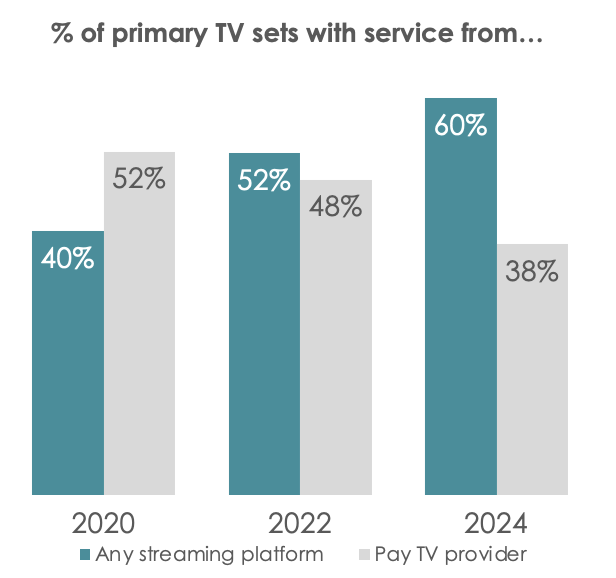
Internet-connected televisions continue to impact how consumers view their home entertainment. New data from Hub Entertainment Research found that 60% of respondents “most-used” TV sets are connected to a streaming platform — up by half since 2020.  At the same time, the share of primary TVs connected to cable, telecom or satellite continues to fall to 38% this year, down from 52% in 2020.

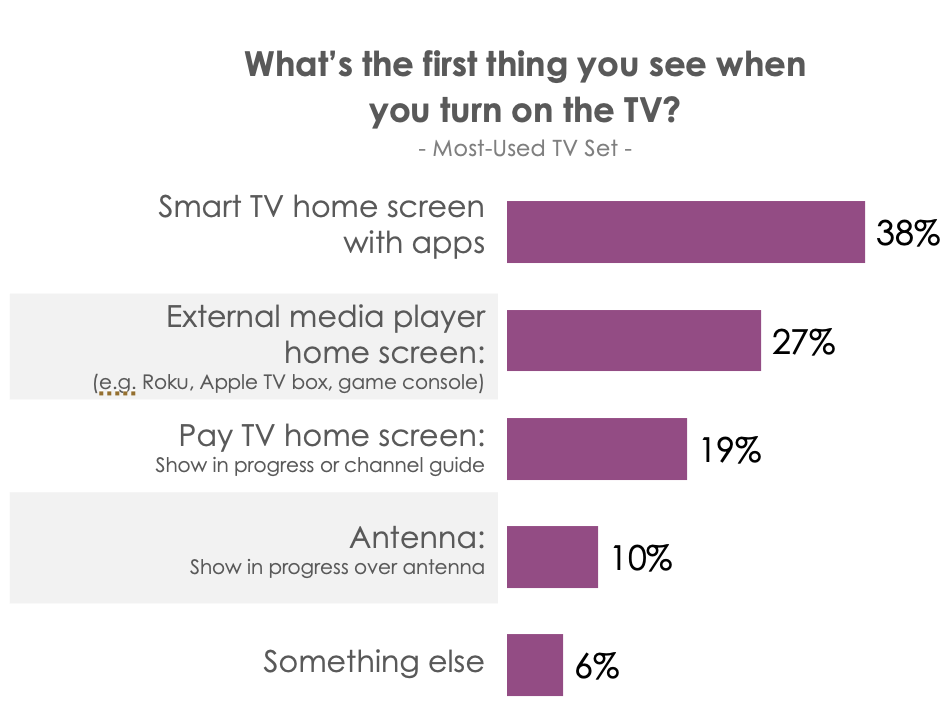
Citing a May survey of 2,517 U.S. consumers ages 16-74, 38% said the first thing they see when they turn on their TV is the apps installed on the home screen of their smart TV. Another 27% said they see the apps on a home screen of an external media player, such as a Roku player. And only 19% see a show in progress from a pay-TV provider. Thus, the discovery process is becoming one driven by apps and smart TV operating systems.

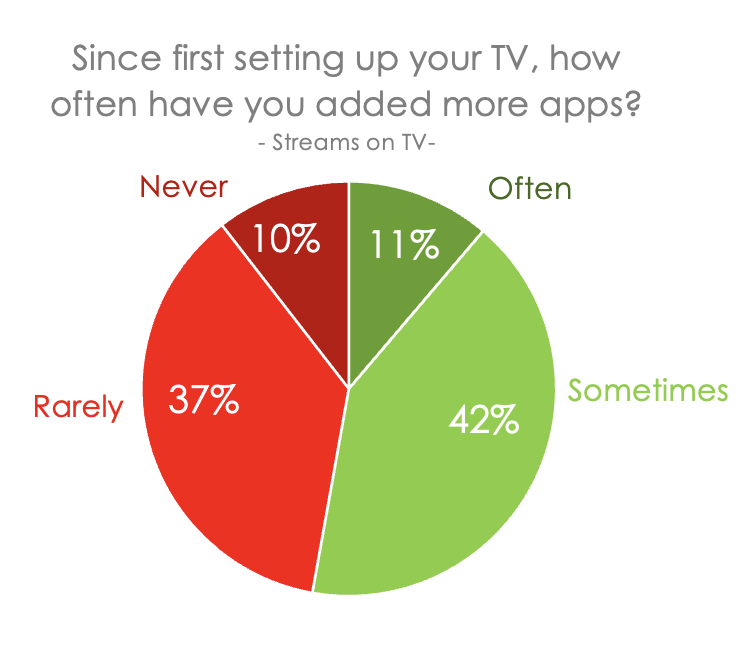
Half (51%) of respondents said that they installed a new TV app recommended by their smart-TV operating system when they set up their TV for the first time. And nearly half (47%) said that once their TV was set up, they rarely or never add more apps.

Hub contends the trend is likely to accelerate in the future as 79% of respondents said that when buying a new TV, they preferred to buy one with the same operating system as their existing set, only further underscoring the fact that CTV’s operating systems play a big role in which shows and apps respondents find out about and ultimately use.

Subscribe HERE to the FREE Media Play News Daily Newsletter!

“You can’t underestimate the power of what people see first when they turn on the TV,” senior consultant Jason Platt Zolov said in a statement. “Smart TVs are clearly becoming home technology hubs, giving programmers and advertisers more opportunity to partner with TV manufacturers in compelling ways that will only deepen engagement with viewers.”

Hub: 80% of U.S. Homes Own a Smart TV; Consumer Demand for Apple Vision Pro VR Headwear Limited

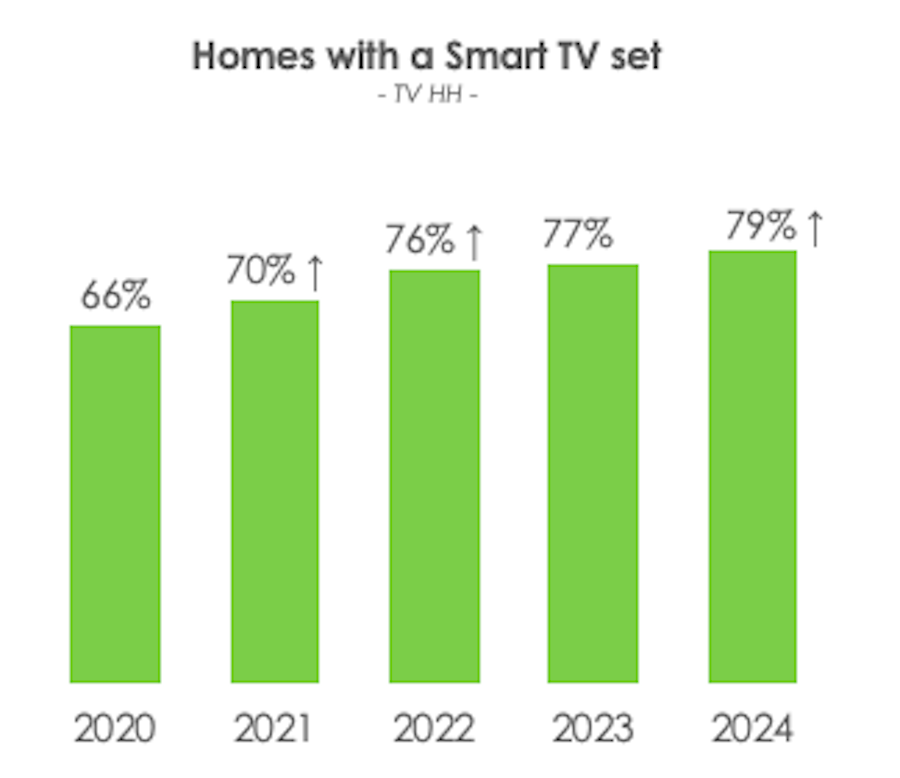
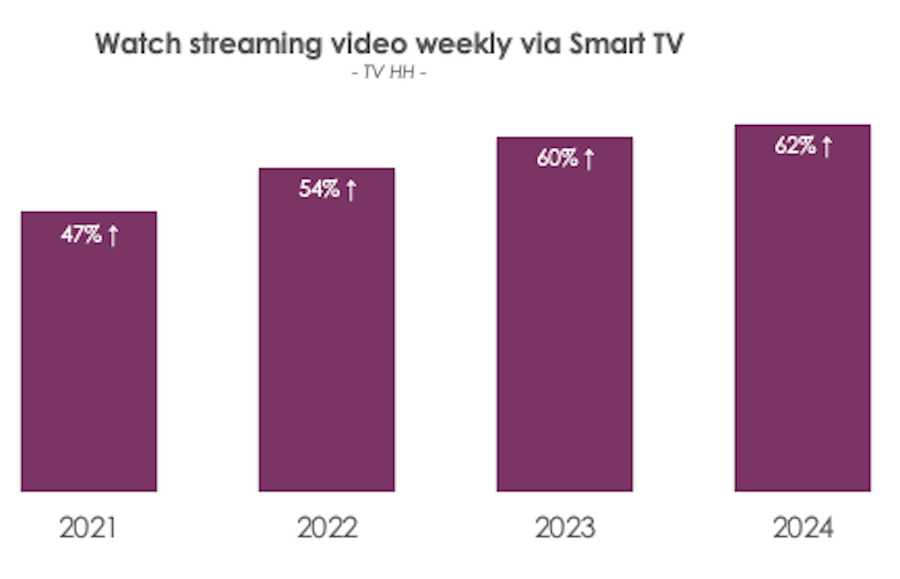
U.S. household Smart TV ownership increased to nearly 80% in the first quarter ended March 31, from 77% in the previous-year period, according to new data from Hub Entertainment Research. Citing a February survey of 5,026 respondents, Hub found that 62% of TV households are now streaming weekly on internet-connected televisions, up significantly from 47% in 2021.

While separate streaming media player devices such as Roku and FireTV are in half of respondent homes, device growth has stalled compared to all-in-one smart TVs that promote seamless integration for viewers.
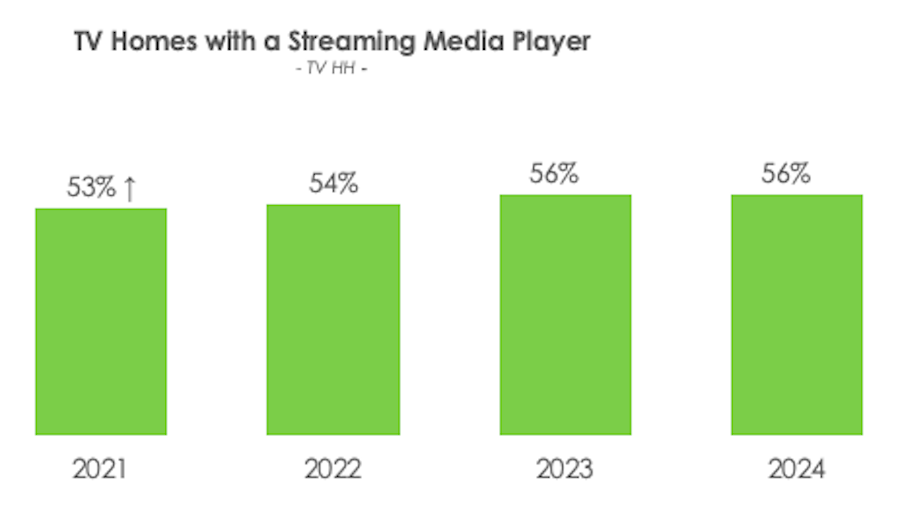
In addition, the growth of sound bars is improving the external sound systems for many while they otherwise are hesitant to upgrade to 4K or 8K TV sets.

“With more affordable and higher quality TVs available, it’s no surprise that people are continuing to upgrade their home theaters to better Smart TVs that make watching favorite streaming content easy,” Jason Platt Zolov, consultant to Hub and study co-author, said in a statement.

Subscribe HERE to the FREE Media Play News Daily Newsletter!

Separately, with a reported 200,000 Apple Vision Pro virtual reality headsets sold upon launch, Apple would appear to have established solid awareness (49%) and interest (53%) for the $3,500 device. However, consumer intent to purchase remains low (10%), with interest in the devices around 21%. Respondents still believe the most popular use case for headsets lies in gaming, and not watching television.
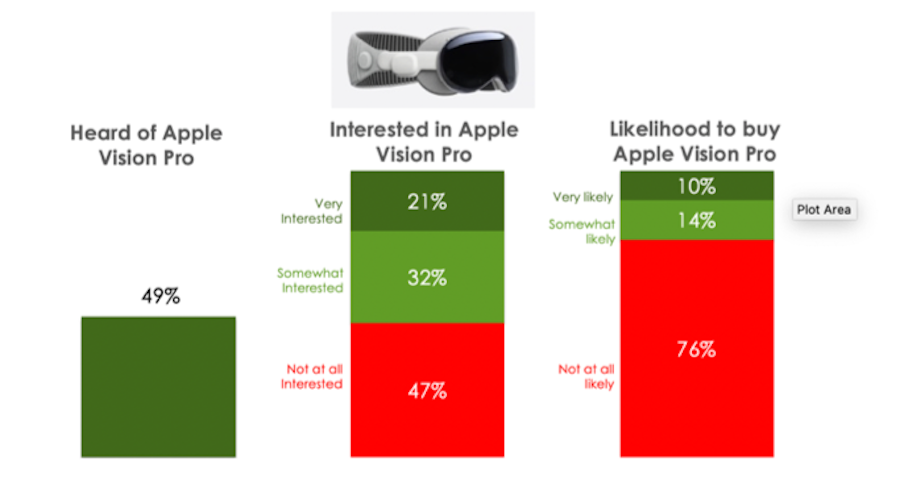
“The debut of the Apple Vision Pro headset is a big step toward making advanced headset usage more mainstream — although there is clearly room to grow in further integrating it into traditional living room behavior,” Zolov said in a statement.
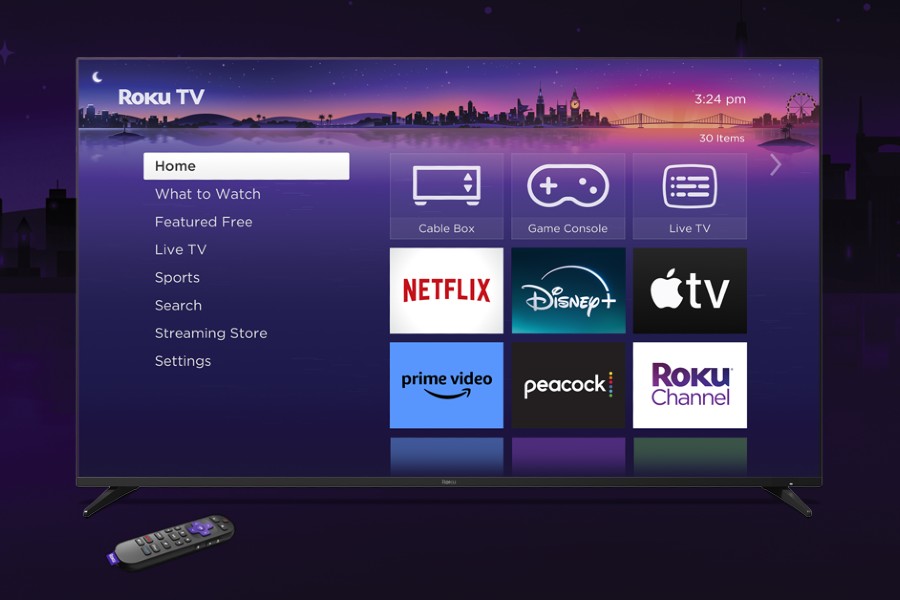
Roku Now Selling Branded Pro Series TVs Online at BestBuy, Amazon, Walmart, and in Best Buy Stores

Roku April 10 announced it is now selling its branded line of Pro Series televisions online at BestBuy, Amazon and Walmart, and in Best Buy stores.

First announced at CES in Las Vegas in January, the new TVs are thinner (1.9 inches), can be mounted on a wall like a picture frame, offer improved mini-LED backlighting, picture settings, HDR10+ and Dolby Vision IQTM audio, and an improved branded processor, among other features.

Subscribe HERE to the FREE Media Play News Daily Newsletter!

“For years, we’ve been invested in making the picture great for the shows and movies — and now we’ve added the simplicity of automation,” Chris Larson, VP of retail strategy, said in a statement.

According to Roku, picture quality is a key feature for 70% of smart TV viewers when purchasing a television. While many TVs come with settings that enhance the picture for content, ranging from sports to movies to animation, only 9% of smart TV viewers often adjust those settings as they watch different types of content, according to a Harris Poll study commissioned by Roku. To address this, all Roku TV models — even those from a decade ago — will get Roku Smart Picture with an automatic software update.

Created by Roku’s Advanced TV Technology team, Roku Smart Picture uses metadata to automatically adjust picture modes before content even starts to play. In addition, Smart Picture Max uses AI to refine color, contrast and sharpness in real-time scene-by-scene.

Separately, the new Roku Voice Remote Pro 2nd edition includes motion-activated backlit buttons, USB-C charging, and a shortcut enabling users to quickly access live TV or a current binge-watch show. Pro Series TVs also come with a remote finder button on the side of the TV that triggers a chime on the remote.

Roku Pro Series TVs are available in 55-inch, 65-inch and 75-inch models with pricing ranging from $899.99 to $1699.99, with the Roku Slim-profile wall mount kit available for $99.99.

Roku Voice Remote Pro (2nd Edition) is available for purchase on Roku.com for $29.99, and will be available in major retailers in the coming months. Roku Voice Remote Pro (2nd edition) is included with all Roku Pro Series TV.

Study: Nearly a Quarter of Marketers Plan to Increase Connected-TV Advertising

Nearly a quarter (23.6%) of marketers plan to increase their spending on connected TV campaigns, according to a new survey from tvScientific, an advertising platform.

The study, which collected responses from more than 600 marketing professionals in Q4 of 2023, found that 35% of respondents plan to increase their overall ad spend in 2024.

“Finally, we have validation from a large group of marketers of what we have always known — TV is a superior and highly effective medium that can now be connected to business outcomes,” Jason Fairchild, co-founder and CEO of tvScientific, said in a statement. “Marketers are putting their money where their results are, with CTV leading all mediums in terms of planned investment increase for ‘24.”

Additional findings from the tvScientific survey include:

  • 65% of advertisers report an increase in sales when performance TV is added alongside other paid channels such as search and social.
  • With a diverse marketing mix, 68% of respondents say their company’s brand awareness has increased since using performance TV.
  • 62% of respondents said it’s easy for them and their team to prove TV’s impact.


Subscribe HERE to the FREE Media Play News Daily Newsletter!

“We expect advertisers will continue making intelligent, bold investments in performance TV as it helps brands drive more engagement, ROAS, and sales in 2024,” Fairchild said in a statement. “With structural changes underway in other digital advertising channels, CTV’s addressability, accessibility, and efficiency are poised to change the game for advertisers of every description.”

BBC News Launching on CTV/FAST Platforms

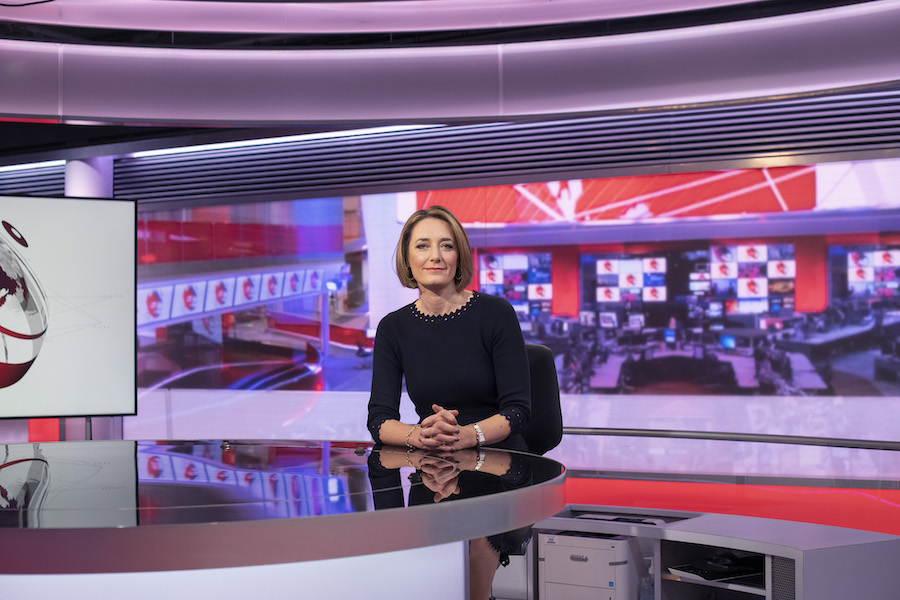
AMC Networks and BBC Studios, the commercial subsidiary of the BBC Group, March 13 announced the launch of BBC News as a 24-hour live news channel on a variety of CTV/FAST platforms. Initial launch partners are Pluto TV, Samsung TV Plus, Xumo Play, Vizio WatchFree+, Sling Freestream and Plex.

The BBC News channel delivers 24-7 coverage of breaking news and moments of global significanc. AMC Networks is the distribution and sales representative for BBC News in the United States through its BBC America joint venture.

As part of the BBC’s expansion in North America, BBC News has grown its news operation out of its Washington, D.C., bureau, expanding its nightly primetime coverage and developing programming focused on national news to better serve audiences in the United States and around the world, according to the news organization. BBC News live 24-hour coverage is anchored out of the United Kingdom, the United States and Singapore. The channel features chief presenters including Sumi Somaskanda and Caitríona Perry in Washington,D.C.; Matthew Amroliwala, Christian Fraser, Lucy Hockings, Maryam Moshiri and Sally Bundock in the United Kingdom; and Steve Lai in Singapore.

“This is a significant milestone for the BBC as this launch will more than double the current reach and availability of the BBC News channel in the U.S. at a time when access to independent news and information is more important than ever,” Tara Maitra, chief commercial officer of global media and streaming for BBC Studios, said in a statement. “We’re proud to launch this channel with the support of so many of the leading CTV/FAST platform partners as we continue to expand the footprint of BBC News and bring the BBC’s journalism to wider audiences in the region.”  

“What a profoundly meaningful addition to the rapidly growing CTV/FAST space, at a time when access to authoritative and impartial news could never be more important,” Kim Kelleher, chief commercial officer of AMC Networks, said in a statement. “The BBC is one of the largest, most-trusted and comprehensive news-gathering organizations in the world. The arrival of BBC News as a live, 24-hour channel on these free platforms is a landmark moment for global news, our partner platforms and the entire FAST distribution ecosystem.”

“This latest addition to our news offering expands our diverse programming lineup and gives us the opportunity to reach an even wider audience via a well-respected and trusted international news source,” Amy Kuessner, EVP of programming for Pluto TV, said in a statement. “In today’s day and age, free round-the-clock access to a strong audience-centric news brand like BBC News is indispensable.”

“Live local and national news has always been a top performing category on Xumo Play, and with the addition of BBC’s 24/7 live coverage, our viewers can now enjoy a fresh, international perspective on major news moments happening across the world,” Stefan Van Engen, VP of programming and partnerships for Xumo, said in a statement.

“Samsung TV Plus is committed to providing a platform for a variety of global, national, and local news sources to share important updates that our consumers rely on,” Sarah Nelson, head of BD and strategic partnerships, Samsung TV Plus, said in a statement. “We’re excited to partner with BBC Studios and AMC Networks to bring this 24-hour live news channel to our viewers, empowering them to stay informed and engaged with the world around them.”

Subscribe HERE to the FREE Media Play News Daily Newsletter!

This additional CTV/FAST distribution of BBC News is complementary to existing wide distribution on pay-TV platforms including DirecTV, Comcast’s Xfinity, Charter’s Spectrum, YouTube TV, Philo, Dish and others. BBC News programming includes popular flagship shows such as “Verified Live,” “BBC News America,” “Newsday,” “Influential with Katty Kay,” and “World Business Report” plus “The Travel Show,” “Click,” and “BBC Documentaries.”

Crunchyroll Anime Streaming Service Launches on LG Smart TVs

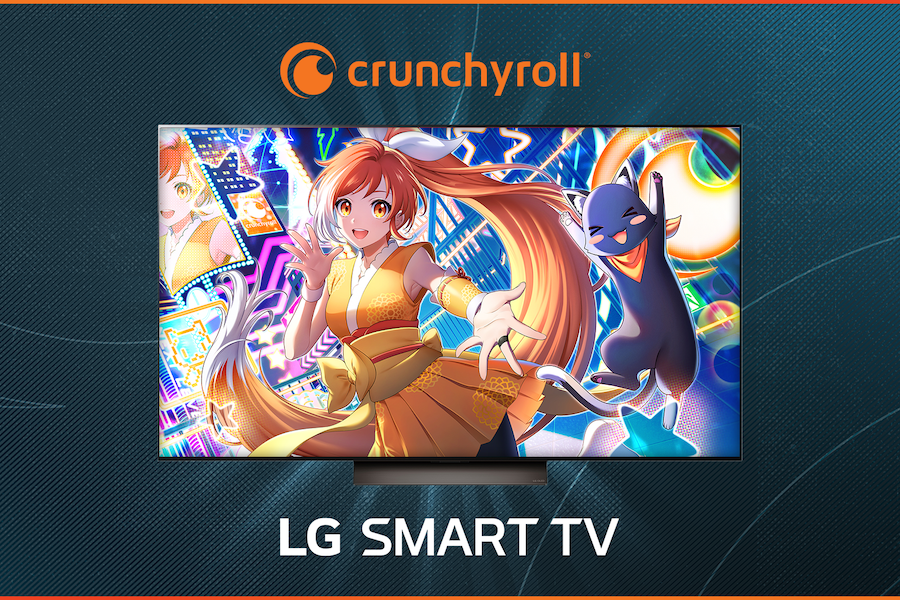
The Crunchyroll anime streaming service app launched Feb. 21 on LG Electronics smart TVs in the United States and across international regions.

The service features more than 18,000 hours, 46,000 episodes and films, and 3,300 Japanese music videos and concert specials.

Viewers will also get expanded access to the simulcast series streaming on Crunchyroll shortly after premiering in Japan, including the dark fantasy “Solo Leveling,” “Frieren: Beyond Journey’s End,” and the comedic “Mashle: Magic and Muscles,The Divine Visionary Candidate Exam Arc,” among other content. Crunchyroll’s catalog is available in subtitled or dubbed formats across more than 12 languages including English, Spanish (Latin America and Spain/Castilian), Portuguese, French, German, Arabic, Italian, Hindi, Telugu and Tamil.

“Our new partnership with LG makes it even easier to be an anime fan,” Kaliel Roberts, chief product officer at Crunchyroll, said in a statement. “Anime offers a variety of genres and viewing adventures and now viewers have even more options to dive deeper.”

Subscribe HERE to the FREE Media Play News Daily Newsletter!

Crunchyroll has more than 13 million paying subscribers globally, and serves 200 countries and territories with a dedicated anime streaming library, while also offering events and experiential, theatrical, gaming, merchandise, e-commerce and more.

From Around the Web