


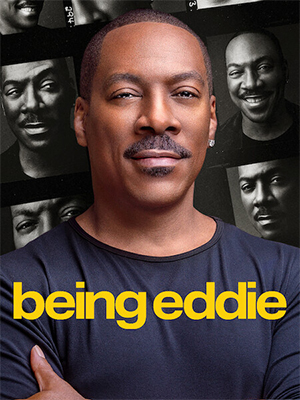
Being Eddie
November 22, 2025


STREAMING REVIEW:
Netflix;
Documentary;
Rated ‘R’ for language throughout, sexual references and brief nudity.
Features Eddie Murphy, Dave Chappelle, Jerry Seinfeld, Charlie Murphy, Arsenio Hall, Tracy Morgan, Barry Blaustein, Chris Rock, Tracee Ellis Ross, Jamie Foxx, Jeffrey Katzenberg, Elvis Mitchell, John Landis, Kevin Hart, Pete Davidson, Jerry Bruckheimer, Ruth Carter.
The new Netflix documentary Being Eddie offers a compelling, yet guarded, portrait of a superstar. The film’s very existence is a direct result of Murphy’s big strategic brand partnership with Netflix, which secured the rights to his stand-up return, Beverly Hills Cop: Axel F, and designated the streamer as the primary home for his next career phase — a relationship solidified by the critical success of Dolemite Is My Name. Produced by Brian Grazer (who appears in the doc) and directed by Reginald Hudlin (who also appears and shares a long history with Murphy, having directed him in Boomerang), the one-hour and forty-three-minute documentary is clearly an authorized celebration.
While it provides unprecedented access to the reflective composure of the 64-year-old icon and features high praise from friends and peers such as Chris Rock, Dave Chappelle, Arsenio Hall, Jerry Seinfeld, Kevin Hart and Pete Davidson, the narrative stops short of revealing the man on a truly deep level. We receive tantalizing bits and pieces, but the central question — Who is Eddie Murphy, the intensely private person —remains unanswered. For instance, the documentary only scratches the surface of the complex reality of the man who is a devoted family guy with 10 children from relationships with five different women, leaving the viewer with only a surface appreciation of his unique life.
The Eddie Murphy we see today sits within the quiet luxury of his massive home compound, which is like a resort hotel setting — somewhat understated but impeccable — a striking contrast to the garish red leather suit of Delirious and the equally garish purple suit of Raw, specials he acknowledges were true stories of his life up to that time.
His career, which began when he was so young and new that he was not all that familiar with “Saturday Night Live,” was quickly championed by a major industry player. The studio production head, Jeffrey Katzenberg, recognized his star power and, remarkably, prevented him from being fired just two weeks into filming his huge mass appeal hit, 48 Hours. This early break and the subsequent whirlwind matured into a defining self-awareness. He refuses to be categorized simply as a comedian or an actor, stating that he is an “artist” capable of many mediums. He is confident in his achievements, which include thoughtfully breaking new ground for Black people across varied genres, like leading a romantic comedy, and his unique mastery of playing multiple characters, achieved effectively with extensive costuming and make-up in films such as The Nutty Professor and with limited costuming and make-up in Bowfinger. Despite his impact, he notes the one major accolade he has never won: an Academy Award.
His artistic influences were colossal, but his greatest comedy influence was Richard Pryor. The documentary highlights that discovering Pryor’s comedy was a pivotal moment that shaped his entire comedic voice. He not only admires Pryor as the greatest comedian of all time but also had the unique opportunity to direct him in a film, Harlem Nights. He also cites Elvis Presley for the flash and excitement that inspired his iconic ’80s stand-up outfits. However, his personal hero is Muhammad Ali, whom he praises not just for his charisma, but for standing up for himself in the face of racism and during the Civil Rights movement. The film features a surprising photo reveal, where Murphy recounts the unique story of punching Ali in the face one night after the boxer “talked too much shit.” The film also mentions the sad losses of peers such as Michael Jackson, Prince and Whitney Houston, further emphasizing his own strategic self-preservation.
Murphy’s longevity is rooted in discipline. He knew what he wanted to do from a very young age and feels he knows himself and is not seeking validation outside himself. This conviction is the source of his famous sobriety, though the film presents a curious visual tension. While he has been very open about his choice, stating he has abstained from alcohol and hard drugs throughout his life (a highly unusual feat for a comedian who rose to fame during the drug-fueled Hollywood scene of the 1980s), there is a brief moment where he appears to be holding a clear bottle with a yellowish liquid, resembling a Corona beer. He recounts the famous story of declining cocaine at age 19 with Robin Williams and John Belushi (who died two years later), attributing the choice to a lack of curiosity, self-love and providence. He notes the exception that he tried marijuana much later in life, when he was 30 years old, but that this is the full extent of his drug use.
The arc of his life is complete, having reached a phase in which he found himself surprised when he had lunch one day with Steve Martin in San Francisco and walked 10 blocks without bodyguards or being mobbed, realizing women were no longer chasing him. His highly publicized 2019 return to “SNL” was something of a burying of the hatchet, closing a quiet boycott that had lasted many years after he took earlier criticism personally; it marked his outward reemergence after a break from performing and cemented his new chapter of “artistry.” Now, he knows that family and love are keys to success and happiness in life. He has 10 children from relationships with five different women, has been married twice, and welcomed his 10th and most recent child at 57. His current wife is Paige Butcher, who is 46. The most poignant section of the film is reserved for his older brother, the comedian Charlie Murphy, who sadly passed away in 2017 at the age of 57 from leukemia. Eddie speaks with palpable grief and love, declaring, “Charlie was the funniest person alive,” noting Charlie’s fame on “Chappelle’s Show” and how he had kept the severity of his illness private.
The film ultimately suggests that the true Hollywood champion is not the one with the loudest stage presence, but the one who builds a quiet, rich, and protected interior life—a foundation of peace that has sustained his creative fire for decades, making his grounded persona his most interesting and enduring role, even if that role only partially reveals the man beneath the artistry. As Dave Chappelle concludes in the doc: “Surviving being Eddie Murphy is a hell of an accomplishment.”
Subscribe HERE to the FREE Media Play News Daily Newsletter!