
Late-night talk shows have been a staple in American viewership for decades, offering topical humor, celebrity guests, musical acts, and a host that viewers welcome into their homes to end their day. Inherently time-stamped content, in an era when viewing is almost exclusively time-shifted, these daily programs have faced viewership declines and challenges on their longtime linear broadcast homes. Now, more recently, they have also come under fire from the FCC for their political humor, with free speech at the center of the debate.

With the state of late-night talk shows in new, uncertain territory, we here at Whip Media wanted to gauge consumer viewing preferences for the format. Using our engaged panel of TV Time users in the United States, these content enthusiasts were surveyed Sept. 26-28, 2025, about the late-night talk show format and timely perceptions on issues impacting this content. With more than 6,000 respondents (n=6, 107), we have gathered a few insights about the importance of political humor, the role of broadcast networks, potential changes to how these shows are offered, and general preferences in viewership.
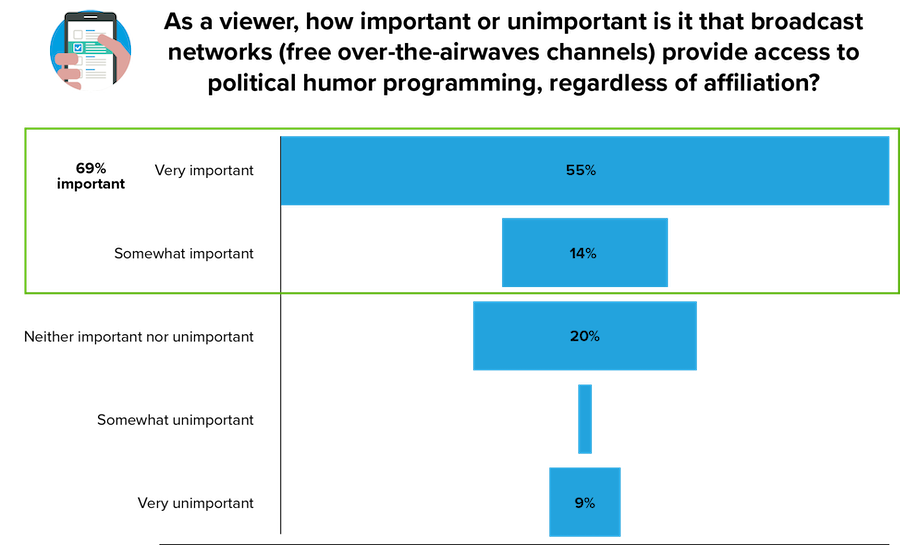
First, a majority of respondents consider it very important (55%) or somewhat important (14%) that broadcast networks provide programming that contains political humor. Among the segment of respondents who watch late-night talk shows at least occasionally, this offering is significantly more fundamental: 71% said it is very important for political humor content to exist on broadcast networks, with a full 81% agreeing to its importance. It is worth noting that the three age buckets examined across total respondents (18-34, 35-54, 55-plus) were incredibly aligned at 55% for Strongly Agree.
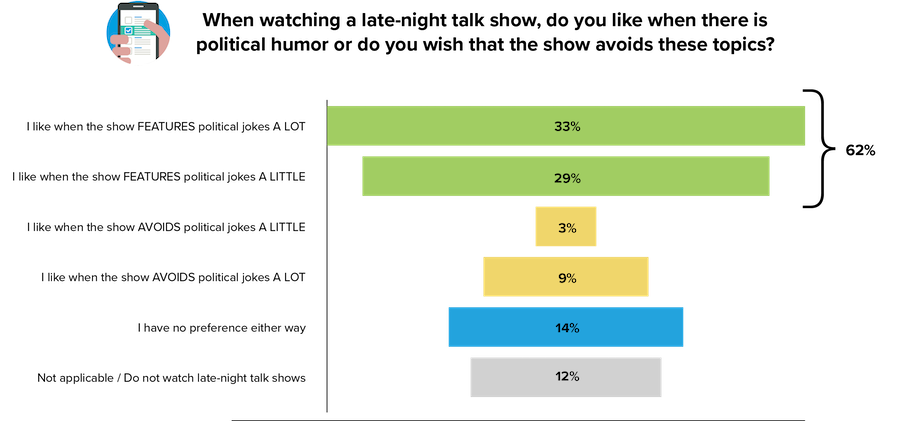
Late-night talk shows have long been known for serving up humor on political news and figures. But are U.S. consumers tired of political jokes in their late-night talk show fare? Not exactly! Two-thirds (62%) of respondents said they like when these shows feature political jokes, with a third (33%) liking it a lot. When removing those who do not typically watch late-night talk shows, the desire for political humor in these programs rises to 80%.
Respondents also generally feel that late-night talk shows do belong on free broadcast networks, with 60% agreeing strongly or somewhat versus 5% disagreeing strongly or somewhat. That number jumps to 73% when segmenting respondents who watch these programs at least sometimes. It is again worth noting that when examining these results by age bracket (18-34, 35-54, 55 plus) there was almost no variation in the “strongly agree” responses, with each age cohort within two percentage points of each other (44%-46% strongly agree).
Respondents were asked about a scenario in which a late-night talk show is canceled or suspended. There is a strong likelihood (69%) that consumer perception of a network or platform will be impacted. When considering just the segment of respondents who watch late-night talk shows, this likelihood is even stronger at 86%.
With the future of the late-night talk show format in flux, coupled with wider changes in the viewing behaviors of consumers, we asked respondents where else they might watch or follow a host they enjoy if that host were no longer on broadcast. Fans are most likely to follow that talent to YouTube (55%), followed by a streaming service (47%). A third of respondents (35%) expressed openness toward a social media platform, and a quarter (24%) would consider a podcast with the host.
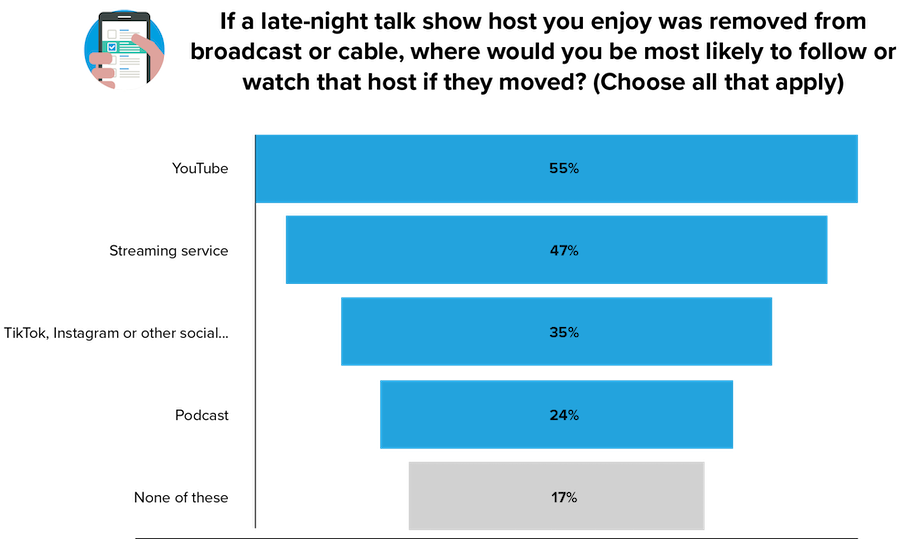
Among respondents 18-34 years old, TikTok/Social was the second ranked option with 49%, after YouTube (62%). Among male respondents, podcasts (26%) edged out TikTok/Social (23%) for the third rank after YouTube and streaming services.
Finally, we asked respondents some overarching preferences about the format of late-night talk shows and what motivates them to watch. In general, U.S. audiences today strongly prefer watching shorter clips of this content (41%) with only 12% preferring a full episode. A quarter (25%) have no preference and will watch both.
As for why they are watching, the guests/interviews are the top driver — with 62% citing it as a main reason. The topical monologue ranked second (51%), whereas the host ranked third (42%).

These findings shed light on the dynamic nature of late-night television and the evolving expectations of its audience. For a genre that was built to deliver nightly laughs, U.S. audiences are realizing there is a greater importance that underscores this type of programming.
Jeni Hatfield Benhain is senior director of client solutions at Whip Media.