
Evan Shapiro



April 28, 2025


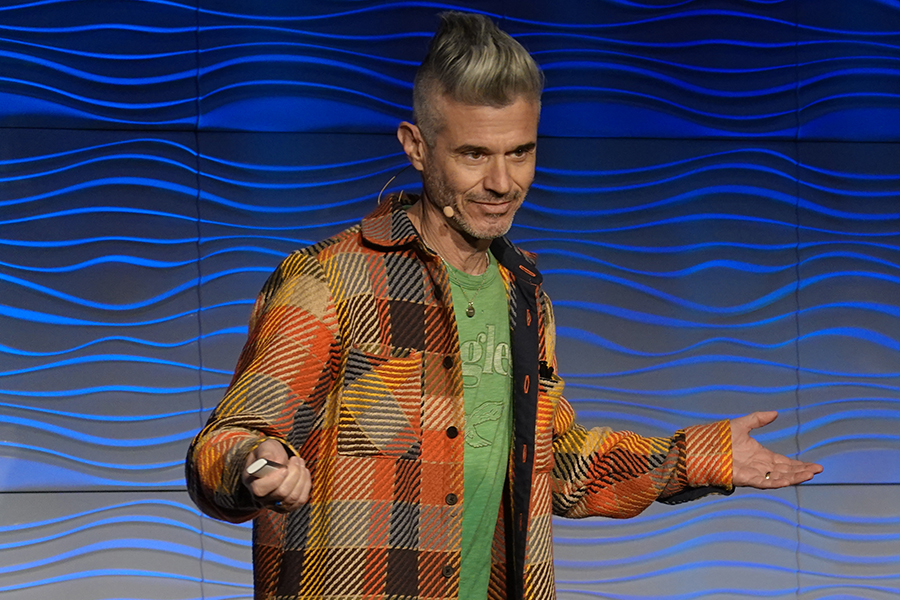
Evan Shapiro stunned the audience at a NATPE session in Miami earlier this year when he proclaimed that the streaming wars are over — and Netflix has won.
He cited Netflix’s high subscriber count, which dwarfs that of the other subscription streaming heavyweights such as Disney+ and Max, and noted that the company’s valuation — which at the time was estimated at $419 billion — is significantly higher than the combined valuation of Comcast, Disney, Fox, Paramount and Warner Bros. Discovery.
“It’s time to move on,” said Shapiro, whom NATPE organizers described as “the cartographer of the Media Universe.” At the Feb. 6 NATPE presentation, he said the industry needs to set its sights on the broader media landscape and how to compete for consumer attention on other media outlets such as social media and YouTube.
An Emmy- and Peabody Award-winning producer of TV, films and podcasts, Shapiro charts media’s future through his essays on his Media War & Peace Newsletter and serves as a professor at New York University’s Stern School of Business.
Netflix co-CEO Ted Sarandos attributes the streaming goliath’s dominance to its focus on content. Indeed, the streamer’s success was all part of a learning curve rooted in the very start of the Netflix story.
“I believe that through our DVD business, when we stocked nearly every title ever published, we learned quickly that tastes are broad and to truly entertain the world, you need to have breadth of storytelling,”
Netflix co-CEO Ted Sarandos told Media Play News. “Netflix set the expectation that you always have something great to watch and we deliver on the promise and carried it into streaming. This sets us apart from the narrow sensibilities of most entertainment brands.”
Netflix seems to be relishing its perceived triumph in the streaming wars, to the point that a year ago executives boldly announced they would no longer report quarterly subscriber numbers. The April financial report covering the first three months of 2025 was the first in which this plan was implemented, but investors didn’t seem to care, focusing, instead, on significant gains in both revenue (13%) and operating income (27%). The results sent Netflix’s stock skyward, with its per-share valuation topping $1,000.
Analysts weren’t surprised. J.P. Morgan analyst Doug Anmuth on March 24, three weeks before the quarterly financial report, reiterated a Buy rating on Netflix, noting that the company’s stock so far this year has outperformed the S&P 500, and said market attention will merely shift to revenue growth.
Many agree with Shapiro’s assessment that Netflix is unbeatable. “Netflix has won the streaming wars. Case closed,” Robert Fishman, analyst with MoffettNathanson, wrote in a March 17 note as he increased his 12-month share price target for the streamer from $850 to $1,100.
The analyst said he believes Netflix will generate more than $6 billion in advertising revenue in 2027, and nearly $10 billion by 2030.
Netflix ended 2024 at a record high. The streamer added 18.9 million subscribers in the last three months of the year to dominate the industry with 301 million global paid subscribers, more than 700 million viewers, and $8.7 billion in full-year profit on revenue of $39 billion.
The windfall well outpaces the competition, which includes Disney+, Warner Bros. Discovery’s Max, Paramount+, Hulu and Peacock, among others. While the streamers added a collective 12 million subs in the final three months of 2024, Disney+ lost 700,000 subs and Peacock added no paid members. Apple TV+ and Prime Video do not disclose subscriber numbers.
Furthermore, the collective studio direct-to-consumer finances don’t come close to closing the gap to Netflix’s billions. When combining the fiscal-year results of Disney+, Hulu, ESPN+, Max/HBO, Paramount+/Pluto TV and Peacock, the assets generated a combined loss of $1 billion on revenue of
$46.1 billion, according to a Media Play News analysis. Netflix’s revenue, meanwhile, was just 15% less than the combined revenue of its seven major rivals, excluding Apple TV+ and Prime Video.
Even competitors admit Netflix’s dominance.
“In many respects, Netflix is the gold standard when it comes to streaming,” Disney CEO Bob Iger said of his company’s competitor on an earnings call last year.
Netflix’s market cap is 836% higher than Disney, a brand that includes theme parks, cruise ships, movie and television studios, and consumer products. Netflix’s cap exceeds Paramount Global’s market cap by a whopping 4,754% and is 194.4% greater than that of Comcast — the latter including NBCUniversal, Xfinity, Universal Studios theme parks, and Sky satellite operator in Europe.
“The Netflix flywheel is in full effect,” Fishman wrote. “Because Netflix has more subscribers to spread its content spending across, it can afford to spend more on content. Because it has more content, it drives better engagement, leading to more subscribers and possibly better pricing power in a virtuous cycle. This is the enduring power of Netflix’s first-mover advantage in [the streaming market].”
SEE ALSO — Thomas K. Arnold: Evan, Ted, and YouTube
Netflix’s victory in the streaming wars is a result of vision and canny content management, observers say.
Being first was certainly a factor — for a long time, Netflix was the only game in town as far as pure-play streamers are concerned, having launched the whole subscription streaming concept back in January 2007 as an outgrowth of its DVD rental-by-mail business, which flourished under a similar all-you-can-watch subscription model. Amazon didn’t add on-demand streaming video to its Prime memberships until February 2011, and by then Netflix had already built up a formidable library of content — virtually all of it acquired from the major Hollywood studios.
“We did this to ourselves,” Shapiro said at NATPE. “We sold Netflix all the content they needed to take over the television world. And then we wondered, how did that happen?”
That content accelerated the streamer’s rise and helped make the Netflix brand practically synonymous with the concept of streaming itself. Remember the phrase “Netflix and chill”?
“How did Netflix win the streaming wars? They did it by buying TV’s best content from them (the studios and other media companies), spending more than what is rational to acquire scale, and then moving the goalposts to become old-fashioned TV now, with ads and sports,” Shapiro says.
He’s not alone in that view. Ben Feingold, who during Netflix’s rise was president of Sony Pictures Home Entertainment, told Media Play News in 2022 that, in retrospect, the rush to sell movies to Netflix was a bad idea. Not only did it devalue films by including them on an all-you-can-watch subscription platform, but it also enabled Netflix to grow stronger at the studios’ expense.
“People were shortsighted,” Feingold said. “When you work at a large public company and you have a bunch of bombs or a bad quarter, there’s a lot of pressure from the finance people to make your number. So somebody comes along and offers to plug a hole, so they do it and worry about the future later. But you should never let short-term profits affect your strategy.”
Warren Lieberfarb, Warner Home Video president from 1982 to 2002, agreed, telling Media Play News in 2022 that licensing product to Netflix “would ultimately prove to be cannibalistic to the linear cable networks, pay-cable networks, ad-supported cable networks, and broadcast television networks that were owned by these same studios’ parent companies. And those networks were the largest sources of profits for the media conglomerates. The studios were creating a behemoth that years later they would try to copy, but in the interim they were threatening their own cable and broadcast interests.”
It was only just before Disney+ and Apple TV+ launched in November 2019, followed in swift succession by the other big SVOD services eager to capitalize on the pandemic’s stay-at-home orders, that the content flow to Netflix tapered off.
The Walt Disney Co. CEO Bob Iger struck first, halting the licensing of theatrical releases to Netflix ahead of the Disney+ launch. It was a decision that cost Disney $150 million in annual licensing revenue.
“That would be like selling nuclear weapons technology to a Third World country, and now they’re using it against us,” Iger told The New York Times at the time.
Less than a year later, just as the pandemic hit, the former WarnerMedia (now Warner Bros. Discovery) also stopped licensing content to Netflix as it readied the launch of its streaming service HBO Max (now just Max).
But the drought didn’t last long. Iger effectively took back his “nuclear threat” comment at Disney’s 2023 shareholder meeting, when the executive said Disney would accelerate its licensing of content to third parties, including Netflix.
And the Warner embargo only lasted until the new owner, Discovery’s David Zaslav, took control in 2022.
Since then, WBD has aggressively licensed content such as Dune: Part Two and Godzilla x Kong: The New Empire, in addition to TV shows including “Young Sheldon” and catalog fare such as “Six Feet Under,” “Band of Brothers,” and “Ballers” to the streamer.
“The fact is, licensing some library content to other VOD platforms like Netflix … as part of a co-exclusive agreement is just smart business,” Zaslav said on an August 2023 earnings call. “We’re expanding our audience while maximizing the value of the asset and providing more revenue streams. And that is our job — to optimize the windowing to get the best possible return on investment.”
Today, there’s no question that Netflix’s continued growth — and its dominance over the other big streaming services — is fueled largely by licensed content from TV networks and movie studios, from past Starz-licensed movies acquired through third-party studios in the early 2000s to an existing exclusive Pay 1 theatrical deal with Sony Pictures and a pending exclusive 10-month window for Universal Pictures and Focus Features’ theatrical releases, beginning in 2027.
Content to which the streamer had rights, including “Grey’s Anatomy,” “NCIS,” “Young Sheldon,” and Universal’s Minions, The Super Mario Bros. Movie and The Boss Baby, all ranked among Nielsen’s top 10 most-streamed content in 2024.
Netflix’s Feb. 25 debut of Sony Pictures’ sci-fi actioner Venom: The Last Dance generated 12.8 million global views in its platform debut — four months after the movie’s theatrical release.
Other dated third-party theatrical hits on the platform include Paramount Pictures’ Sonic the Hedgehog 2, which cracked Netflix’s top five movies two years after bowing on Paramount+; Sony’s Kraven the Hunter; Universal’s Ted, released theatrically in 2012; New Line Cinema’s Rush Hour (1998) and Rush Hour 3 (2007); and Sony’s Bad Boys: Ride or Die (2024), among others.
It’s not just movies. When NBCUniversal licensed the 2011-19 legal series “Suits” to Netflix in 2023, it became one of the most-streamed shows that summer, topping the Nielsen charts for an unprecedented 12 weeks. Nielsen said the show was watched for a total of 57.7 billion minutes on Netflix that year.
“We see impactful opportunities to secure licensed content from our partners in a way that’s a win for them and a win for us,” Netflix CFO Spencer Neumann told investors March 5 at the Morgan Stanley 2025 Technology, Media & Telecom Conference in San Francisco.
Licensing content certainly is a financial “win” for Netflix, according to Wedbush Securities media analyst Michael Pachter. He says Netflix’s streaming competitors’ content is more expensive, as it is produced initially for broadcast and theatrical. Looking at any week’s top movies on Netflix, one will find numerous big-budget blockbusters from the major studios that cost hundreds of millions of dollars to make. Similarly, Netflix’s top series charts are routinely populated by TV shows from third parties that had to shoulder the initial production or acquisition costs.
“Netflix is distributing content for 50% or less the cost of network TV shows,” Pachter says.
The analyst says he believes that a significant flaw in competitors’ business models revolves around rushing content to their streaming services, which he says cannibalizes from the broadcast business. It’s a “vicious cycle,” he says. “Why watch ‘The Voice’ with ads on NBC when you can watch the same show ad-free on Peacock?” Pachter says, adding that expedited streaming access ultimately leads to cancellation of cable TV. Netflix, on the other hand, “loses nothing if I cut the premium-TV cord,” Pachter says.
Subscribe HERE to the FREE Media Play News Daily Newsletter!
And yet, Netflix is hardly resting on its laurels. The company is set to spend $18 billion on original content this year, up 11% from its 2024 original content spend of $16.2 billion, as it seeks to grow its share of household TV viewing, according to Netflix’s Neumann. Netflix had the second-largest share (after YouTube) among streaming services in February, with 8.2% of the overall TV market. It also had the top streaming program in February with original action-thriller series “The Night Agent,” which captured 6 billion viewing minutes across the month.
To Neumann, the single-digit TV market share represents an opportunity.
“There’s roughly 80% of the TV share that neither [YouTube nor Netflix] are capturing,” he says. “We’ve got a pretty good sense of [our] ability to drive demand and revenue from investments across the business. So, that’s our big growth opportunity.”
Those investments include spending a record $320 million on the new sci-fi actioner The Electric State, starring Chris Pratt and Millie Bobby Brown, which topped all global streamed content on the service with 25.2 million views in its first week. The movie is Netflix’s most-expensive feature film ever made.
And over-the-top spending isn’t limited to feature films. The streamer also plunged head-first into streaming live sports, a costly endeavor that appears to be paying off. Netflix last year live-streamed its first-ever NFL games, two exclusive Christmas Day games it reportedly paid $150 million each for. The company paid another $20 million to Beyoncé to showcase her Grammy-winning Cowboy Carter in a halftime show. The platform paid billions more to live-stream “WWE Raw” on Mondays as part of a 10-year exclusive deal.
Chief content officer Bela Bajaria, in a recent podcast, said Netflix is also interested in bidding on a package of Sunday NFL games when the opportunity presents itself. Those license rights are currently held by CBS and Fox through 2033.
Neumann told investors that he is interested in live watercooler events such as last year’s Mike Tyson/Jake Paul boxing match, which became a major viewing event for Netflix and generated a record 108 million live global views despite technical glitches.
“We loved the NFL on Christmas Day, Beyoncé Bowl, it worked,” he said. “We want things that kind of pierce the pop culture that folks are talking about, that drive conversation — and live is a component of that.”
Subscribe HERE to the FREE Media Play News Daily Newsletter!
As Netflix takes steps to secure its crown in the subscription streaming marketplace, an even bigger battle in the media universe lies ahead — a battle for eyeballs that goes beyond the big streamers and their billions of dollars of carefully crafted and curated content. There are only 24 hours in a day, and yet the competition for viewership has never been higher.
Broadcast TV, despite the naysayers, is far from dead. Broadcast and cable TV still accounts for a good chunk (almost 45% in February) of media viewing, according to Nielsen. And then there’s YouTube and the whole creator content arena that draws viewers, particularly Gen Z. Indeed, Gen Z, which grew up with smartphones, is used to getting content from sources such as YouTube.
According to Nielsen’s February 2025 Gauge Report, Netflix has fewer viewers than either YouTube or Disney, with the latter buoyed not by its streaming services but by broadcast.

In his NATPE presentation, Shapiro said that Netflix’s win in the streaming wars is something of a Pyrrhic victory: “Yes, Netflix is the greatest television channel, probably ever. But as we’ve seen, it’s not always a great business model, right? So they have to now change and do something they said they would never do, which is sell ads and do sports. Remember when they said they would never do either of those things? And now they’re just TV. They’re no longer a cool tech company. They’re CBS 2.0.”
Shapiro maintains the mistake made by big media companies is they judge everything by their own tastes and habits and not by the younger, fast-growing audience that is radically different from the present one — an audience that grew up in the digital age, rather than with traditional television, like preceding generations.
“We are now in the great media war,” Shapiro said. “And the great media war is a battle for attention and dollars and time. … However, mostly this war is with ourselves. This fight we’re now fighting is the battle that we’re having with our old selves who still believe that the streaming wars are a thing and that old models can work and that we can just tweak what we’ve done in the past and turn it into what we need in the future.
“It’s about ignoring the things that are staring us in the face. It’s a battle over understanding that things have changed so dramatically that we are no longer in charge of the media universe. The consumer is. And you put the consumer at the center of everything you do. And until you accept that, you’re going to be at war with yourself, with your own executives, with your own models.”
The model of the past won’t win this new media war, he contends.
“Selling high-priced, premium television to gatekeepers is not really a great model anymore. You need to learn how to build your own audience, direct to consumer,” Shapiro says.
“By the way, this battle is asymmetrical. It is nuanced, it is complicated. It is not going to make sense all the time. The model is not clear, and you are going to have to keep changing the model over and over again to keep up.”
Additional reporting by Thomas K. Arnold and Stephanie Prange