

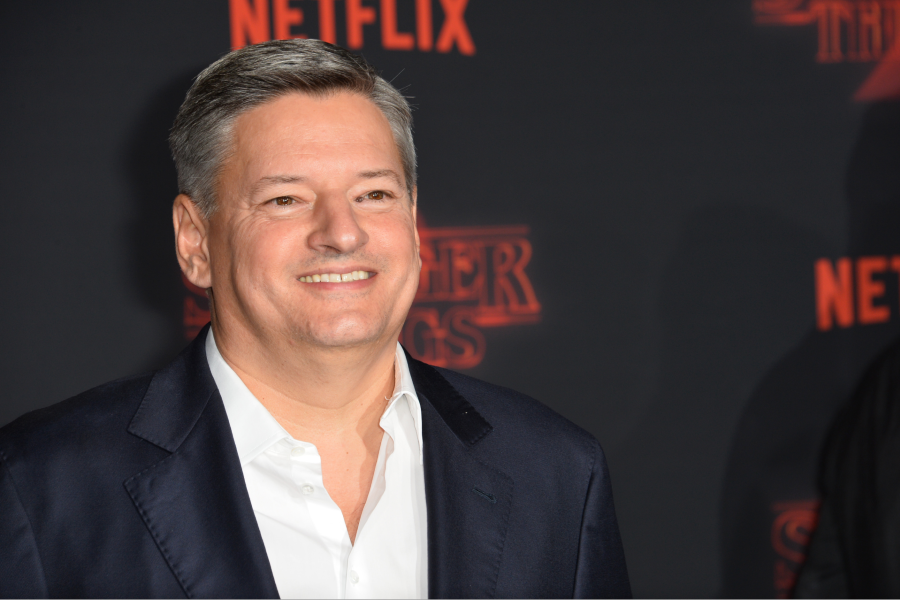
Netflix’s Ted Sarandos: We Were Dealing With ‘Unusual, Irrational’ Competitor in WBD Sweepstakes

On the heels of Netflix declining to match Paramount Skydance’s $31-per-share all-cash ($110.9 billion equity value) bid for Warner Bros. Discovery, Netflix co-CEO Ted Sarandos says the decision to walk away was not a difficult one.

“We definitely wanted this asset; We didn’t need it,” Sarandos told Bloomberg News in an interview.

Paramount is now on the hook to pay WBD $76.9 billion in cash, in addition to assuming upwards of $79 billion in net debt, which includes $57.5 billion in new debt financing, $15 billion to refinance WBD’s existing debt load around $33 billion, and $3.5 billion in bridge financing.

Discovery acquired the former WarnerMedia from AT&T for $43 billion in 2022 to create Warner Bros. Discovery.

Paramount also paid Netflix a $2.8 billion termination fee, in addition to guaranteeing a $7 billion termination fee to WBD, and a $650 million quarterly “ticking” fee should the deal not close by the Sept. 30 deadline.

The outsized fiscal size of the deal and Paramount’s relatively modest finances (outside the funds from Larry Ellison, father of Paramount CEO David Ellison, who is offering $45.7 billion in cash; $24 billion in Middle East sovereign wealth funds; and $54 billion bridge loan from Bank of America, Citi and Apollo Capital) surprised Sarandos.

“Unusual, yeah, unusual, irrational, whatever words you want to use in that,” Sarandos said.  “It’ll be fascinating to see the next steps.”

The executive believes that due to the fiscal levering of the deal, Paramount will fast-forward cost synergies and cuts involving at least $6 billion — which Sarandos believes will result in layoffs and a reduction of content production.

“We were in the books of Warner Bros., and the biggest cost centers are people in productions,” he said. “They are telling people who lend them the money that’s gonna happen in 18 months or so. It would be less production, less people working.”

Sarandos said Netflix’s involvement in the M&A deal involved dealing with 50 regulatory bodies around the world, in addition to the Justice Department and Congress in the United States.

“There are easier ways to make $2.8 billion,” Sarandos quipped.

When asked about Netflix shareholder’s apparent dislike for the WBD asset merger involving Warner Bros. Studios and HBO Max, Sarandos said short-term negative reaction on Wall Street is nothing new to the streamer.

Netflix’s stock price shot up 10% following its withdrawal, and was up 13.7% through midmorning trading on March 2.

“We’ve taken short-term hits for long-term gains in our business many times in our 20 years as a public company. And they worked out pretty well,” Sarandos said.

The executive has no idea if the Paramount deal will pass regulatory muster, adding that it should be scrutinized as much as Netflix was.

“It should be looked at with every bit of the same microscope,” Sarandos said. “Remember, we were asked to go and testify [before Congress]. David and I both were. I came.”

Regardless, Sarandos wishes Paramount well going forward, adding that Netflix will continue licensing content from both Paramount and Warner Bros. Discovery.

“I wish them luck,” he said. “They’ve got regulatory hurdles to clear. Even when we were thinking about keeping these businesses together and running, we knew that we had a difficult task ahead of integration. I can’t imagine doing all that and trying to cut billions and billions of dollars. Today, Paramount has half of the people that they had one year ago. So that gives you some sense of where this is heading for the town and for the business.”

Subscribe HERE to the FREE Media Play News Daily Newsletter!
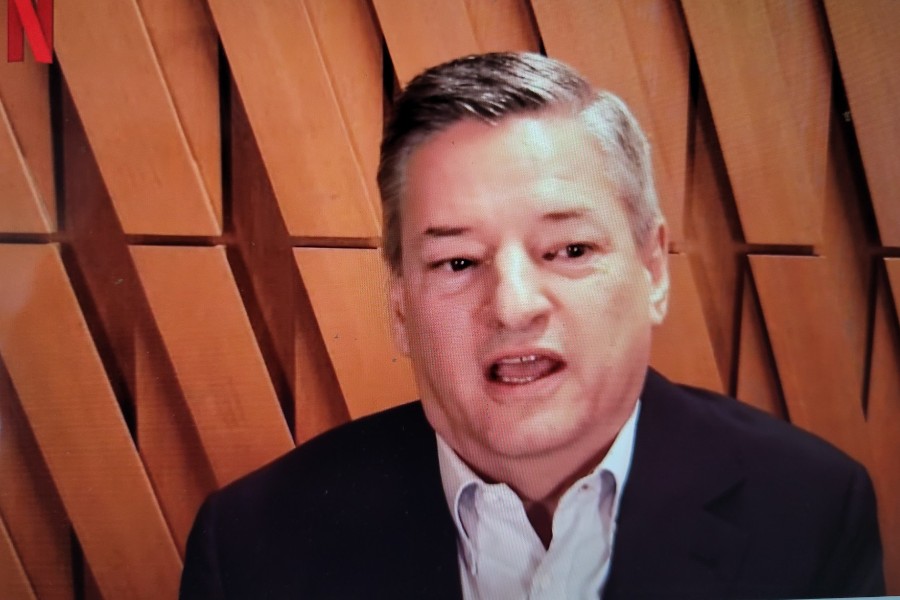
Netflix’s Ted Sarandos to Meet Trump Officials at the White House on Feb. 26

Netflix co-CEO Ted Sarandos is reportedly meeting at the White House with Trump Administration officials on Feb. 26 to discuss issues surrounding the streamer’s accepted $82.7 billion all-cash acquisition of Warner Bros. Discovery’s streaming and studio assets.

As first reported by Politico, the meetings will address President Trump’s social media call for the streamer to fire board member Susan Rice following her negative comments about corporations allegedly “bending at the knee” to the president.

It was not immediately clear if Sarandos would meet with Trump personally.

Sarandos apparently has a cordial relationship with the president, meeting with Trump before his inauguration and last November to discuss the Warner Bros. Discovery deal.

Trump, who initially said he would be personally involved in the transaction, later backed off saying he would remain an observer. That mindset changed on Feb. 21 after Trump saw a social media post from right-wing influencer Laura Loomer, in which she decried comments made by Rice, former U.S. Ambassador to the United Nations and National Security Advisor in the Obama Administration.

“Fire racist, Trump Deranged Susan Rice, IMMEDIATELY, or pay the consequences,” Trump wrote on his Truth Social X account. “She’s got no talent or skills — Purely a political hack! HER POWER IS GONE, AND WILL NEVER BE BACK. How much is she being paid, and for what??? Thank you for your attention to this matter. President DJT.”

Sarandos, in response, downplayed Trump’s comments, arguing the Warner Bros. Discovery transaction is a business decision, not political.

Since then, rival suitor Paramount Skydance has upped its hostile all-cash bid to $110.9 billion, which includes WBD’s television networks. Paramount has also agreed to separately absorb upwards of $11.3 billion in termination fees, penalties and other charges — a stunning pledge considering Skydance Media acquired Paramount Global for $8 billion.

Speaking to British press over the weekend, Sarandos was asked if Netflix would counter a new bid. The executive said the streamer is not dependent upon WBD for its future success, and has a strong history of letting other companies overpay for third-party assets.

If WBD accepts the Paramount deal, Netflix is set to receive a $2.8 billion termination fee.

Subscribe HERE to the FREE Media Play News Daily Newsletter!
Ted Sarandos Downplays Trump’s Call For Netflix to Fire Board Member Susan Rice

Netflix co-CEO Ted Sarandos Feb. 23 downplayed threats made over the weekend by President Trump that the streamer fire board member Susan Rice over her negative comments about him and his administration on a third-party podcast.

Appearing on BBC Radio’s “Today” show, Sarandos, who was in London attending the annual BAFTA Awards, was asked about Trump’s social media post — made after right-wing influencer Laura Loomer posted comments Rice, who was the former U.S. Ambassador to the United Nations in the Obama Administration, made on Preet Bharara’s podcast, “Stay Tuned for Preet” — and how they might impact the streamer’s $82.7 billion acquisition of Warner Bros. Discovery’s streaming and studio assets.

“This is a business deal,” Sarandos told the BBC. “It’s not a political deal. This deal is run by the Department of Justice in the U.S. and regulators throughout Europe and around the world.”

Rice had said that U.S. companies cozying up to Trump might see an undisclosed backlash when the political tide turns.

“For those that decided that they would act in their perceived very narrow self interest, which I would underscore as very short-term self-interest, and take a knee to Trump. I think they are now starting to realize, ‘Wait a minute. This is not popular. Trump is not popular,’” Rice said.

Loomer, in her post, alleged that “anti-American, WOKE” Netflix acquiring Warner Bros. Discovery’s streaming and studio assets would give former President Barack Obama and First Lady Michelle Obama a bigger platform for their “upcoming witch hunts against Trump.”

Netflix has a production deal with the Obamas’ Higher Ground Productions content company, whose recent titles on the streamer include Fatherhood with Kevin Hart; “The Later Daters” reality romance show; the sci-fi drama Leave the World Behind, starring Julia Roberts and Ethan Hawk; and “Our Great National Parks,” among others.

When pressed about Trump’s threat that Netflix not firing Rice could lead to the streaming giant “pay[ing] the consequences,” presumably in its quest to acquire WBD, Sarandos reiterated that the WBD-board’s accepted $82.7 billion offer would grow the digital entertainment market, while sustaining the existing exhibition industry.

“[Trump] likes to do a lot of things on social media,” Sarandos said.

“This is a vertical merger,” he added. “We’re buying a movie studio and a distribution entity that we don’t currently have — we’ll be adding to the market, where Paramount has committed that they’re going to cut $6 billion out of the business right away. This industry will be much smaller under that ownership than it would be under the Netflix version.”

Subscribe HERE to the FREE Media Play News Daily Newsletter!
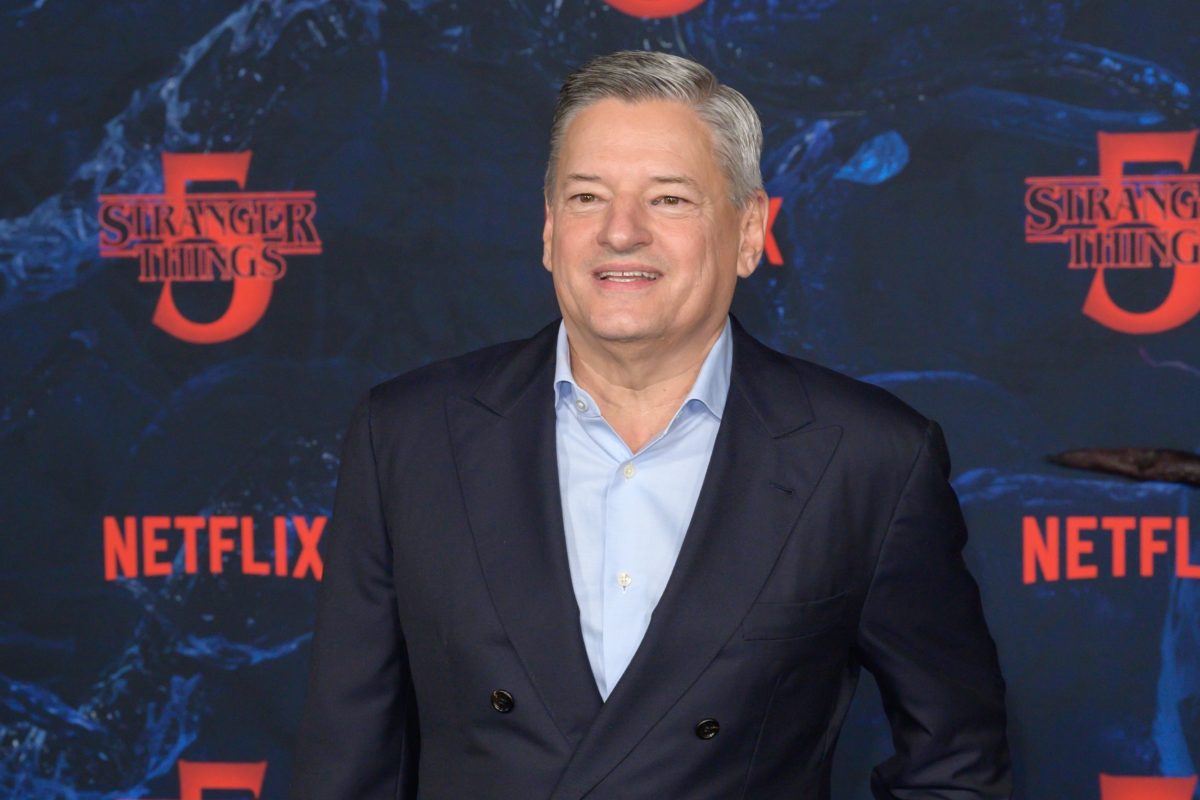
Netflix’s Ted Sarandos to Paramount: Show Me the Money

On the heels of Warner Bros. Discovery’s board’s willingness to revisit Paramount Skydance’s hostile $108.4 billion bid for the entire company, Netflix co-CEO Ted Sarandos, whose company has an accepted $82.7 billion deal for WBD’s streaming and studio assets, came out swinging.

Appearing on CNBC’s “Closing Bell: Overtime,” Sarandos said Paramount has been targeting WBD shareholders with misinformation and “flooding the zone” with confusion after myriad failed attempts to sway the WBD board with its fiscal bids.

The executive said that he and co-CEO Greg Peters agreed to give Paramount seven days to fish or cut bait with its best and final offer.

“We’re certain that the Netflix deal … is the best deal [that] generates the best value for [WBD] shareholders,” Sarandos said. “And [the WBD board]  think so too. That’s why they recommended the deal and why they reiterated recommending that deal post this [period]. So give [Paramount] seven days to put their money where their mouth is.”

Indeed, Paramount has floated the idea of raising its $30-per-share all-cash bid to $31, adding that the new amount might not be their final offer. Last week, Paramount attempted to restart negotiations with WBD by agreeing to pay the $2.8 billion termination fee to Netflix should WBD walk away from its agreement with the streamer, in addition to paying an additional $1.5 billion penalty fee.

Paramount also agreed to pay WBD a $650 million “ticking” fee for every fiscal quarter the transaction does not close after Dec. 31.

When asked how much higher Netflix is willing to go from its current $27.75-per-share all cash offer, Sarandos would not disclose the number.

“Well, that’s not something you typically do with a phone call,” he said. “And I don’t want to get into the hypotheticals of what we do, what — of all these moves. Let [Paramount] make a move and then we will see where the next step takes us.”

Sarandos reiterated that Netflix’s plan for the WBD assets involve largely running the businesses as they are today. Paramount, however, has said it would look to cut $9 billion in synergistic expenses when combining the two studios, while promising to release 30 theatrical releases per year.

“Keep in mind that all the healthy studios have only released about 20 movies a year for some time now, for about five years,” Sarandos said. “And what we want to do is, we’re going to keep those films going and keep them in the theaters the same way they release them today. Remember, we’re buying a revenue stream from both their television studio and their theatrical distribution business, and … we want to keep that intact and grow.”

When asked how Netflix should react to the fact that its shares have lost about 25% in value since announcing its acquisition of Warner Bros. Studios, Warner Bros. Television and HBO Max on Dec. 5, 2025, Sarandos said that the company is coming off a record fiscal year that generated more than $11 billion in profit on revenue of more than $42 billion.

“We grew our revenue 16%. We grew our engagement by a couple of billion hours, including a 9% increase in the viewing of our originals, which is the jet fuel for our business,” Sarandos said. “And we grew our operating income by 30%.”

Paramount, which is set to release year-end financial results Feb. 25, posted a net loss of $13 million on revenue of $4 billion for the fiscal period ended Sept. 30, 2025.

“Our goal here is to make sure that folks know, take the seven days to figure out exactly where they stand. And then, on March 20, there is a vote and they will make the decision,” Sarandos said. “We have a very healthy balance sheet and a very strong business with or without this deal to keep pushing forward at this.”

Subscribe HERE to the FREE Media Play News Daily Newsletter!
Netflix Co-CEO Ted Sarandos Tells Congress WBD Acquisition Is Good for Consumers, Economy

Netflix co-CEO Ted Sarandos Feb. 3 appeared before a U.S. Senate subcommittee hearing touting what he views as the positives surrounding the streamer’s $82.7 billion acquisition of Warner Bros. Discovery’s streaming and studio assets.

The hearing, which addressed the potential impact on competition in media and streaming, also featured testimony from Bruce Campbell, WBD’s chief strategy officer.

In his opening comments, Sarandos said the purchase of Warner Bros. Studios and HBO Max would strengthen the American entertainment industry, preserve choice and value for consumers, and create opportunities for creators.

The executive reiterated that Netflix over the years has created more than 155,000 American jobs, in addition to injecting $225 billion into the U.S. economy. Sarandos said Netflix would honor Warner’s current 45-day theatrical window for new-release movies.

“TV and film have never been more competitive than they are today, and this deal will not change that. Our goal is to win the moment of truth. That’s when Americans sit on their couch, pick up the remote control and decide what to watch. That’s where we compete today,” Sarandos said. “Consumers can easily choose between broadcast and cable, like CBS and so many other networks and streamers like Disney+, HBO Max, Peacock, Paramount+, Tubi. That also includes deep pocketed tech companies who are trying to run away with the television business like Google’s YouTube, Prime Video and Apple.”

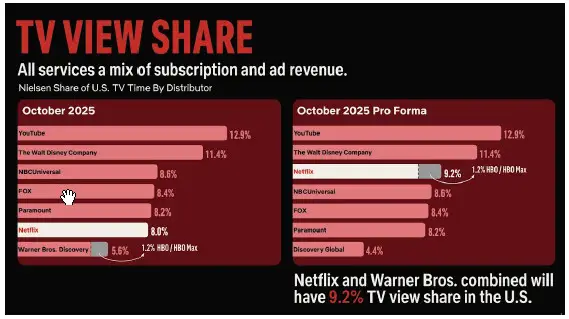
Sarandos explained that YouTube represents growing competition, underscored by the social media video platform’s reigning No. 1 position on Nielsen’s monthly chart of top media distributors across household televisions.

“YouTube is not just cat videos anymore. YouTube is TV,” he said.

Sen. Cory Booker (D-N.J.) questioned whether Netflix’s acquisition of WBD would negatively impact the “tens of thousands” of Hollywood workers by the elimination of movies and TV show productions.

“We know Netflix’s power,” Booker said. “I have concerns about Netflix gaining more power over consumers [and leaving consumers with] fewer options.”

Sarandos said Warner Bros. is both a competitor to Netflix and a supplier of content to the streamer.

“Our history is about adding more [content and choices]” to consumers, he said.

Booker said he was disappointed that Paramount Skydance CEO David Ellison, whose company has submitted a rival $108.4 billion bid for the entire WBD, had declined an invitation to address lawmakers.

When asked by Utah Sen. Mike Lee, a Republican, how YouTube could be considered a competitor to Netflix, Sarandos explained how the Google-owned platform will soon live-stream the Academy Awards show, in addition to last year’s opening NFL game from Brazil.

The executive also pointed out that YouTube content creator Markiplier, the pseudonym of Mark Edward Fischbach, had ranked among the top three at the weekend’s box office.

Subscribe HERE to the FREE Media Play News Daily Newsletter!
Policy Expert Says Netflix’s Acquisition of WBD Is Pro-Consumer

Ahead of Netflix co-CEO Ted Sarandos’ scheduled Feb. 3 appearance before the U.S. Senate Judiciary subcommittee’s antitrust hearing to discuss the streamer’s $82.7 billion acquisition of Warner Bros. Discovery’s studio and streaming assets — and its possible impact on the entertainment industry and consumers — one research group contends any antitrust issue is overblown.

The hearing, titled “Examining the Competitive Impact of the Proposed Netflix-Warner Brothers Transaction,” will feature Sarandos and Warner Bros. Discovery chief strategy officer Bruce Campbell.

Kristian Stout

To Kristian Stout, director of innovation policy at the International Center for Law & Economics, a nonpartisan global research and policy center, any antitrust conversation on Capitol Hill about the deal doesn’t square with the myriad ways people consume entertainment in the modern era.

“Antitrust analysis should reflect how people actually watch video today, not how the industry looked decades ago,” Stout said in a statement.

Stout contends that viewers divide their time across multiple subscription services, ad-supported streaming and open platforms such as YouTube, with minimal friction to navigate between them.

U.S. consumers spend approximately three to five hours per day streaming video content, depending on the measurement criteria used. As of mid-2025, streaming had surpassed traditional broadcast and cable television combined, accounting for more than 47% of total TV viewing time, according to Nielsen.

In 2025, audiences spent a record 16.7 trillion minutes streaming, a 19% year-over-year increase. The average American streams more than 20 hours of content per week.

Households now average roughly 6.9 streaming services, split between 3.9 paid and 2.6 free/ad-supported services, according to Nielsen.

Frequent “binge-watchers” spend an average of three to four hours per day. Approximately 43% of U.S. viewers reported watching more than three episodes of a show in a single sitting.

Notably, 45% of Netflix viewing hours now occur on its ad-supported tier.

“The Netflix–Warner transaction does not signal market power,” Stout said. “Instead, it looks like a pro-consumer response to intense competition in a crowded market where attention — not subscriptions — is the binding constraint.”

Subscribe HERE to the FREE Media Play News Daily Newsletter!

Mr. Sarandos Going to Washington

Netflix co-CEO Ted Sarandos is set to go to Washington, D.C., reportedly in February, to address a U.S. Senate committee’s antitrust concerns ahead of the streamer’s $82.7 billion acquisition of Warner Bros. Discovery’s streaming and studio assets.

The hearing, which will address the potential impact on competition in media and streaming, will also feature testimony from Bruce Campbell, WBD’s chief strategy officer.

Sarandos’ trip to the nation’s capital follows Netflix’s accepted all-cash deal with WBD, which has a rejected $108.4 billion competing bid from Paramount Skydance for all of WBD’s assets, including its television networks.

The U.S. Department of Justice earlier this month launched an expedited in-depth antitrust review (second request issued Jan. 16), pausing the standard waiting period.

The deal, which is one of the biggest media deals, topping Disney-20th Century Fox in 2019 ($71 billion) and AT&T-Time Warner at $85 billion, has drawn the attention of President Trump, whose personal friend, tech billionaire Larry Ellison, is funding a significant portion of the Paramount bid.

Paramount has opposed the deal, calling it “presumptively unlawful” in letters to lawmakers and arguing it would further establish Netflix as the dominant player in Hollywood and the world.

Sarandos has defended the deal, emphasizing it as pro-consumer and pro-innovation, emphasizing Netflix’s commitment to maintaining theatrical windows (45 days for Warner movies).

No direct involvement from Congress on Paramount’s bid is tied to this hearing, but the antitrust focus could indirectly address broader consolidation concerns in Hollywood.

Subscribe HERE to the FREE Media Play News Daily Newsletter!

Ted Sarandos: Netflix Has ‘Made Progress’ Getting Regulatory Approvals for WBD Acquisition

With Netflix revising its accepted $82.7 billion offer for Warner Bros. Discovery’s streaming and studio assets from a mix of cash and stock to all cash, co-CEO Ted Sarandos, speaking on the company’s Jan. 20 fiscal-quarter webcast, said the streamer has submitted all the required regulatory paperwork with the Department of Justice for approval.

The executive said he felt optimistic about clearing federal scrutiny, which will include President Trump, who has said he wants to be personally involved in the proceedings.

“We’ve submitted our HSR (Hart–Scott–Rodino Antitrust Improvements Act) filing. We’re working closely with the WBD and the regulatory authorities, including the Department of Justice and the European Commissions,” Sarandos said.

“We’re confident we’re going to be able to secure all the approvals because this deal is pro-consumer, pro-innovation, pro-worker, pro-creator, and it is pro-growth,” he added.

Sarandos reiterated that in WBD, the deal includes three core businesses Netflix does not currently have, including Warner Bros. Pictures, New Line Cinema, and related film production/distribution operations; Warner Bros. Television Studios, Telepictures, Alloy Entertainment, and other TV production arms, and HBO and HBO Max.

“We’re going to need those teams,” he said. “These folks have extensive expertise and experience. We want to stay an run those businesses.”

Sarandos emphasized that the transaction would expand content creation, instead of collapsing it. He said the deal would enable Netflix to “significantly” expand its production capabilities in the United States, and keep investing in original content over the long term.

“This means more opportunities for creative talent and more jobs,” he said. “This is really a vertical deal for us. It allows us to get access to 100 years of Warner’s deep content and IP for development. And distribution in more-effective ways that will benefit consumers and the industry as a whole.”

Sarandos says HBO is a very complementary business to Netflix, adding that the current TV market is “very dynamic” and “very competitive.”

“The competitive lines around TV consumption are already blurring as a number of services put their content on the linear services and streaming services at the same time,” he said. “More platforms are making their way onto the TV in your living room. TV is not what we grew up on. TV is now about everything.”

Sarandos said that recent moves in the industry — including YouTube’s deal for exclusive access to the Oscars ceremony and the NFL, networks such as Fox Sports simulcasting the recent Super Bowl on Tubi, Amazon’s acquisition of MGM Studios, Apple TV competing for Emmys and Oscars, and Instagram’s move into the scripted entertainment — underscores the rationale for acquiring Warner Bros. Discovery.

“YouTube is not user-generated content and cat videos any more,” he said. “YouTube has full-length films and new TV episodes. The BBC is going to create original content for YouTube. They are TV.

“So, we compete with them in every dimension. For talent. For ad dollars. For subscription dollars. And for all forms of content. Our [WBD] deal strengthens the market place. And it ensures healthy competition. That’s why we’re confident in the approval.”

Subscribe HERE to the FREE Media Play News Daily Newsletter!

Ted Sarandos: Netflix Committed to Warner Bros.’ 45-Day Theatrical Window

Netflix co-CEO Ted Sarandos is continuing his PR campaign to reassure Hollywood and regulators that the subscription streaming video behemoth is committed to the exhibition industry when it closes the $82.7 billion acquisition of select Warner Bros. Discovery assets — despite a history of opposing theaters’ exclusive access to new-release feature films in a 45- to 90-day theatrical window.

In an interview with the New York Times, the 61-year-old Sarandos says his historical aversion to the theatrical window is misunderstood. The executive contends that Netflix has never been against the theatrical business model, arguing instead that until the WBD acquisition, theatrical exhibition has not been part of streamer’s business plan.

“When this deal closes, we will own a theatrical distribution engine that is phenomenal and produces billions of dollars of theatrical revenue that we don’t want to put at risk,” Sarandos said. “We will run that business largely like it is today, with 45-day windows. I’m giving you a hard number. If we’re going to be in the theatrical business, and we are, we’re competitive people — we want to win. I want to win opening weekend. I want to win box office.”

Since the inception of Netflix’s pioneering SVOD business, Sarandos has argued that the theatrical window is outdated, inefficient and misaligned with modern consumer preferences for immediate access to video entertainment at home.

“The studios and the theaters are duking it out over trying to preserve this 45-day window that is completely out of step with the consumer experience of just loving a movie. … It’s an outdated concept,” Sarandos said in April.

In 2024, Sarandos said that “audiences don’t care about windows at all. They never talk about it over dinner.”

The executive’s comments have drawn backlash from theater owners, studios, and some filmmakers (Christopher Nolan, Steven Spielberg) who view Netflix as a threat to the moviegoing experience and box office revenue.

The stance has also threatened Netflix’s accepted offer for Warner Bros. Studios and HBO Max, which may need to pass the Trump Administration’s DOJ scrutiny regarding antitrust issues.

In December, Sarandos offered a more nuanced take on theatrical exclusivity, arguing that the window should be predicated on individual movies — an approach already embraced by most studios, including Universal Pictures, which has shortened the theatrical window to less than 17 days depending on the initial box office.

“I think, over time, the windows will evolve to be much more consumer friendly, to be able to meet the audience where they are quicker,” Sarandos said in a separate interview.

The executive says the theatrical window is only effective in markets with a strong exhibition presence. The industry has reportedly lost more than 2,000 screens since the pandemic.

Sarandos said he believes Netflix is “saving Hollywood” by adapting to streaming dominance, but critics accuse him of undermining theaters.

When asked by the Times whether he regretted labeling the theatrical business as an “outmoded idea,” Sarandos said the comment has to be framed within the context of market reality.

“I said ‘outmoded for some,'” Sarandos said. “I mean, like the town that Warner’s Sinners is supposed to be set in does not have a movie theater. For those folks, it’s certainly outmoded. You’re not going to get in the car and go to the next town to go see a movie. But my daughter lives in Manhattan. She could walk to six multiplexes, and she’s in the theaters twice a week. Not outmoded for her at all.”

Subscribe HERE to the FREE Media Play News Daily Newsletter!

Netflix Co-CEOs Hail WBD Acquisition as ‘Consumer, Industry Win’ in Staff Letter

Netflix co-CEOs Ted Sarandos and Greg Peters, in a Dec. 15 staff letter, reiterated why the streamer’s pending $72 billion acquisition of the studio and streaming assets of Warner Bros. Discovery is good for Hollywood.

The “five-minute read” letter aimed to give employees clarity and understanding around strategic bets/issues, and a “heads up” on important news surrounding the landmark deal.

Specifically, Sarandos and Peters said they feel confident that Netflix’s accepted Dec. 5 offer by WBD’s board and CEO David Zaslav is pro-consumer, pro-innovation, pro-worker, pro-creator and pro-growth.

The executives addressed ongoing industry concerns that the transaction would undermine the legacy theatrical business, countering statements by Sarandos in April suggesting that the movie theater business is outdated.

“The studios and the theaters are duking it out over trying to preserve this 45-day window that is completely out of step with the consumer experience of just loving a movie,” Sarandos told the Time100 Summit in April. “Folks grew up thinking, ‘I want to make movies on a gigantic screen and have strangers watch them play in the theater for two months.’ It’s an outdated concept.”

In the letter, Sarandos and Peters said they remain “fully committed” to releasing Warner Bros. movies in theaters, just as the legacy studios does today.

“Theatrical is an important part of their business and legacy, and we don’t want to change what makes Warner Bros. so valuable,” read the letter. “If this deal had happened two years ago, hits like A Minecraft Movie and Superman would still have premiered on the big screen as they did — and that’s how we plan to keep it.”

The executives said Netflix has not prioritized theatrical distribution in the past because that wasn’t the streamer’s business.

“When this deal closes, we will be in that business,” read the letter.

Separately, the co-CEOs said Paramount Skydance’s $108.4 billion hostile counter offer for the entire WBD was “entirely expected,” and they believe Netflix’s accepted deal is “solid” and great for shareholders, consumers, and the industry.

“It’s a strong way to create and protect jobs in the industry,” read the letter. “We’re confident we’ll get it over the finish line — and we’re genuinely excited about what’s ahead.”

Subscribe HERE to the FREE Media Play News Daily Newsletter!

From Around the Web