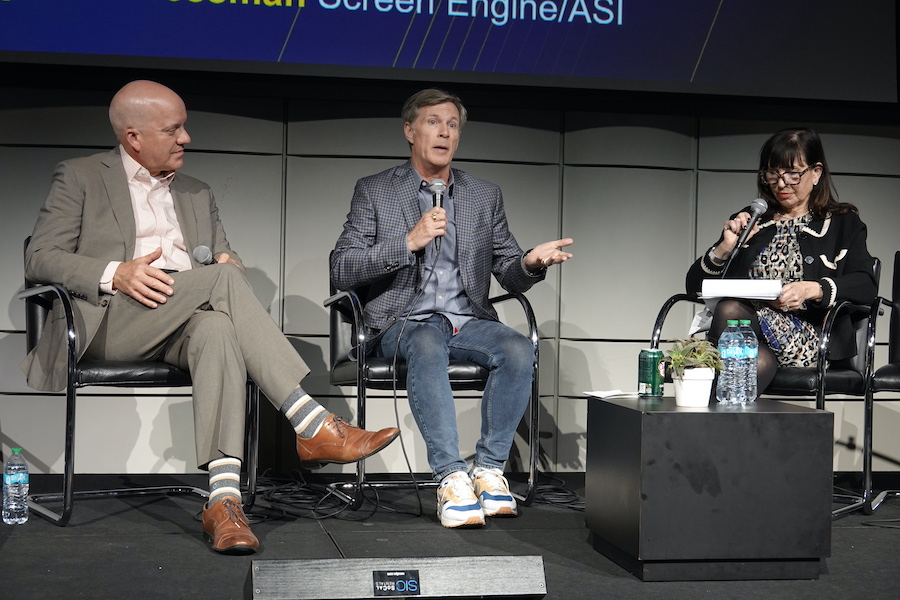
Building a passionate audience is the key objective at direct-to-consumer services Angel Studios and Fandango, executives said Feb. 25 during DEG: The Digital Entertainment Group’s EnTech Fest conference at the Skirball Cultural Center in Los Angeles.
“We want audiences to care,” said Thomas Hughes, EVP, head of distribution strategy and global partnerships at Angel Studios. “That’s our difference, is to bring audiences in and have them invest in what we do.”
Angel, which he noted has 2.1 million members, is based on a unique model where members vote on films greenlighted and, for a monthly fee (from $12 to $20), are offered tickets to its theatrical movies and access to its a streaming service.
“Nobody [in the executive suite] decides what gets made at Angel; the audience decides,” Hughes said. “Every film, even a licensed film. These days we have licensed films with partners like Lionsgate on our platform, and those films — even if it’s been out for 15 years — they go in front of our audience and the audience chooses whether or not we put our name on it.”
Cameron Douglas, who is SVP of OTT/Streaming for Fandango and heads the company’s transactional (digital sale and rental) streaming service Fandango at Home, agreed that, as at Angel, the audience connection at Fandango is all important.
“We both address very passionate audiences, just in a very different way,” he said.
“I think what’s happening now is the ultimate goal of Fandango being synonymous with fandom. Whether you’re seeing something in the theater or at home — then Fandango will be able to support you,” he added.
Fandango was recently spun off from Comcast under the Versant Media Group monicker.
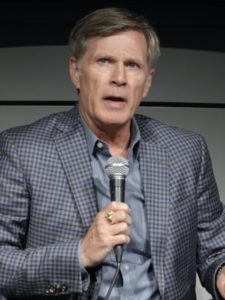
“[Versant] is managed under four pillars. Political news and opinion. Business news and personal finance. Golf and sports participation. And then sports and genre entertainment and that’s where Fandango is part of that portfolio,” Douglas said. “Now each of those have very passionate audiences. … But Fandango I’d say has the most traditional passionate fan base. That could be the guy who always wants to see opening weekend premium movies coming out at the theater. That could be the person that wants to collect the next superhero movie on Fandango at Home when it comes out, and they’d be willing to pay $20 for that. That is the dad that just wants to have a family night with his kids and go out to the theater. He actually organizes that and buys the tickets through Fandango. That is the fandom that we are talking about, and that’s what we’re leaning into going forward.”
That isn’t to say each of the services works alone.
“With the help of partners like Fandango at Home we distribute well beyond our own platform,” Hughes said. “But we don’t make movies. We don’t develop movies. People bring us movies and series that either go into theaters if it’s a movie or on our platform if it’s a series, and then we do full distribution downstream. We are licensing to third parties, to SVOD platforms in many instances, and again working with transactional partners like Fandango at Home to unlock other revenue streams for these filmmakers. We do it a little bit differently in that we don’t take a distribution fee. … We only participate in the profitability when it becomes profitable.”
Douglas agreed that partnerships are key.
“We identify organizations like Angel Studios that are willing and interested in working with us both with theatrical and at Home entertainment that we’ve built where they can lean into the power of what we can do to market their films,” he said.
At Fandango, the new spin-off company also offers new opportunities, buttressed by the existing flat, but stable, transactional digital entertainment business, Douglas said.
“If we’re looking at who we serve now, we own the transactional customer,” he said. “We have this great ticketing business. We have 41 million addressable consumers every month. We have hundreds of millions of hours consumed on Fandango at Home every year. … Basically that is our current audience.”
The cable channels that came along with Versant also offer new opportunities in the Fandango at Home DTC ad-supported marketplace.
“It is well known that the cable audience is declining and there is a passion for what that traditionally has been, which is an ad-supported business, to go into streaming and digital,” Douglas said. “We’ve always had a nascent AVOD and FAST component at Fandango at Home, post Vudu, but we haven’t invested in it.”
The new, smaller organization at Versant “allows us to focus and make investment in relaunching essentially later this year our FAST business” with these cable assets’ content, including reality and true crime content.
“What actually came along with the spinoff is Versant now has a vast library of originals produced by E! and Syfy and Oxygen, etc. — a lot of reality, a lot of true crime,” he noted. “And true crime is huge in AVOD.”
That kind of ad-supported programming has growth potential, he noted.
“That is really the growing part of the business because the transactional part of our business, which we are very successful at, is a mature market,” Douglas said, noting that Fandango has added PPV and cable TVOD capabilities that also allow it to enter the live streaming market.
Still, attracting and keeping a passionate viewer is the top challenge, both said.
“[The key is] finding customers and keeping them,” Hughes said. “We believe a number of our members believe in us causally, but at the end of the day people want to be entertained, and there has to be enough entertainment value there to extract their money on a month in month out basis. That’s the challenge.”
Subscribe HERE to the FREE Media Play News Daily Newsletter!