DEG EnTech Keynote: Netflix’s Ad Chief Says Viewer Experience Is Most Important

Preserving the quality of the subscriber experience at Netflix is key as the service considers its advertising plan, said Amy Reinhard, Netflix’s president of advertising.

“For us the viewer or member experience is by far the most important thing,” she said during a keynote speech at DEG: The Digital Entertainment Group’s EnTech conference Feb. 25 at the Skirball Cultural Center in Los Angeles.

“We want to make sure we are the first SVOD service that people are logging into,” she said. “We know we’re that last service that people want to cancel so making sure that members keep coming back onto the service to watch that great variety and quality of content is very, very important. At the same time, we think that is very important to advertisers because they want our members to have a really great experience.”

Consequently, Netflix pays head to how members experience ads, she said.

“When we think about things like ad load, we take a long-term view on ad load. We think it’s very, very important that the ad load is light,” she said. “We think about things like frequency capping. We think there’s nothing more frustrating than getting onto a platform and being shown the same ad, the same creative four or five times in a row. So we’re very, very picky about making sure that that member experience is fantastic. And at the end of the day that’s really relevant for advertisers.”

Reinhard also discussed the various franchise tie-ins employed by the service.

“I love our brand marketing,” which has fandom at its heart, she said. She pointed out the Dove soap tie-in with “Bridgerton.”

“It feels very authentic, leans into the brand attributes,” she said.

She also cited the Cheetos tie-in with “Wednesday,” which included the character Thing having Cheetos fingerprints.

The tie-ins are designed to feel “really authentic to the user,” she said.

Reinhard also discussed the company culture and leadership philosophy, saying it’s about “making sure as leaders that you’re not micromanaging.”

“I always think from a leadership perspective, it’s important to hire people who are smarter than us,” she said.

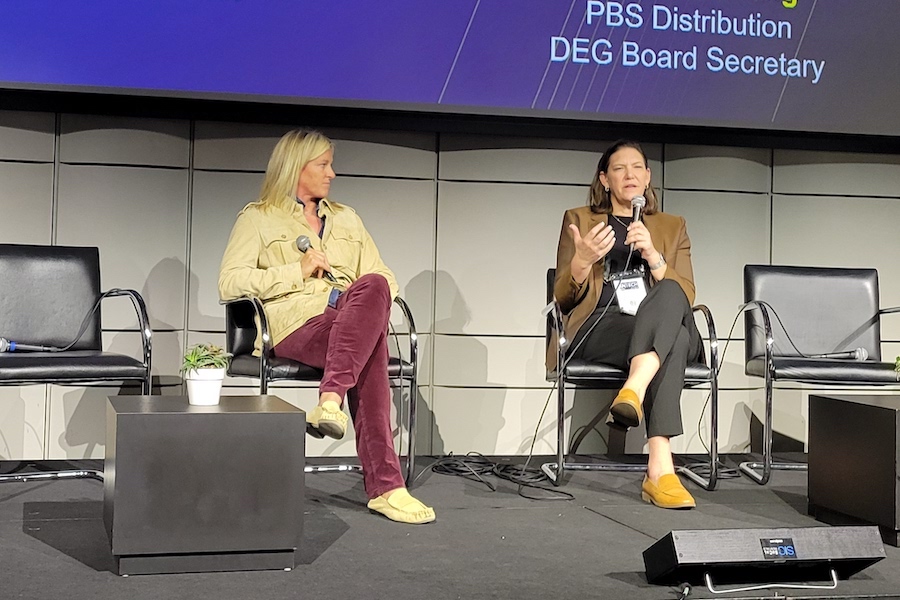
Moderator Andrea Downing, president of PBS Distribution and DEG board secretary, asked Reinhard about the qualities needed for leadership.

“The best leadership advice that I’ve ever gotten came from Ted [Sarandos, Netflix co-CEO],” Reinhard said.

Reinhard said he noted that early in your career you move up because you are an expert, but later, “as you move up it really becomes about being a leader of leaders,” she said. It’s about “communication and collaboration.”

She also stressed the need to be flexible.

“You need to be OK with change,” she said, noting the numerous reorganizations the company has experienced.

Downing also broached the subject of artificial intelligence.

“I am excited about AI,” Reinhard said. “We can be fearful, or we can lean into it. And I take the latter approach.”

She said AI promised productivity gains.

“It will enable us to do more things quicker,” she said, adding “the human creativity is really, really important and we want to make sure we keep that.”

She noted that AI might help with quick production turnarounds.

“This is an area where, given my production background, I’m very excited about dovetailing the opportunities there,” she said.

She cited the surprise success of KPop Demon Hunters.

“We never could have imagined that it was gonna be the kind of cultural phenomenon that it was,” she said.

AI could allow for quick turnaround of marketing, she said, noting that in the past a spot could take six to nine months to produce.

“I think with AI we are able to jump on those kind of opportunities much more quickly,” she said.

Reinhard said Netflix’s move into sports and live event programming was more about creating buzz then boosting advertising.

“Sports is not something that we went into because of advertising,” she said. “It really started with a programming approach.”

Events such as the Jan. 24 free solo climb by Alex Honnold of the 1,667-foot Taipai 101 skyscraper in Taiwan are about “being able to make sure it’s a must watch experience so people tune in at that time,” she said.

“We want to drive big audiences,” she said, noting that the first foray into this strategy was the Mike Tyson-Jake Paul boxing battle.

In addition to the “must watch” experience, the programming team also thinks about the ability to drive the conversation.

The aim is “seeing the social conversation for days, sometimes even weeks after the event,” she said.

“We want to own Christmas Day,” she said of Netflix’s holiday NFL lineup, because families are together on that day.

The service is expanding beyond U.S. sports as well, she said.

Subscribe HERE to the FREE Media Play News Daily Newsletter!
Entertainment in a Brand World

For a century, the relationship between brands and entertainment was simply transactional. We called it “the commercial break.” Brands paid for the privilege of interrupting our stories, hoping that a short intrusion would earn enough loyalty to move a product off the shelf.

That era is dead.

Rob Tonkin

In a world of infinite choice and zero patience, “interruption” has been replaced by “destination.” Hollywood’s gatekeepers no longer hold the exclusive deed to the “greenlight.” The power has shifted to those who hold the capital and the culture. Today, the most ambitious stories aren’t always being told by studios seeking a box office hit; they are also being told by brands seeking a soul. We have moved from Sponsorship to Studio. The future of entertainment is self-liquidating: a world where the “ad” is so valuable that the audience pays to see it, shares it, and lives within it.

Product to Personality

To understand this evolution, we must first redefine the “brand.” In the 20th century, a brand was a product or a service — a static promise of quality. Today, a brand is a living entity, and products have personalities. It can be a corporate giant like Nike, a person like Tom Brady or Pharrell Williams, or a personality like the unhinged Duolingo owl. Even a meme — a fleeting unit of cultural energy — is a brand.

In a brand world, “celebrity” is the marketing department, and the “product” is the ticket to entry. Whether it is a luxury house, a creator on OnlyFans, or a viral joke, a brand is simply a vessel for a story that people want to belong to.

Long-Form Narrative

In the early decades of the 20th century, the airwaves were a quiet, experimental frontier. When radio began to hum to life in living rooms across America, the relationship between commerce and art was a subsidized arrangement. Families would gather around a heavy wooden cabinet, waiting for the vacuum tubes to cast a warm amber glow behind the dial. As the static cleared, a human voice would emerge, but it wasn’t alone.

Procter & Gamble and Colgate-Palmolive didn’t just want to sell soap; they wanted to buy time. They understood that if they provided the capital to keep the “lights on,” they could whisper their messages during the intermission. This was the dawn of the “age of the patron,” a time when the “soap opera” was engineered — not in a writers room in Hollywood, but in the marketing departments of household cleaners. The brand was the silent landlord of the airwaves, happy to stay behind the velvet rope as long as the sponsor’s name was on the marquee.

As the century turned toward the neon glow of the 1980s and ’90s, that polite distance began to dissolve. Brands realized they could no longer just stand next to the story; they had to become a character within it. This was the “age of the guest.” Pepsi-Cola shattered the mold by taking massive leaps, betting millions on icons like Michael Jackson and Britney Spears to create commercials that felt like high-budget music videos rather than sales pitches. This spirit reached a fever pitch when a bag of Reese’s Pieces became a literal plot point in Steven Spielberg’s E.T. Soon, brands weren’t just guest starring in films; they were building their own traveling festivals. We saw the rise of music sponsorship, in which the brand was the curator of the experience. The Vans Warped Tour and the Honda Civic Tour weren’t just logo placements; they were fully integrated cultural movements. Fans didn’t feel “advertised to” — they felt like they were part of a brand-sanctioned tribe. The product became the subculture’s parallel.

By the mid-2000s, Red Bull took this further, proving a brand could become a global media conglomerate. Through Red Bull Media House, they didn’t just sponsor extreme sports; they owned the record labels, the film studios, and the cultural events themselves. When Felix Baumgartner jumped from the edge of space, the world didn’t see an advertisement; they saw a brand-owned intellectual property that generated its own revenue. The marketing had begun to self-liquidate.

In 2026, we have entered the Age of the Architect. High-level entertainment executives have moved from major studios into corporate roles at retail giants like The Gap. They aren’t there to make and buy spots; they are there to treat a clothing line like a media franchise. In this landscape, traditional talent agencies like CAA and WME have reinvented themselves as “venture architects,” building equity-based empires for talent that bypass the traditional studio “greenlight” entirely.

This shift has signaled the death of the traditional brand ambassador. The static, polished celebrity spokesperson of the past has been replaced by the influencer — a cultural translator who doesn’t just “pose” with a product, but integrates it into a raw, daily narrative.

However, the most radical shift in this new world is the move from “polished perfection” to the “friction economy.” Brands have discovered that in a world of infinite content, the only way to pierce the cynicism of the scroll is to create a moment of genuine, jagged discomfort. This is the weaponization of rage-baiting and cringe-baiting. A “brand studio” today might release a sixty-second “prestige mini-drama” in which the protagonist commits a social “crime” — perhaps wearing socks with sandals or eating pizza with a fork. The “rage” ignites the algorithm, as thousands flood the comments to correct the behavior, inadvertently catapulting the video into the feeds of millions. To seal the deal, the brand leans into the “cringe,” releasing content so intentionally awkward or “unhinged” that it bypasses consumers’ defensive filters.

As the public grows weary of algorithmic feeds, the conversation is moving underground into “shadow channels” — platforms like Patreon, Fansly, and OnlyFans. This is the most complex frontier of the brand world. These platforms were pioneered by an explicit, adult industry where “shadow culture” mastered the art of the one-to-one connection. It is a dark and direct economy where pornographic enablers proved that intimacy is the ultimate self-liquidating product.

The infrastructure for this new world is the “digital mall.” Streaming giants like Netflix and Amazon have become the malls — neutral spaces providing the infrastructure for traffic — while FAST Channels (free ad-supported streaming TV) and social media act as the storefronts. While these entities exist on different technical planes, they function as a single economic ecosystem: Streamers provide the “real estate” of attention, while brand-owned channels and social feeds serve as the dedicated “storefronts” where the actual transaction of culture — and commerce — takes place. We see this play out with “anchor tenants” who no longer wait for a network invite. Red Bull TV owns its own 24/7 channel on Roku and Vizio, while Starbucks Studios places its “flagship store” inside the Netflix mall to capture a massive reach. Even in gaming, Nike built Nikeland as a persistent boutique within the virtual mall of Roblox.

In the gaming worlds of Fortnite and Roblox, this cycle completes itself. Players now pay real money for digital “skins” to fit out their avatars in Nike or Balenciaga. The “ad” has become a profit center. The space between a “cringe” laugh and a checkout button has evaporated.

The brands that succeed are those that realize they must act like studios first and marketers second. They must protect the narrative — even the uncomfortable parts — at all costs. The most successful entertainment company of 2030 may not be a legacy studio in Los Angeles; it might be a brand — whether it is a person, a product, or a meme — that finally realized it was a storyteller all along.

Survival of Art

The risk is that the production feels too contrived — where the corporate influence becomes overly obvious, and the art seems like just a checklist. But in today’s friction economy and era of private access, true authenticity isn’t about the perfect pitch; it’s often found in the imperfect moments. When a brand can get past its own “cringe” and find a place in your private subscription feed, it stops feeling like an outsider. Instead, it becomes a meaningful part of the story you tell about yourself.

Subscribe HERE to the FREE Media Play News Daily Newsletter!

Luma AI Announces Advertising Creative Competition

Luma AI has announced The Luma Dream Brief, a global creative competition inviting advertising creatives to bring their best unmade ideas to life, with a grand prize of $1 million to be awarded to creative work using Luma AI that wins a 2026 Cannes Lions Gold Lion.

Developed in collaboration with experiential and creative agency DE-YAN, The Luma Dream Brief challenges creatives to use Luma AI’s platform to create fully realized commercials for Luma itself. At its core, The Luma Dream Brief is built around a familiar industry truth: some of the most ambitious ideas never get made — not because they lack originality, but because they are perceived as too risky, too expensive, or too difficult to visualize, the company notes. By pairing creative ambition with Luma AI’s powerful AI tools, the competition gives creatives greater control, predictability, and craft in AI-generated commercials, advertisements, and content.

“A lot of great advertising never gets made,” Caroline Ingeborn, COO of Luma AI, said in a statement. “The Dream Brief is about removing those constraints and letting creatives prove what’s possible when ideas set the ceiling.”

“Almost everyone in advertising has an idea they loved that never saw the light of day,” Jason Kreher, chief creative officer at DE-YAN and former creative leader at Wieden+Kennedy, Maximum Effort, and Accenture Song, said in a statement. “That shared frustration became the insight behind this project. Rather than fearing how generative AI might change our industry, this is a chance to understand it, by using it to make something that previously had no path to being real.”

The Luma Dream Brief will roll out in multiple phases, beginning with a launch week featuring original films created with Luma AI. Creatives will then be invited to submit their own commercials through The Luma Dream Brief website by March 22.

In line with Cannes Lions’ rules, Luma AI will provide a brief to ensure the work is legitimate and created for a real client. Removing one of the most common barriers between bold creative ideas and real awards consideration, selected finalists will receive paid media support to ensure that the work has launched publicly and has run within the required eligibility period. Submissions will be reviewed by a jury of leading voices in advertising and culture.

The Luma Dream Brief is open to creatives worldwide, with submissions required to be created using Luma AI. Full rules, eligibility criteria, and submission details will be available at www.LumaDreamBrief.com.

Subscribe HERE to the FREE Media Play News Daily Newsletter!

Roku, iSpot Bringing Outcome-Based Optimization to Ad-Supported Streaming

Roku Jan. 6 announced an expanded pact with iSpot technology to help third-party advertising brands achieve more-accountable, performance-focused campaign results on the Roku platform.

Roku advertisers can now use iSpot-attributed outcomes to track return-on-investment, adjust creative strategies, and help drive business results, such as Web conversions. Early testing showed strong results, including a 23% increase in ad leads and a 31% increase in website visits, according to Roku.

“Our expanded partnership represents an important step in our mission to give advertisers the most effective and measurable streaming advertising solutions,” Miles Fisher, senior director of strategic advertising partnerships at Roku, said in a statement.

The optimization features build on the data and measurement partnership first announced in 2024.

“This deeper integration with Roku marks a key moment for outcome-based streaming,” Stuart Schwartzapfel, EVP of media partnerships at iSpot, said in a statement. “We’re not just measuring performance; we’re helping drive it, ensuring advertisers gain new levels of efficiency and ROI directly on the Roku platform.”

Roku, which helped launch the SVOD market in the United States with Netflix, reports that more than 80 million U.S. households owned a Roku device through Sept. 30. The platform topped 90 million streaming households in January 2025.

Subscribe HERE to the FREE Media Play News Daily Newsletter!
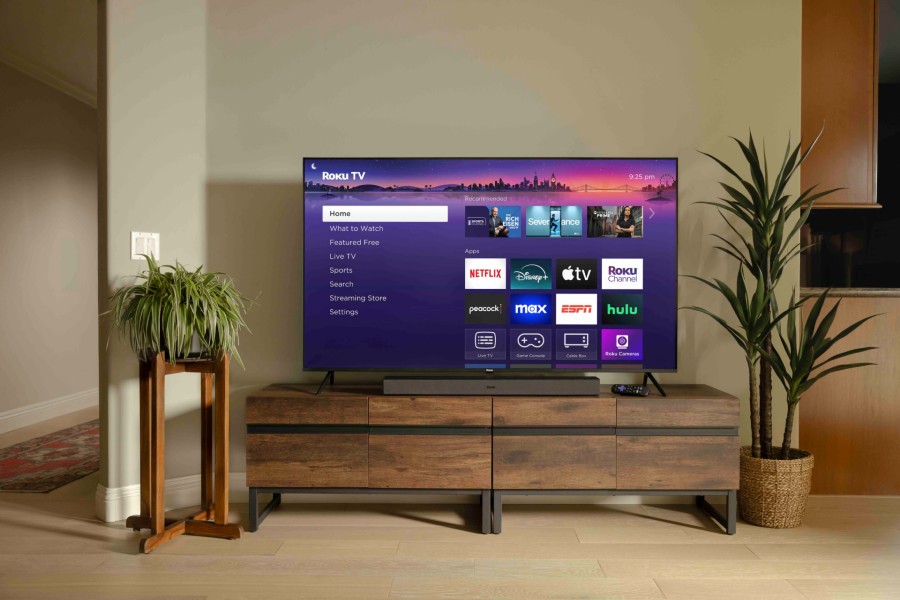
Xumo Launches New ‘Identity’ Software to Help Third-Party Advertisers

Xumo, the streaming joint venture between Comcast and Charter Communications, Jan. 5 announced the launch of a new advanced identity software designed to help advertisers better connect with audiences across the platform’s streaming inventory.

Xumo reports it can now offer advertisers more effective audience targeting, improved campaign measurement, and enhanced transparency, all while respecting consumer privacy.

By combining verified third-party data sources with Xumo’s streaming footprint spanning devices, smart TVs and ad-supported channels, the enhancements empower agencies and brands to maximize ROI and achieve better outcomes across their streaming investments.

“We built this solution alongside industry data and identity innovators to deliver measurable outcomes for advertisers,” Jiro Egawa, SVP of platform growth and monetization, said in a statement.

Working with credit source TransUnion, online ad facilitator The Trade Desk, and SaaS company LiveRamp, Xumo hopes to ensure that advertisers can activate data seamlessly, more confidently and at scale.

“Advertisers need solutions that balance precision with privacy, and that’s exactly what this collaboration delivers,” Julie Clark, SVP of media and entertainment at TransUnion, said in a statement.

Xumo’s identity infrastructure brings together proprietary viewership data across its free ad-supported streaming TV (FAST) channels, household and demographic data from TransUnion, third-party identifiers from The Trade Desk, and LiveRamp for secure, privacy-conscious data activation

The collaboration promises a “smarter,” more accurate identity layer for richer ad requests, higher match rates, and more measurable impact for advertisers, according to Xumo.

Subscribe HERE to the FREE Media Play News Daily Newsletter!
Gracenote Content Connect Launches for Ad Targeting

Nielsen’s Gracenote is aiming to enable better connected-TV ad planning, buying and reporting with the launch of Gracenote Content Connect.

The new platform provides agencies, brands, supply-side platforms (SSPs) and demand-side platforms (DSPs) access to Gracenote’s standardized program-level metadata to facilitate precise program-level ad targeting, better CTV campaign performance and transparent post-campaign reporting.

Media buyers can use Gracenote Content Connect in a range of ways to suit their workflows. They can either directly access the platform for “hands-on-keyboard” creation of private marketplace (PMP) and programmatic guaranteed (PG) deals, or they can leverage their partner SSPs or DSPs to create, manage and activate deals on their behalf. 

The platform taps Gracenote’s proprietary content ID graph made up of standardized program metadata organized in a structured taxonomy and connected by unique identifiers. This ensures both ad buyers and sellers are using a common language in relation to programming, a key necessity when shows are widely available across different ad-supported CTV platforms and services. 

“Gracenote data is widely recognized as the media industry’s gold-standard for powering consumer entertainment search and discovery broadly,” Kanishk Prasad, VP of product at Gracenote, said in a statement. “By opening up access to content-based signals which enable smarter CTV ad targeting and better campaign performance, we’re taking a big step towards giving advertisers transparency, control and maximum scale across all CTV platforms.”

With visibility into key content signals such as genre, rating and mood, users can bid on CTV inventory and target messages at the program level. This gives them full control over brand safety and ensures privacy-compliant placements while still delivering the scale needed to meet campaign objectives, according to Gracenote.

Gracenote will preview the new Content Connect platform at CES running January 6-8, 2026, in Las Vegas.

Subscribe HERE to the FREE Media Play News Daily Newsletter!

Samsung Ads Touts Engagement on Trivia Spots in Europe

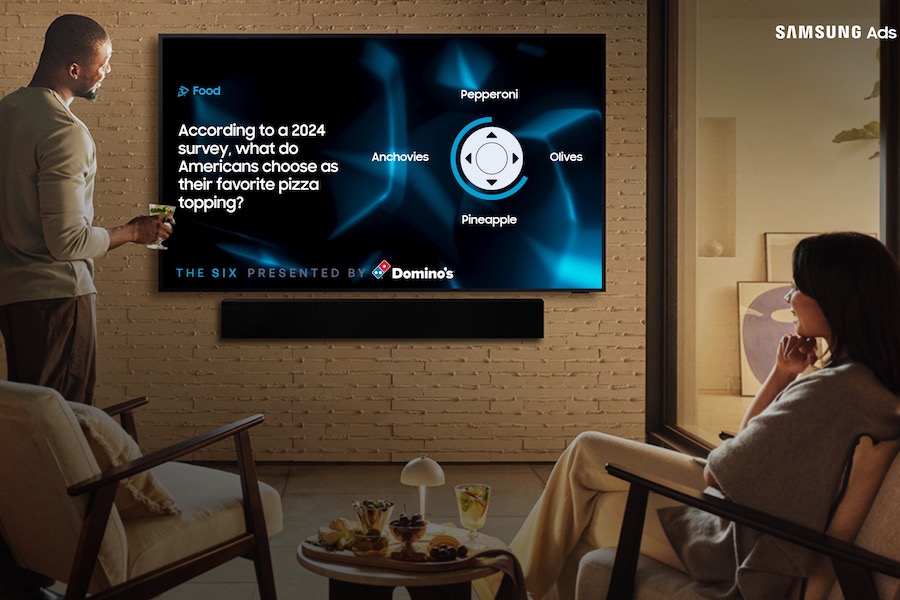
Samsung Ads, the advertising arm of Samsung Electronics’ media division, Domino’s Pizza and Havas have released results of the first European advertising campaign to use Samsung Ads’ GameBreaks ad unit, which replaces the conventional ad with a branded, remote control-powered trivia quiz or game. The campaign delivered an engagement rate of 3.84%, and a 31% uplift in brand consideration.

The Domino’s campaign presented viewers with a pizza-related trivia question: “According to a 2024 national survey, what do Americans choose as their favourite pizza topping?”, along with four possible answers. Viewers could select their answer using the TV’s remote control, with an onscreen message telling them if they were right or wrong (The answer was pepperoni). The quiz section was then followed by a 10-second section promoting Domino’s Ultimate Gunpower Chicken pizza, part of the Ultimate Indian Feast.

The results mirror those of an independent study of GameBreaks ads carried out by MediaScience in the United States, which found they deliver a 53% lift in unaided brand recall, outperforming standard video ads by 1.5 times. The study also found that 89% of viewers preferred GameBreaks over traditional commercial breaks. 

GameBreaks launched earlier this year, initially in the United States and Canada, rolling out to the United Kingdom over the summer. Advertisers can customise trivia questions, themes, and design elements within GameBreaks ads to align with campaign goals. 

“Domino’s has always been something of a crowd-pleaser and this impacts consideration which, in turn, impacts purchase intent,” Harry Packshaw, head of AV at Domino’s media agency, Havas, said in a statement. “There’s a lot of data to show how gamification moves the dial on brand metrics so it was no surprise to us to see that the campaign was so warmly received and performed so well.”

“Interactivity is at the heart of CTV, so there’s no reason why the ads should not also embrace the idea,” Lauren Barnett, head of U.K. sales at Samsung Ads, said in a statement. “We’re delighted, though not surprised, at the success Domino’s have seen with their GameBreaks campaign and we look forward to working with them on more in the future.”

Subscribe HERE to the FREE Media Play News Daily Newsletter!
How Streamers Can Win Thanksgiving Week: What CTV Promotions Reveal About the Next Big Battle for Attention

Every November, the entertainment industry hits its version of the Super Bowl.

Francesca Pezzoli

Thanksgiving week is no longer just a retail battleground. It’s one of the most valuable media windows of the year, where live sports, blockbuster streaming premieres, and Black Friday subscription deals converge on the biggest screen in the home: television.

According to Samsung smart-TV viewership data, streaming activity jumps 11% during Thanksgiving week compared with average non-holiday weeks. With audiences off work, on the couch, and primed to browse, the Thanksgiving window has become a high-stakes promotional moment for streamers, studios and sports leagues.

To understand what actually worked in 2024 and what will shape a competitive advantage in 2025, Looper Insights analyzed promotional activity on major connected TV platforms, evaluating thousands of placements using its MPV (Media Placement Value) metric, which measures on-screen visibility, and $MPV (Dollar MPV), which assigns an equivalent media dollar value based on placement prominence.

Our “Thanksgiving 2025 Playbook” report reveals a new truth about streaming success during peak windows: Visibility is currency. If audiences can’t see the content title, they can’t click, stream, rent or subscribe.

The NFL Dominated the Screen

Thanksgiving has always belonged to the NFL, but on connected TVs, the league didn’t just win viewership; it won real estate.

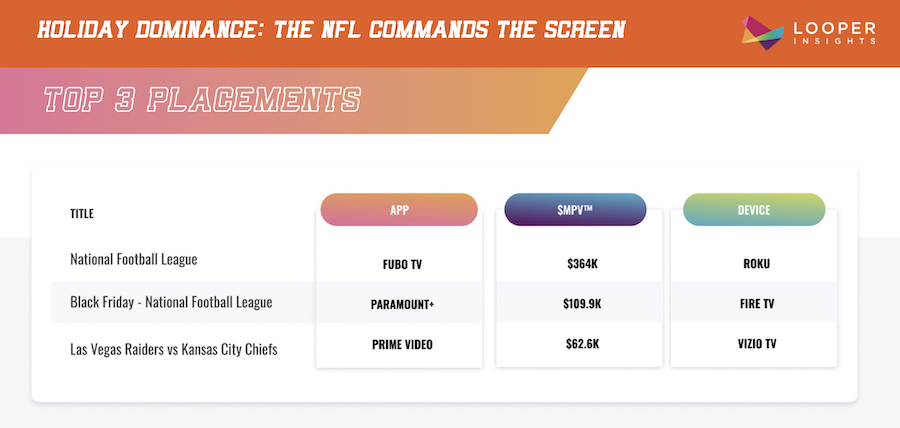
Looper’s analysis shows that the top three NFL promotional placements across Roku, Fire TV and Vizio each achieved the maximum MPV score of 24, ranking them in the top 2% of all U.S. connected-TV promotions during the week.

Those three placements delivered a combined $536,000 in $MPV, led by Fubo TV’s “Turkey Day Football” takeover on Roku.

What made them so effective? Fubo TV’s “Turkey Day Football” on Roku used festive Thanksgiving visuals to spark excitement; Fire TV paired NFL action with other sports in a dynamic Black Friday split-screen offer; and Vizio highlighted the “Raiders vs. Chiefs” matchup with bold rivalry imagery and a strong call to action. Together, these placements show how tailored creative and premium placements drive standout visibility during one of the NFL’s biggest viewing weeks.

And the NFL didn’t stop at the games. Spin-offs such as Madden NFL, NFL Icons and NFL Slimetime carried that momentum into other formats, ranking among the week’s highest-performing secondary promotions. Even during tentpole moments, the league used its IP to stay visible before, during, and after the games.

Black Friday Becomes a Streaming Holiday

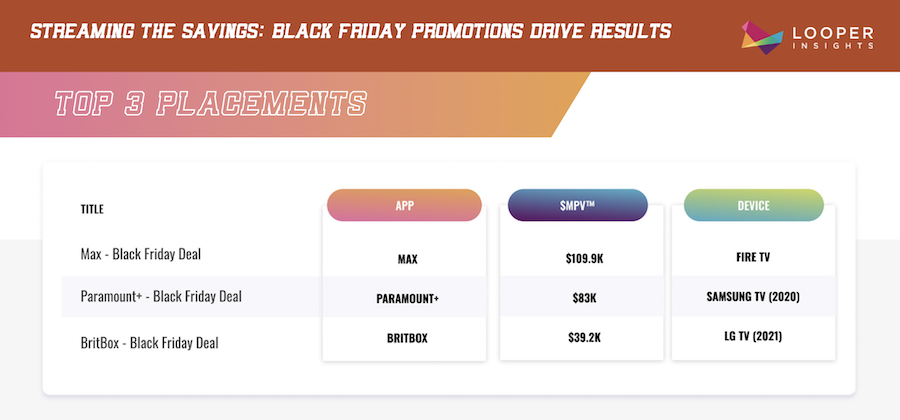
Black Friday has become just as important for streaming services as it is for retail, with major platforms using the holiday to promote subscription deals aggressively. However, the results showed a surprising trend: a longer offer duration is more effective than a deeper price discount. Both Max and Paramount+ had the same subscription price, but Max provided a longer promotional window and ultimately came out on top.

The New Rules of Holiday Streaming

Our analysis surfaced five clear strategies for Thanksgiving 2025:

  • Put your marquee IP in the most premium placement and surround it with supporting content. The properties that dominated Thanksgiving didn’t just appear on the homepage; they owned the hero units, full-width banners, and the top position in rotators. When you anchor your priority title with supporting spin-off content, you extend engagement beyond the main event and multiply visibility hours.
  • Control the platform, control the outcome. Streamers who control the distribution environment (device OS, app store, or app UI) can guarantee top placement when it matters most. Placement is not a creative choice; it’s a competitive advantage.
  • Longer offer windows beat deeper discounts. Our data shows that the duration of a promotional offer drives more conversions than the size of the discount. Viewers are more likely to start a trial when they feel they have time to enjoy the content, not when forced to decide under time pressure.
  • Match the CTA to the device for simplicity to win. On mobile and app-store environments, flexible CTAs like “Subscribe at a discounted price” outperform price-specific messaging because users are already in transaction mode. On CTV home screens, performance improves when CTAs focus on immediate action, such as “Watch Live” or “Stream Now.”
  • Always-on repetition beats a one-day splash. The best-performing campaigns didn’t rely on a single takeover tile; they used multiple recurring placements across rows and carousels to stay persistently visible throughout the week. Frequency drives familiarity, and familiarity drives clicks.


The Bottom Line

Thanksgiving week is no longer just a ratings race. It’s a visibility race.

In a world where more than half of users decide what to watch from the CTV home screen, the titles that win the screen win the week. And as films and franchises such as “Stranger Things,” Wicked: For Good, and multiple NFL matchups will compete for audience attention this Thanksgiving, streamers will need every advantage they can get.

Francesca Pezzoli is VP of marketing at Looper Insights, which specializes in providing granular, real-time analytics and insights on the promotional impact of content on connected TV platforms (CTV). 

Roku Ups Partnership With Double Verify to Combat False CTV Ad Data

Roku Nov. 5 announced a new deal with Double Verify to verify media quality, optimize ad performance, and prove campaign outcomes on connected-TV (CTV) advertising.

According to DV’s recently released report, “Global Insights: Trends in the Modern Streaming Landscape,” the online ad industry continues to grapple with fraudsters targeting streaming environments that lack strong security measures.

The scale of this problem is staggering, with 4 million infected CTV bot devices generating extreme volumes of invalid traffic daily, according to the report. This wave of bot activity can lead to wasted budgets, with losses exceeding $7.5 million monthly from just one bot variant, based on industry CPM estimations. This rise of falsification schemes underscores the need for enhanced protection measures across the CTV advertising ecosystem.

“CTV remains one of the fastest-growing channels in digital advertising and, unfortunately, one of the most targeted by fraudsters due to high CPMs and the relative newness of the ecosystem,” Mark Zagorski, CEO of Double Verify, said in a statement.

One of the more effective ways to block fake CTV ad impressions that falsely claim to be generated by Roku devices has been Roku’s Advertising Watermark. Roku’s Advertising Watermark is designed to ensure that only genuine Roku devices can display authenticated ads, providing an additional layer of protection against device spoofing and other falsification schemes.

“Our partnership with DV enhances our collective capabilities to secure the TV streaming advertising ecosystem,” added James Kelm, VP of product, advertising and media at Roku.

Starting in 2022, Roku and DV collaborated to shut down SmokeScreen, a CTV ad fraud operation that used screensaver apps to generate fake ad impressions in the background. For a year, DV and Roku investigated the group of apps involved and used signals from Roku’s Advertising Watermark to reveal key technical details about how the scheme operated.

From 2023 to 2024, DV also uncovered and mitigated CycloneBot, one of the largest CTV ad fraud schemes ever detected, according to the company, which generated up to 250 million fake ad requests daily and employed advanced evasion techniques. DV’s early collaboration with Roku and its Fraud Lab played a critical role in dismantling CycloneBot, leveraging insights and signals from Roku’s Advertising Watermark.

DV and Roku’s partnership also extends beyond fraud protection, with measurement capabilities on Roku’s home screen and native formats — allowing an effective way for advertisers to reach their audience on the largest screen within the household.

Subscribe HERE to the FREE Media Play News Daily Newsletter!
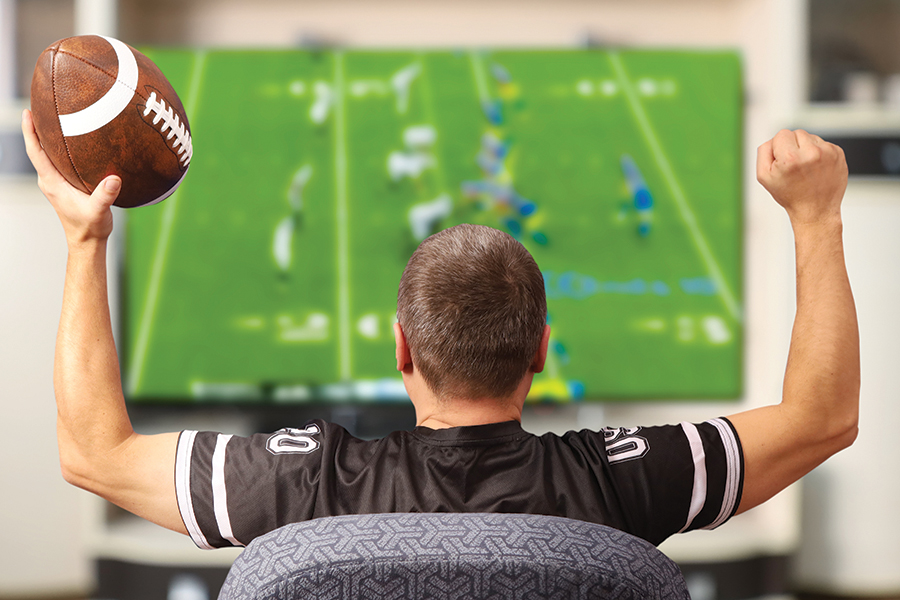
Looper Insights Launches Sports Visibility Tracker to Measure Promotions

Looper Insights, a CTV merchandising analytics platform, has announced the launch of its new Sports Visibility Tracker, a solution enabling sports streamers, broadcasters, and rights holders to verify campaign compliance, measure performance, and optimize live event promotions across connected TV devices in real time.

The tracker offers visibility into when and how sporting events were being promoted, according to Looper Insights.

Built on the company’s proprietary MPV (Media Placement Value) framework, the Sports Visibility Tracker monitors campaigns before, during, and after major sporting events, according to Looper Insights. It verifies that promotions are compliant, accurate, and timely ahead of each game, then delivers live data throughout game day, complete with highlight reels of wins, misses, and competitor activity. The service provides clients with visual evidence and actionable insights to fix errors in real-time and refine their promotional strategies for upcoming games.

“In sports streaming, visibility is a zero-sum game; every second on the home screen is a second your competitor doesn’t have,” Francesca Pezzoli, VP of marketing at Looper Insights, said in a statement. “Our Sports Visibility Tracker turns what was once guesswork into a measurable, repeatable process, giving teams and platforms the clarity to act fast, justify spend, and win attention where it matters most.”

Key benefits of the Sports Visibility Tracker, according to Looper Insights:

  • Real-Time Visibility and Global Reach: Track every live sports promotion as it appears on connected TV home pages across hundreds of devices and 25+ countries, exactly as fans see it.
  • Game-Day Proof: Receive visual confirmation of how and where sporting events were promoted, complete with screenshots and analysis after each fixture.
  • Competitor Benchmarking: See how visibility and Media Placement Value (MPV) stack up against other leagues, broadcasters, and platforms.
  • Actionable Insights: Real-time alerts integrate with live operations, helping teams resolve issues quickly and deliver a seamless viewer experience. Receive reports and recommendations to optimize strategy and boost fan engagement.
  • Campaign ROI Measurement: Quantify how the paid media spend drives earned visibility and return on promotion.
  • Real-Time Alerts: Stay agile with instant notifications when promotional placements need correction or updates.


Subscribe HERE to the FREE Media Play News Daily Newsletter!

From Around the Web