Luma AI Opening Saudi Arabia Office to Expand HUMAIN Create

Silicon Valley-based AI company Luma AI Feb. 9 announced it will open a dedicated office in Riyadh, Saudi Arabia, to expand its presence in the Middle East and further the development of HUMAIN Create, a venture with Saudi AI company HUMAIN focused on leveraging AI in the development of video games, film and advertising.

Luma AI also announced a strategic partnership with Publicis Groupe Middle East, in collaboration with HUMAIN, under which Luma AI will serve as the preferred generative AI technology partner for the Groupe across Saudi Arabia and the wider MENA region.

Luma AI’s Riyadh office will deepen its partnership with HUMAIN and support ongoing development of the world’s first Saudi-built, Arabic-native foundation model. HUMAIN is a Saudi AI company established in 2025 to develop AI capabilities through next-generation data centers, advanced AI models and cloud platforms.

For Luma AI, the new office will serve as a regional hub for client engagement, partnerships and advanced AI development.

“Saudi Arabia is the natural home for our regional headquarters in MENA,” Amit Jain, CEO and co-founder of Luma AI, said in a statement. “Establishing a local office allows Luma AI to work directly with this next generation of builders and creators, while developing AI that is deeply connected to the region it serves.”

Tareq Amin, CEO of HUMAIN, said the new office will help accelerate the development of HUMAIN Create. “This new office marks a major step forward in deepening our collaboration with Luma AI,” Amin said in a statement. “Through HUMAIN Create, we are accelerating the development of Arabic-native, culturally fluent AI systems that enable creators, brands, and organizations across the region.”

HUMAIN and Luma AI launched HUMAIN Create in 2025 to develop advanced video generation models and leverage them through gaming, movies, entertainment and advertising. As part of that effort, Luma AI in July 2025 opened an office in Los Angeles called Dream Lab LA to extends its mission to the entertainment industry and train filmmakers on how to use its AI models.

Subscribe HERE to the FREE Media Play News Daily Newsletter!

Artificial Intelligence Key Theme at DEG’s EnTech Fest 2026 Feb. 25

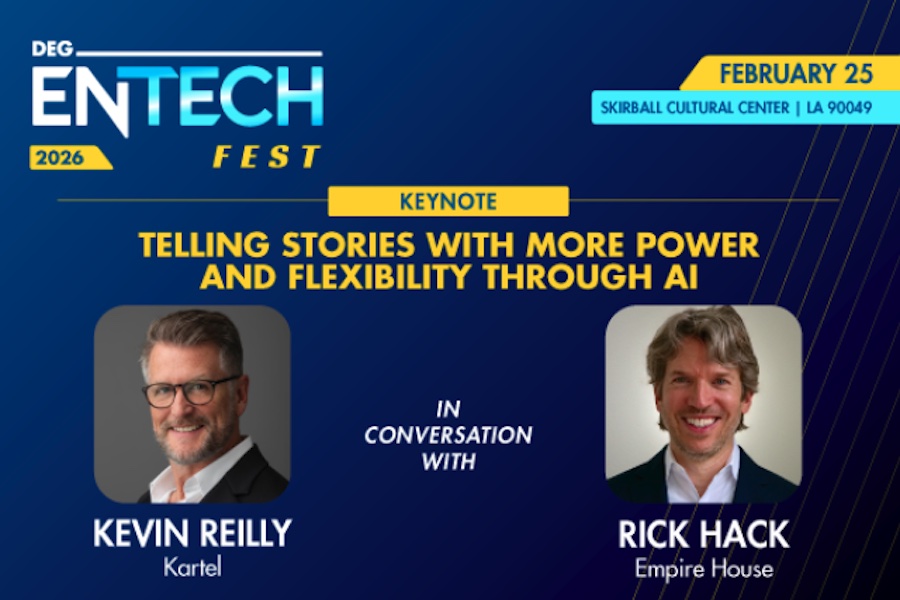
Artificial intelligence will be a key theme at DEG: The Digital Entertainment Group’s Feb. 25 EnTech Fest 2026 at the Skirball Cultural Center in Los Angeles.

The lineup includes a keynote conversation, “Telling Stories With More Power and Flexibility Through AI,” featuring Kartel CEO Kevin Reilly, who is known for reshaping network and streaming content over four decades, who will discuss with Empire House’s Rick Hack the opportunity to enhance storytelling with AI that extends human creativity. They will discuss how the future of advanced content creation and distribution will be built with more-efficient processes for integrated workflows, intelligent systems that support content creators, and frameworks that amplify marketing.

Also part of the program is a conversation featuring Quinn Favret of Tavus and moderator Ben Relles of the Office of Reid Hoffman, exploring what happens when content can respond, adapt and hold a conversation. AI-powered avatars and digital twins are turning passive viewing into interactive experiences, opening new possibilities for how audiences connect with talent and storytelling. This session will explore where AI avatars are already gaining traction, where interactive video is headed and why it matters now.

In a fireside chat with leading entertainment lawyer Ken Ziffren, known for his groundbreaking deals in film and television, Ziffren will share his views on how the use of AI in entertainment will develop over the next five years. The chat will be moderated by The Wall Street Journal‘s Ben Fritz.

A panel will discuss how AI might help consumers, overwhelmed by an explosion of choice and a maze of fragmented platforms, figure out what to watch — and where to watch it, as well as how streamers and platforms differ on where discovery should happen. Panelists include Justin Inman of Emberos, Andreas Hofmann of LG Electronics and Matthew Dominguez of Xperi.

A case study panel, “Adding AI Layers to Modernize Legacy Product Offerings,” will unveil how two companies are innovating their legacy offerings by leveraging AWS’s AI Prototyping Team to help make their customers’ workflows more efficient. Speakers include AWS’s Shane Madigan, Fabric’s Rob Delf and Nomad Media’s Adam Miller.

EnTech Fest 2026 is a one-day event that includes exhibits, conference programming, and the DEG’s annual reception. In addition to AI, focus exhibit categories include emerging technologies, the consumer experience, immersive storytelling, and advanced content delivery. The annual event is for content distribution and marketing executives, platform partners, technology enablers, trend trackers, connected device and display developers, and innovators in digital entertainment.

Subscribe HERE to the FREE Media Play News Daily Newsletter!

AI Tech, Micro-Content Company Holywater Acquires VFX Outfit Jeynix

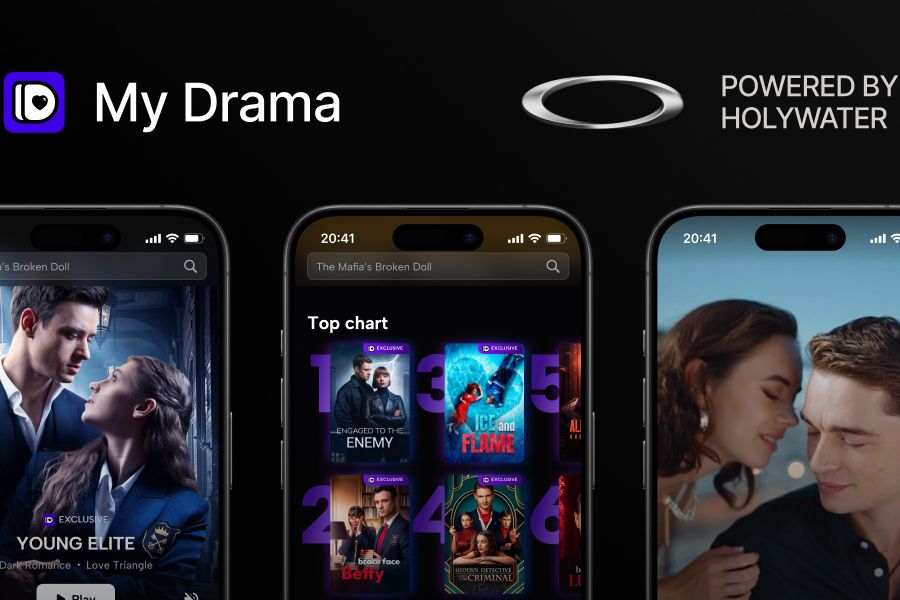
Holywater — the AI tech company with products including My Drama for vertical series, My Passion for books, and My Muse for AI streaming — has announced the acquisition of Jeynix, an AI-assisted production team specializing in hyper-realistic visual effects and performance preserving techniques for video.

Following the acquisition, Holywater has rebranded the company as Holywater Tech. The agreement brings Jeynix’s technical team and proprietary production expertise into Holywater Tech, significantly strengthening the company’s ability to deliver cinematic-quality visuals at scale, according to the company. These additional capabilities enable series produced on modest budgets to achieve the look and feel of significantly higher-budget productions, while also allowing for rapid localization across markets in a matter of days, Holywater notes.

Holywater recently announced its largest financing round to-date at $22 million to further its strategy of turning microdramas into mainstream entertainment in the United States. The round was led by Horizon Capital, with strategic participation from U.S. investors, Endeavor Catalyst and Wheelhouse, representing the largest single investment round in the sector outside of Asia.

In 2025, Fox Entertainment acquired an equity stake in Holywater and is in production on a robust slate of 200 original microdramas and vertical series for the platform.

In January 2026, Fox Entertainment and Dhar Mann Studios entered a multiyear partnership to create and produce an initial slate of 40 narrative-driven titles designed to debut exclusively on the Holywater platform, My Drama.

Founded in 2025 as a production-focused technical studio, Jeynix is known for its ability to integrate AI-assisted tools into professional VFX pipelines while maintaining natural detail, subtle movement, and the integrity of on-screen performances. Its workflows span facial animation and enhancement, performance-driven visual effects, and formats such as lip-sync, designed to feel indistinguishable from traditional, high-end post-production, according to Holywater.

“Holywater Tech aims to build a category-defining entertainment company that brings together creators’ imagination and cutting-edge technology, especially AI, to unlock new creative possibilities at scale,” Bogdan Nesvit and Anatolii Kasianov, co-founders and co-CEOs of Holywater Tech, said in a statement. “Jeynix demonstrated a level of visual truth and performance preservation like face matching, that we simply couldn’t find elsewhere. Bringing this expertise in-house allows us to reinvest our production budgets into significantly higher quality, faster iteration, and more consistent results across our slate.”

“We’re thrilled to keep building with Holywater Tech,” Nemir Yevhen, Jeynix founder said in statement. “By bringing Jeynix’s AI-assisted creative tools to a larger platform, we’re giving audiences new ways to jump into the content and make each scene their own.”

Holywater Tech’s content platforms reach more than 85 million users and include My Drama, what it bills at the No. 1 vertical streaming app among American and European companies; My Passion, which it bills as the No. 1 independent digital book publishing platform among American and European companies; My Muse, a leading platform for vertical series produced with the support of generative AI; and Freebits, an ad-supported vertical streaming service offering content for free.

The Jeynix team specializes in facial animation, face replacement, de-aging, and lip-sync. All technologies are powered by various artificial intelligence systems, allowing companies to achieve realistic results without the “uncanny valley” effect, according to the company.

Subscribe HERE to the FREE Media Play News Daily Newsletter!

Luma AI Announces Advertising Creative Competition

Luma AI has announced The Luma Dream Brief, a global creative competition inviting advertising creatives to bring their best unmade ideas to life, with a grand prize of $1 million to be awarded to creative work using Luma AI that wins a 2026 Cannes Lions Gold Lion.

Developed in collaboration with experiential and creative agency DE-YAN, The Luma Dream Brief challenges creatives to use Luma AI’s platform to create fully realized commercials for Luma itself. At its core, The Luma Dream Brief is built around a familiar industry truth: some of the most ambitious ideas never get made — not because they lack originality, but because they are perceived as too risky, too expensive, or too difficult to visualize, the company notes. By pairing creative ambition with Luma AI’s powerful AI tools, the competition gives creatives greater control, predictability, and craft in AI-generated commercials, advertisements, and content.

“A lot of great advertising never gets made,” Caroline Ingeborn, COO of Luma AI, said in a statement. “The Dream Brief is about removing those constraints and letting creatives prove what’s possible when ideas set the ceiling.”

“Almost everyone in advertising has an idea they loved that never saw the light of day,” Jason Kreher, chief creative officer at DE-YAN and former creative leader at Wieden+Kennedy, Maximum Effort, and Accenture Song, said in a statement. “That shared frustration became the insight behind this project. Rather than fearing how generative AI might change our industry, this is a chance to understand it, by using it to make something that previously had no path to being real.”

The Luma Dream Brief will roll out in multiple phases, beginning with a launch week featuring original films created with Luma AI. Creatives will then be invited to submit their own commercials through The Luma Dream Brief website by March 22.

In line with Cannes Lions’ rules, Luma AI will provide a brief to ensure the work is legitimate and created for a real client. Removing one of the most common barriers between bold creative ideas and real awards consideration, selected finalists will receive paid media support to ensure that the work has launched publicly and has run within the required eligibility period. Submissions will be reviewed by a jury of leading voices in advertising and culture.

The Luma Dream Brief is open to creatives worldwide, with submissions required to be created using Luma AI. Full rules, eligibility criteria, and submission details will be available at www.LumaDreamBrief.com.

Subscribe HERE to the FREE Media Play News Daily Newsletter!

Luma AI Updates Ray3 Reasoning Video Model

Luma AI has announced the launch of Ray3.14, a major update to its reasoning video model Ray3.

Ray3.14 delivers performance for animation, video-to-video, and cinematic workflows where temporal stability, motion fidelity and consistency are essential, according to Luma AI.

Built specifically for professional creative environments, Ray3.14 combines native 1080p outputs, four-times-faster generation speeds, and per-second pricing that is three times cheaper, eliminating the quality-speed-cost trade-off in generative video, according to Luma AI.

“The model delivers the highest quality and stability Luma has ever achieved, excelling in animation-heavy and high-fidelity workflows where other models struggle with frequent flicker, drift and inconsistency,” according to the company.

Ray3 pioneered reasoning-based video generation by understanding scenes holistically, maintaining coherence across motion, lighting, characters and camera behavior, according to the company. With Ray3.14, that reasoning engine is applied even more powerfully to animation and professional video workflows, producing higher detail adherence, Luma AI reports.

“Ray3.14 is designed for creators who need animation and video to behave like real production assets,” Amit Jain, CEO and co-founder of Luma AI, said in a statement. “By delivering native 1080p, dramatically faster generation, and per-second pricing that is three times cheaper, we’re giving advertisers and filmmakers a model that excels in animation and can be trusted for real-world creative workflows.”

Subscribe HERE to the FREE Media Play News Daily Newsletter!

Luma AI reports that new Ray3.14 updates include:

  • Best-ever quality and stability for animation and video-to-video workflows — Ray3.14 delivers Luma’s highest level of visual stability to date, excelling in animation and video-to-video use cases where temporal coherence and motion fidelity are critical. Characters, environments and styles remain consistent across frames, enabling narrative continuity, polished animation and production-ready outputs.
  • Native 1080p across core workflows — Ray3.14 generates video natively at 1080p, eliminating the need for post-upscaling or quality compromises. Outputs are suitable for broadcast, streaming and digital delivery, allowing footage to move directly into editorial, finishing and distribution pipelines.
  • Industry-leading speed for real creative iteration — With generation speeds four times faster, Ray3.14 enables teams to iterate under real production timelines. Compared to competitive AI video models, Ray3.14 delivers substantially faster time-to-first-frame and end-to-end generation, allowing agencies and filmmakers to explore more concepts, review options side-by-side, and reduce downstream revisions.
  • Per-second pricing designed for production scale — Ray3.14 introduces dramatically improved per-second economics. For a typical five-second video, costs are reduced by a factor of three, making AI video viable for campaign-scale use cases such as multiple formats, cut-downs and regional variations. This pricing model provides predictable costs and enables creative teams to scale output without increasing budgets.

Home Entertainment Forecast 2026: Streaming Flexes Its Muscle, Transactional a Critical Revenue Bridge

The home entertainment industry settled into a more stable pattern in 2025, with the free ad-supported streaming and transactional marketplaces complementing a subscription streaming business that began to rake in more profits and increase its dominance in Hollywood.

Streaming is expected to continue to flex its muscle in 2026, with Netflix on the verge of gobbling up Warner Bros. Discovery’s studio and streaming businesses — and with growth coming mostly from ad-supported models, along with live sports and other event programming.

The transactional business, meanwhile, will continue to serve as a premium monetization bridge between theatrical, subscription and free viewing — reinforcing ownership, catalog value, and event-driven releases in an otherwise flat-fee streaming world.

Looking back, much of what happened in 2025 set the stage for what is expected to happen in 2026.

Whether or not Netflix ends up jumping over political, regulatory and other hurdles in purchasing much of WBD, the top streamer has clearly won the streaming wars. Even before the studio buy, analyst Evan Shapiro stunned the audience at a NATPE session in Miami early in the year when he proclaimed that the streaming wars were over — and Netflix had won.

The analyst, who charts media’s future through his essays on his Media War & Peace Newsletter and co-hosts “The Media Odyssey” podcast, cited Netflix’s high subscriber count, which dwarfs that of the other subscription streaming heavyweights, and noted that the company’s valuation at the time was significantly higher than the combined valuation of Comcast, Disney, Fox, Paramount and Warner Bros. Discovery.

Shapiro now says he sees Netflix as the likely winner in the Warner battle, “but I do anticipate a dark horse to enter the race if Netflix hits bumps on the approval process.”

“Depending on when Tim Cook makes an exit, it could be Apple,” he posits, which would also be a streamer taking over a Hollywood studio.

Paramount Skydance still lurks, however, and could emerge triumphant in buying Warner Bros. Discovery, adding the studio’s HBO Max streaming service to its direct-to-consumer lineup, including Paramount+, led by former Netflix exec Cindy Holland.

“Regardless of whether Netflix or Paramount wins Warner, HBO is highly likely to see a greatly expanded reach and see accelerated growth,” says Wedbush Securities media analyst Michael Pachter. “Netflix is more likely to integrate HBO into its core offering, which will accelerate growth even more rapidly.”

In an added flourish to Netflix’s year, the service beat out Prime Video after three years at No. 2 on Parks Associates’ “Top 10 SVODs by Subscribers” chart.

Netflix’s financial footprint also dwarfed its competitors in 2025. For the year, Netflix delivered $45.2 billion in revenue, up 16% year over year. Ad revenue rose more than 250% to more than $1.5 billion. Net income for the year was $10.98 billion, versus $8.71 billion in 2024. Netflix ended 2025 with more than 325 million paid subscribers, up from 301 million subs at the end of 2024.

Disney’s direct-to-consumer business segment, which includes Disney+, Hulu, ESPN+ and the recently launched ESPN Unlimited, in September reported a fiscal-year profit of $1.3 billion, a massive increase from the $143 million the company reported for the prior fiscal year. Disney+ and Hulu (Hulu and Hulu + Live TV) together had 196 million paid subscribers worldwide as of Sept. 30.

Paramount’s direct-to-consumer segment, which includes Paramount+, Pluto TV and BET+, reported net income of $153 million for the year through Sept. 30, a reversal from a net loss of $211 million in the prior-year period. Paramount streamers ended the period with 79.1 million paid subscribers, up 10% from the previous year.

Warner Bros. Discovery’s direct-to-consumer segment reported a profit of $977 million through Sept. 30, up significantly from $268 million in the prior-year period. The segment, which includes HBO linear, HBO Max and Discovery+, reported 128 million paid subscribers, up from 110.5 million in 2024.

NBCUniversal’s Peacock streaming service was an outlier, reporting a net loss of $533 million for the year through Sept. 30. The platform ended the fiscal period with 41 million paid subscribers, up from 36 million subs a year earlier.

Apple TV ended its fiscal year (12 months ended Sept. 27) with a reported 45 million paid subscribers. The company does not break out direct-to-consumer fiscal data.

And Amazon’s Prime Video reportedly has more than 200 million subscribers across 23 countries. Amazon does not break out subscriber or fiscal data for the streaming platform, which is also available as a standalone service, and is included free with a Prime membership. Media reports suggest Prime Video generated revenue of $17.5 billion in 2025, up from $14 billion in 2024.

The pervasiveness of streaming is underscored by Parks Associates’ latest annual “State of Streaming” report, which found that the SVOD market as a whole has achieved a 91% penetration rate among U.S. households. The pay-TV business, in comparison, has a meager 41% household penetration rate.

On average, according to Parks Associates, U.S. SVOD households subscribed to 5.9 SVOD services in 2025, up from 5.6 in 2024. Parks Associates expects the average number of SVOD services subscribed to by SVOD households in 2026 to grow slightly, to 6, driven largely by bundling and discounted promotional rates.

As streaming became even more entrenched in U.S. homes, SVOD services felt safe to go on a price hike binge. Netflix kicked off 2025 by increasing prices for all U.S. plans, raising the ad-supported plan to $7.99, the standard ad-free plan to $17.99, and the premium plan to $24.99 monthly. Disney, HBO Max and Apple TV+ (now just Apple TV) subsequently raised their monthly subscription prices by a few dollars as well.

Streamers will continue to raise prices going forward, predicts Michael Goodman, director of entertainment research for Parks Associates. He says the price hikes, particularly on premium tiers, “are as much about driving consumers to the ad-supported tiers as they are about driving revenue growth.”

After falling 2.6% in 2025 to an average of $10.96 as cheaper ad-supported tiers took hold, average revenue per SVOD service will once again grow in 2026, Goodman predicts, reaching $11.30 by the end of the year.

“As to when we will see price hikes slow or even stop, it is largely in the hands of consumers,” Goodman maintains. “Until we see net adds stall or decline as a result of price hikes, services have no incentive to stop raising prices.”
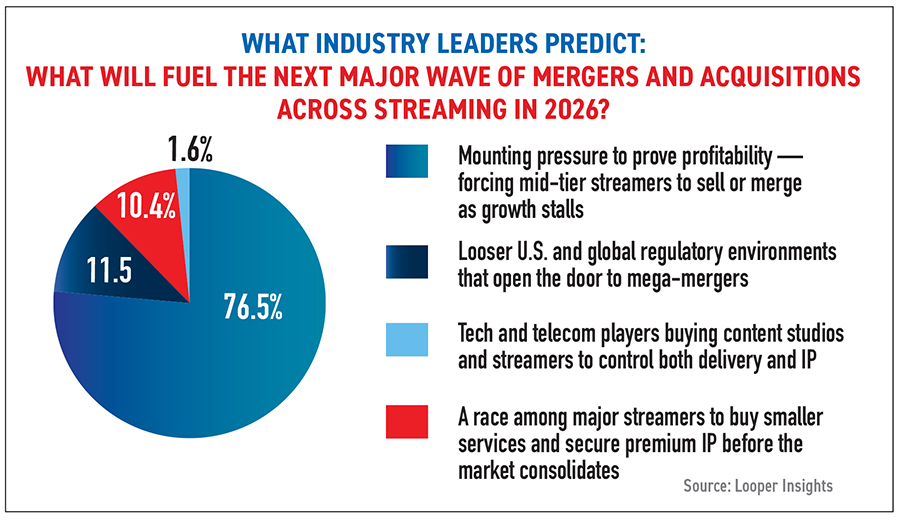
In a search for increased profits, the industry can also expect more consolidation in the coming year, according to industry leaders surveyed by Looper Insights. In the survey, a whopping 76.5% expect that mounting pressure to improve profitability will force mid-tier streamers to sell or merge as growth stalls. That consolidation will mean less new content for consumers.

“Streaming consolidation is likely to mean fewer shows overall, with budgets and attention concentrated on bigger, safer bets,” Parks’ Goodman says. “Mid-budget and niche originals are more likely to be cut, shows will be given less of a chance to prove themselves and will be canceled faster, and franchises, sequels and event programming that can travel globally and reduce churn will be prioritized.

“As ad-supported tiers grow, platforms will favor sticky content like procedurals, reality and comfort TV that drive long viewing sessions, while libraries become less permanent as titles rotate in and out for cost control. While there may be the occasional mega-hits, overall there will be less experimentation, fewer risk-taking projects, and less catalog stability for viewers.”

Bundles, as they did in 2025, will increase, as services that are raising prices look to offer more value for price-conscious consumers.

“Regardless of who wins the fight for WBD, the direction is the same — fewer giants controlling more premium IP, which will lead to more bundling and fewer standalone ‘must have’ alternatives,” Parks’ Goodman says. “Instead of subscribing to services individually, a growing segment of the population will buy a bundle of SVOD services, either through the services themselves, TV providers, or broadband/mobile bundles, as this helps mitigate price increases and reduce churn. On the live-TV side, expect to see more skinny/genre-specific bundles such as sports, news, entertainment, etc., similarly to what YouTube TV and Sling TV are doing.”

Sling TV offers mini-bundles that allow consumers to curate their content choices, including sports.

“Look for churn-reducing bundling across lifestyle products — especially from mobile and retail platforms,” analyst Shapiro adds.

Another key trend that developed in 2025 and is expected to accelerate in 2026 is the expansion of ad-supported tiers to lower the price for subscribers. During the annual Tech Trends to Watch presentation Jan. 4 at this year’s CES in Las Vegas, show marketing and communications VP Melissa Harrison called out “the rise of ad-supported streaming” as a primary driver in a projected 4.2% uptick for 2026 in consumer spending on software and services.

“With 34% of subscribers to ad-supported tiers saying the lower monthly price makes SVOD services more affordable, and an additional 31% not minding ads if it saves them money, affordability is becoming a significant factor in SVOD subscription growth, while providing an alternative to cancellation,” Parks’ Goodman says.
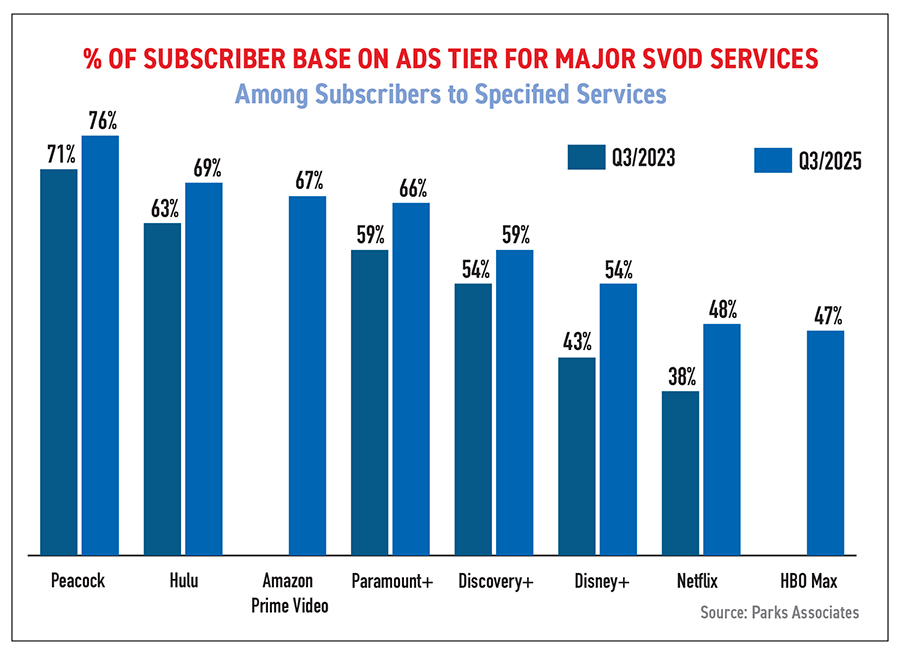
According to the Parks Associates Subscription TV Forecast, ad-supported tiers are projected to account for all SVOD subscription growth in 2026, growing from nearly 363 million in the U.S. in 2025 to nearly 376 million in 2026. At the same time, subscriptions to ad-free premium tiers are projected to fall slightly from 280 million in 2025 to 279 million in 2026.

“Coinciding with this will be more features designed around ads (i.e., targeting, new formats), and in some cases increased ad loads,” Goodman says.

Analyst Shapiro is even more bullish on ad-supported free streaming.

“I predict that the ad-free TV viewer will disappear,” adds Shapiro. “Yes, viewers will have some ad-free experiences, but all regular TV viewers will see ads, every week, in sports, news, and through unavoidable ads on their TV home screen.”

The industry is entering a new era, pundits say, where, in many ways, streaming is television.

Lucas Bertrand, founder and CEO of Looper Insights, calls it a “reset phase.”

“The challenge in 2026 isn’t content volume anymore; it’s visibility,” he says. “As discovery shifts to TV operating systems and AI assistants, even the biggest streamers will have to work much harder to secure visibility.”

Consequently, in Looper Insights’ survey of industry leaders, the biggest segment (37.7%) said unified discovery across multiple streaming services and live channels will drive the next generation of streaming user interfaces in 2026.

Hub analyst Mark Loughney forecasts that Amazon will tackle the discovery problem.

“As frustration with content search and discovery reaches a tipping point, 2026 could see Amazon Prime Video introduce a universal video search experience that spans platforms — including services outside the Amazon ecosystem,” he predicts. “By positioning itself as the easiest place to find anything to watch, Amazon stands to become a default viewing hub.”

Subscribe HERE to the FREE Media Play News Daily Newsletter!

YouTube as the New Tube

Looming large in the background of the streaming landscape is YouTube, the streaming behemoth owned by Google, which is ramping up the competition.

“Traditional streamers aren’t competing with each other anymore; they’re competing with YouTube for TV viewers’ attention,” Looper Insights’ Bertrand notes. “That means rethinking discovery, pacing, and even creator-driven formats if they want to stay relevant.”

“Next summer, on TVs, YouTube will surpass all of broadcast combined,” analyst Shapiro predicts.
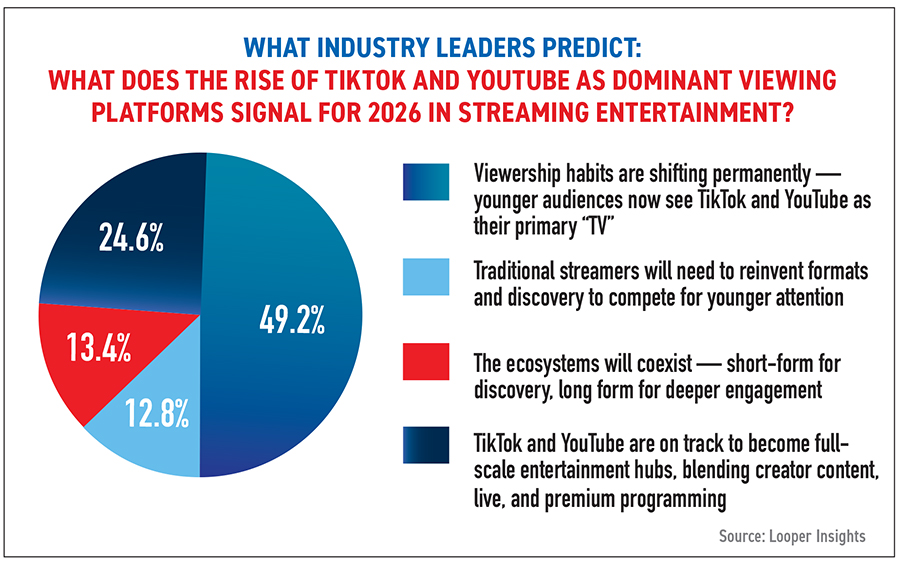
The streaming goliath has already made inroads in the traditional TV space. YouTube got into the sports game in 2025, exclusively live-streaming the first game of the 2025 NFL season in São Paulo, Brazil, in September to a worldwide audience (outside North America) on YouTube and YouTube TV. This marked the first exclusive NFL game to be streamed live and for free in its entirety on YouTube. YouTube also tangled with Disney over carriage costs on its OTT pay-TV platform YouTube TV. The dustup left YouTube TV subscribers unable to watch content from Disney networks, including ESPN, ABC, Disney Channel, FX, National Geographic and Freeform.

The two companies ultimately settled their dispute, but the fracas showed YouTube was ready to go toe-to-toe with traditional media giants. As a coda to YouTube’s shift into the traditional TV space last year, the Academy of Motion Picture Arts and Sciences signed a multiyear deal giving YouTube exclusive global rights to the Oscars — a broadcast TV staple — from 2029 to 2033.

A key component to YouTube content, the independent creators who populate its service, will also move into the traditional entertainment space, many predict.

“The Affinity Economy — the melding of the Creator Economy and Traditional Media — will take over,” Shapiro says. “This means that more creators will become studios and more studios and brands will act like creators — leaning into social video and the rules of the Creator Economy.”

“Next year we’ll see creators bypass social platforms entirely and go straight to the living room via AVOD and FAST,” says Vikrant Mathur, co-founder of FAST channel distributor Future Today. “These streaming platforms are the new frontier as they’re more flexible, more aligned with how audiences actually watch content, and lucrative, opening new sustainable revenue streams for creators.

“This shift is already under way from the MrBeasts of the world, to other creators such as Like Nastya, Gemma Stafford, and more. With the wealth of audience data and insights CTV environments provide, advertisers can better align with creator-led content that reflects brand values and drives meaningful engagement.

“That’s the revolution: Brands finally have the precision to support creators who build genuine communities and deliver measurable results. The next wave will be long-form IP and creator-led channels that fill the cultural and emotional gaps traditional television left behind.”

FAST/AVOD — An Established Part of the Streaming Mix

The free ad-supported model that YouTube pioneered has become a fixture in the traditional content streaming marketplace.

As the FAST (free ad-supported streaming television) sector closed out 2025, one thing was clear: The category has moved decisively beyond its early “cord-cutter alternative” phase and into the core of the home-entertainment ecosystem. What was once viewed as a secondary distribution outlet is now a primary viewing destination for millions of households — and an increasingly important revenue lever for platforms, programmers and advertisers alike.

In a Looper Insights survey conducted in June 2025, nearly nine out of every 10 consumers said they’d rather watch ads on a free service than pay for a subscription with ads. More than one-third of consumer respondents said they watch more FAST content than they did a year ago, and 88% said they’re open to exploring free ad-supported channels. On the industry side, 83% of media execs said FAST is now central to their strategy, while 50% said they believe FAST is overcrowded or lacks standout content. FAST channels have proliferated in recent years. Gracenote, the content data business unit of Nielsen, found the number of FAST channels grew nearly 14% in 2025 through the end of July (and 76% since 2023).

“FAST has moved beyond being a free afterthought. In 2026 it’s becoming a premium, intentional part of the streaming mix, a core revenue driver and a critical front door into paid ecosystems,” says Looper Insights’ Bertrand.

“Free ad-supported streaming television (FAST) channels have emerged as a critical complement, offering a low-barrier entry point for consumers while generating new advertising revenue streams,” according to Parks Associates.

Observers say 2025 was something of a year of validation for FAST. Throughout the year, Media Play News tracked steady increases in viewing time, advertiser interest and strategic investment across major FAST platforms.

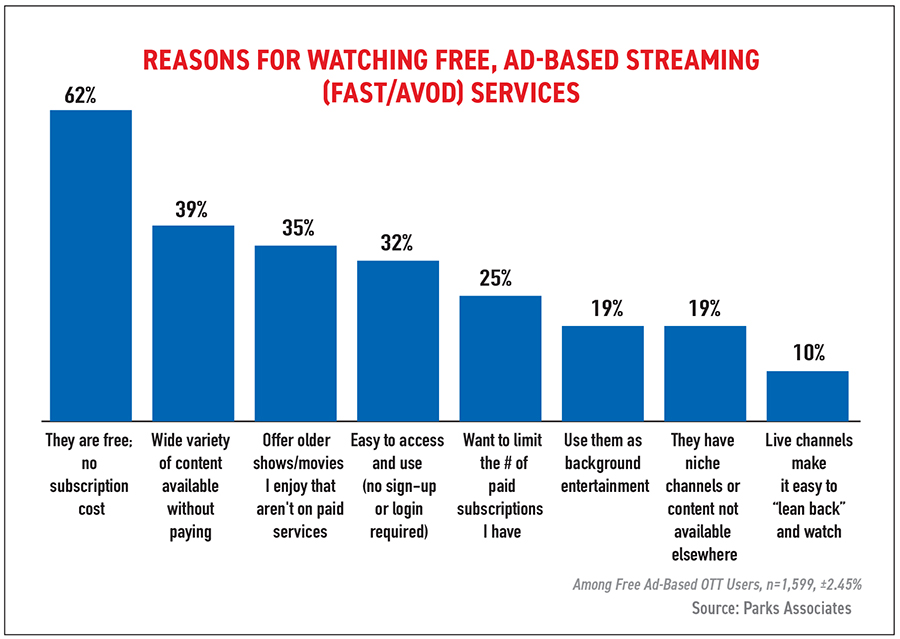
In a 2025 survey of more than 8,000 domestic broadband households, Parks Associates found that consumers’ use of free ad-based services had doubled over the past six years, from 23% in the first quarter of 2023 to 46% in the third quarter of 2025. Nearly two-thirds of respondents in the Parks study said that the fact that FAST/AVOD services were free was their top reason for tuning in.
One of the most important developments in 2025 was FAST’s deeper integration into the broader streaming ecosystem. Rather than existing as standalone destinations, FAST increasingly became embedded within larger platforms and operating systems. Amazon’s move to fold Freevee’s free programming into Prime Video, and the growing prominence of FAST hubs on smart-TV home screens, underscored a shift toward aggregation and discovery over app sprawl. Indeed, Chinese TV manufacturer Hisense, via backend technology from Xumo, joined consumer electronics giants such as Vizio, LG, Samsung and TCL in offering a branded FAST service in August 2025.

The marketplace also experienced a growing maturity in how FAST content was programmed. The emphasis in 2025 shifted away from rapid channel proliferation toward recognizable brands, franchises and libraries that drive repeat viewing.

David Di Lorenzo, SVP of kids and family for Future Today, says 2026 will bring FAST consolidation without contraction.

“The FAST space is slated to mature as the days of launching a ‘whatever we can license’ channel are over,” he says. “In 2026, volume for volume’s sake is out; editorial vision, thematic cohesion and audience intention are in. Viewers are no longer grazing — they’re looking for streaming with a point of view. Expect a rise in creator-led channels, lifestyle verticals, and brand-aligned experiences that feel more like destinations than dumping grounds. Live content, especially news and sports, will show up more in FAST, but not as standalone plays. It will come wrapped in the infrastructure of trusted AVOD platforms where distribution, data and audience already live. That’s the difference between launching a channel and launching an ecosystem. The winners will be the platforms and partners who know their audience, stay disciplined, and build with long-term resonance — not short-term trend-chasing.”

“The next phase of FAST growth is about quality and moments, not just channels,” Looper Insights’ Bertrand adds. “Live events and sports are turning FAST into a frontline viewing experience for audiences.”

Indeed, in 2025, free ad-supported service Tubi made history simulcasting the Super Bowl with Fox Sports. The simulcast saw a record-setting average audience of 127.7 million viewers and generated more than $800 million in gross revenue from ads.

It’s expected that 2026 will see increased interest in growing ad profits.

“We are going to see a lot of the same as we saw for streaming entertainment platforms in 2025, but intensified to focus on increasing profits, while challenged by an increasingly crowded ad space,” says Keith Valory, CEO of free ad-supported service Plex. “It’s important to be conscious of the consumer’s mindset in this high-pressure economy. Interest in and usage of freemium services like Plex is only going to increase. It’ll make for a ripe space for advertisers to get creative, and we are focused on maximizing their creativity with premium ad bundles that can endemically reach the consumer on many surfaces of our platform.”

On the business side, measurement and credibility became central themes in 2025.

Advertisers pushed for more-consistent metrics, improved frequency management, and better alignment with traditional TV-buying expectations.

In the June 2025 Looper Insights survey, 64% of viewers rated FAST as a “good or great value,” but 50% of executives cited inconsistent ad tech and measurement as the most significant barriers to monetization. Viewers were showing up, but the dollars were getting stuck in the funnel, according to Looper Insights.

As a result, FAST platforms spent much of the year tightening ad tech, refining data partnerships, and positioning themselves as reliable, brand-safe environments rather than opportunistic remnant inventory.

Artificial intelligence will come to the rescue in smoothing the bumps in ad tech, Future Today’s Mathur predicts, flipping the power dynamic in advertising within the next year.

“Small and mid-sized businesses will compete on the same playing field as the world’s biggest brands — not because they’re spending more, but because they’re thinking smarter,” he says. “The same sophistication that once required big budgets and agency-scale resources can now be achieved through intuitive, AI-powered platforms. The next wave of AI innovation will be less about flashy creative tools and more intelligence at the infrastructure level: real-time price floor optimization, dynamic audience segmentation, and contextual tracking that works without IDs or cookies.”

Looking ahead in 2026, FAST is expected to enter a phase of disciplined optimization.

Growth will continue, but it will be more intentional. Channel lineups are likely to slim down, not expand, with underperforming channels quietly sunsetting and stronger brands receiving better promotion and placement. The success metric will no longer be the sheer number of channels launched, but the efficiency with which platforms monetize viewer attention.

FAST’s role as a top-of-funnel engine should also become more explicit in 2026. Studios and rights holders are expected to use FAST strategically to extend the life of IP, reintroduce franchises, and funnel viewers toward premium SVOD tiers, transactional rentals and physical media releases.
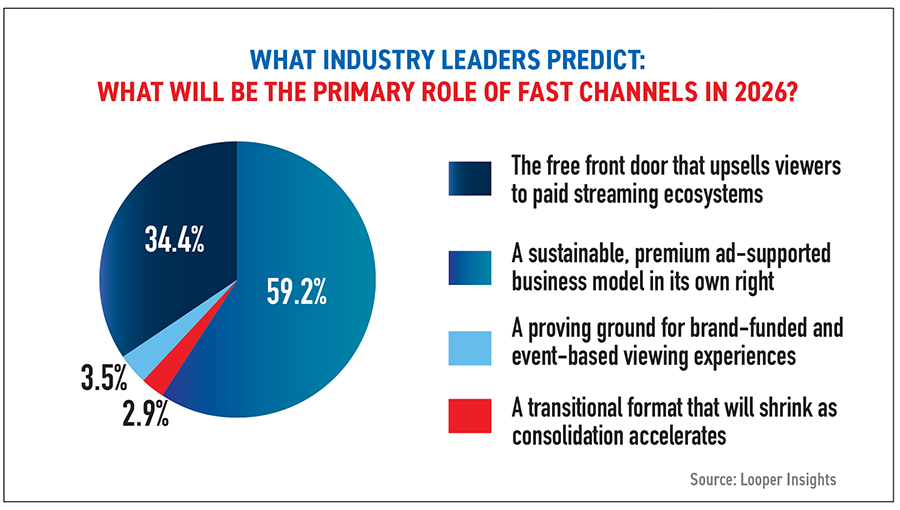
In the Looper Insights survey of industry leaders about how they see FAST’s role taking shape in 2026, more than half (59.2%) said that FAST will become a sustainable, premium ad-supported model in its own right. Meanwhile, one-third (34.4%) said that FAST would be a free front door that upsells views to paid streaming ecosystems. Only 2.9% said FAST is a transitional format that will shrink.

“The industry now views this space as a core revenue driver — not simply a side channel, but a meaningful pillar of the wider streaming economy,” the report concluded.

A major merger of indies in 2025 underscored the durability of free ad-supported streaming as New York-based FAST/AVOD powerhouse FilmRise was combined with Los Angeles-based Shout! Studios, also a major FAST channel supplier. Owner Oaktree Capital changed the name of the combined company to Radial Entertainment and appointed as CEO former Paramount streaming executive Jeff Shultz, who cut his teeth at free ad-supported streaming powerhouse Pluto TV.

“The FAST ecosystem is maturing from an experimental phase into a core pillar of the global content economy,” says David Buoymaster, chief investment officer and chief content officer at Radial Entertainment. “As audiences fragment and platforms look to distinguish themselves in an increasingly crowded and competitive marketplace, we’re seeing a flight to quality — both in programming and in how platforms curate and monetize the user experience. The next wave of winners in FAST won’t just be those with the most channels, but those that can align premium libraries, smart data, and differentiated brand identities to capture sustained viewer engagement.”

Heading into 2026, FAST will look even more like “TV,” not less — with improved program guides, tighter ad loads, and packaging that appeals directly to traditional TV advertisers seeking scale without the cost structure of legacy linear, observers say.

Transactional — A Critical Bridge in the Release Ecosystem

The transactional market — including digital and physical — has become a small part of the home entertainment ecosystem, but in 2026 it is expected to sharpen its role as a premium revenue channel and a strategic bridge in the release window ecosystem.

Top titles often follow a clear progression: theatrical, premium-priced then lower-priced digital purchase and rental, (sometimes) physical disc, SVOD and eventually free ad-supported models (FAST/AVOD). In this model, transactional acts as the monetization bridge, ensuring that studios capture revenue before content is absorbed into flat-fee or free ad-supported environments.

Indeed, for the year of 2025 through September, revenue for digital purchases grew a solid 4.34% to $1.75 billion, according to data from DEG: The Digital Entertainment Group.

A 2025 Parks Associates survey found that 15% of consumers had bought or rented a movie via a connected-TV platform in the prior 30 days. Meanwhile, 6% bought or rented TV episodes.

Collecting titles digitally is lining up as a cost-effective entertainment option, particularly with the rising price of subscription services, says Cameron Douglas, SVP of OTT/streaming for Fandango, who heads up the company’s video-on-demand streaming service Fandango at Home, one of the industry’s leading digital retailers in the transactional space. Fandango is part of the new Comcast spinoff company Versant.

“We remain positive about the long-term viability of this category, particularly as consumers are becoming increasingly thoughtful about their digital entertainment spending habits, where as an example so much of the growth in subscription is now coming in the lower, ad-supported tiers,” he says.

“[Traditional, transactional] home entertainment remains an important part of our ecosystem, especially in the living room,” says Jonathan Zepp, managing director of entertainment content and platforms at Google, which offers digital sales and rentals of titles through its Google Play/YouTube marketplaces.

“Looking ahead, we’re optimistic about the transactional business,” says Adam Frank, EVP of global partner management, sales and distribution for the Lionsgate Motion Picture Group. “With industry forecasts projecting box office growth in 2026, we expect a corresponding lift in transactional home entertainment driven by new-release conversion. Lionsgate expects to be a meaningful contributor with two major event films — Michael and The Hunger Games: Sunrise on the Reaping — along with continued momentum from our 2025 holiday breakout The Housemaid and a diverse slate across action, thriller and horror.”

Lionsgate is already preparing a Housemaid sequel, based on the second novel in Freida McFadden’s best-selling trilogy, The Housemaid’s Secret, with plans for star Sydney Sweeney to return.

“Digital remains the strongest driver of transactional performance across our global business, underscored by robust consumer interest and the industry’s embrace of high-value experiences, which are transforming the transactional landscape,” says Justin Che, president of Universal Pictures Home Entertainment. “As we move through 2026, event-driven releases and major franchises — such as Steven Spielberg’s highly anticipated Disclosure Day, Christopher Nolan’s The Odyssey, and Illumination’s The Super Mario Bros. Galaxy Movie — along with Universal’s vast portfolio of catalog titles, will play a pivotal role in attracting new consumers and driving sustainable growth.”

Indeed, catalog is an enticement for digital collectors.

“One stat that keeps surprising us is the massive growth of catalog TV,” Douglas says. “You have your ongoing important business of whatever the hot new series is at the time, whether it’s ‘Game of Thrones,’ ‘Walking Dead,’ ‘Yellowstone,’ etc. But, even with FAST channels out there dedicated to single series like ‘Murder She Wrote’ or procedurals, we still see a massive interest in classic TV and full-series digital sets.”

“Catalog performance remains a key opportunity,” Frank says. “The category continues to show strength despite increased SVOD and AVOD engagement, as consumers still see strong value in owning films, particularly in 4K, for instant access and the ability to build a personalized library. Catalog titles also play an important role in customer acquisition, bringing new transactors into the digital ecosystem at rates comparable to new releases.”

It wasn’t all smooth sailing in the digital transactional segment in 2025. The Microsoft Movies & TV Store left the business, and, for a time, Google Play/YouTube left the digital rights locker service Movies Anywhere during a carriage dispute between YouTube TV and Disney (which runs Movies Anywhere, which allows consumers to buy an eligible title from any participating retailer and watch it through the site or another participating retailer). Online chatter mused about the continued viability of collecting content digitally. But as the year closed, Disney and YouTube TV patched up the relationship, and Google Play/YouTube returned to Movies Anywhere, preserving stability in the digital transactional marketplace.

Meanwhile, revenue on physical disc purchases, the legacy transactional industry, continued its slow decline in 2025, dropping 9.21% through September to $605.1 million, according to data from the DEG. Still, the sector is bolstered by collectors that are eager to snap up the 4K Ultra HD Blu-ray format and premium Steelbooks, the DEG reports.

Things are looking up for the physical disc business, according to Eddie Cunningham, president of Studio Distribution Services, which was established in April 2021 to distribute physical media from joint venture partners Universal Pictures and Warner Bros. Discovery.

“It’s been an incredibly exciting year for the physical business,” he says. “Clearly, the business trajectory is leveling out compared to what many had predicted. I think consumers are increasingly realizing the comparative benefits of packaged media, from having the best-quality picture and sound, through to the security of ownership for life. We are also beginning to see physical content becoming fashionable again with some younger consumers, and we know what happened with vinyl, so perhaps we can build on that.”

Like the DEG, he points to the growth of 4K UHD sales (up 16% for catalog, and up 28% for new releases) and Steelbook sales (up 10%) as major drivers.

“Catalog sales, at least for SDS, are close to flat year-on-year for our two owners, something that was unimaginable just a few years back,” he notes.

E-commerce (up 15%) continues to fuel some of the success, both through the traditional retailers and the Gruv brand, an online shop run by Universal Pictures, he reports.

Indeed, after several years of retreat, retail participation is stabilizing, Cunningham says.

“Our retail partners have continued to lean into the category with effective holiday promotions,” he says. “Walmart expanded its promotional space in 2025, while Best Buy re-entered the category online through its third-party marketplace, quickly driving incremental sales with added promotional placement.”

“We’re also committed to serving physical media collectors through Lionsgate Limited, our direct-to-consumer storefront for curated specialty releases,” says Lionsgate’s Frank.

“Demand has exceeded expectations, and in just over a year we’ve sold out multiple titles, including Kill Bill Vol. 1 and Vol. 2, Apocalypse Now — Final Cut, Basic Instinct and most recently the long-awaited 4K release of Dogma.”

The physical disc continues to attract movie and TV content connoisseurs, Cunningham maintains.

“Collectability remains important,” he says.

Collections and new-to-format releases — including first-time 4K UHD and Steelbook editions — continue to fuel demand among collectors, he says. Key 2025 catalog Steelbook releases included James Bond 007: Sean Connery 6-Film Collection, The Dark Knight Trilogy, Kingdom of Heaven, Tombstone, Master and Commander: The Far Side of the World and Superman 1978-1987 5-Film Collection, he says. Franchise and collection releases remained top performers as well, he says, led by “The Lord of the Rings,” “Venom,” “Harry Potter,” and “Jurassic World.” Television franchises also performed strongly, with “Yellowstone,” “Supernatural” and “Game of Thrones” ranking among the year’s top disc sellers.

Like consumer enthusiasts, the industry remains aware of the key attractions of physical media — including its tangible qualities.

“From a marketing perspective, studios and retailers increasingly recognize that franchise awareness, combined with compelling artwork, premium packaging and exclusive extras, is critical to the physical consumer, clearly differentiating physical media from digital and streaming experiences,” he says.

Additional reporting by Thomas K. Arnold and Erik Gruenwedel

Hub: Strong Consumer Interest in AI for Discovery and When Use Is Transparent

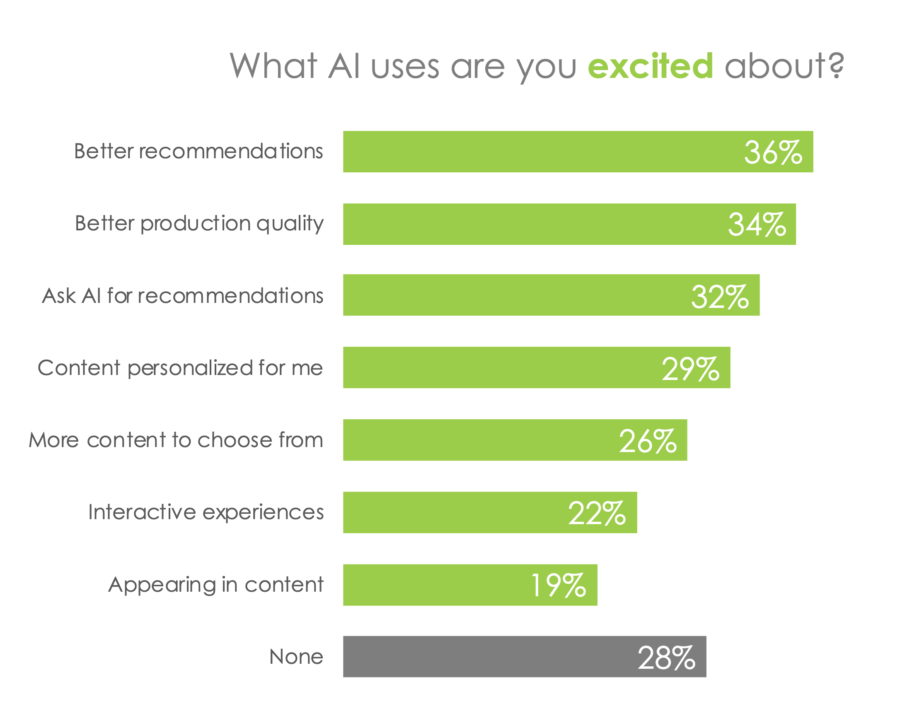
As Hollywood studios embrace more artificial intelligence in entertainment, consumers say they would like AI technology to be transparent when used in content, and they are excited about its use to improve content discovery, according to new data from Hub Entertainment Research.

A new study, based on a survey of 2,500 U.S. consumers age 16–74 conducted in November 2025, found that 72% of respondents feel at least somewhat familiar with generative AI and how it works. Another 73% say they have used generative AI tools online, up from just 57% a year ago.

Almost half (49%) think that generative AI will be good for society — twice the number who think it will be bad, and up from 44% last year.

The strongest excitement centers on AI-powered content discovery, such as smarter recommendations or conversational tools that help viewers decide what to watch next. These uses position AI as a guide that makes entertainment easier to navigate, rather than a tool that fundamentally alters creative output.


On the flipside, survey respondents said their biggest misgivings about AI revolve around being misled by AI-generated content or losing the ability to distinguish what is real from fake.

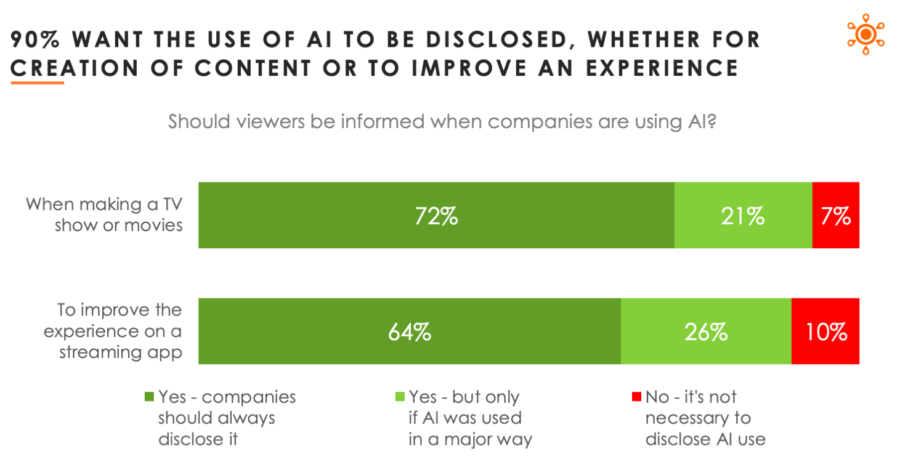
About 72% of respondents said that media companies should always disclose if AI was used in any way to make content they’re watching, and another 21% said studios should disclose if AI played a major role in content creation. Only 7% feel like no disclosure about AI is necessary.


Hub found that 40% of respondents said they are “completely comfortable” with AI being used by “regular people for personal reasons.” That’s roughly twice the number of respondents who feel the same about influencers or companies using AI for commercial purposes.

Hub asked respondents if they’d be interested in an AI application that enables them to create their own stories and videos using Disney IP and characters.

Among respondents who consider themselves familiar with AI, 44% said were “definitely” or “very likely” to use this feature. Another 24% said they might try it.

“Consumers have shifted significantly since last year when it comes to familiarity, usage, and optimism for AI,” Jon Giegengack, principal at Hub and one of the study authors, said in a statement. “The positive reaction to user-generated content using Disney IP reveals maybe the biggest opportunity: enabling media companies to turn audiences into participatory communities. Until now, this has been the domain of companies like TikTok, Roblox or Fortnite.”

Subscribe HERE to the FREE Media Play News Daily Newsletter!

CES 2026 Opens in Las Vegas With All Eyes on AI’s Real-World Impact and Deployment

LAS VEGAS — CES 2026 officially opens Tuesday (Jan. 6) at a time when AI is no longer a shiny new toy, but, rather, an integrated — and integral — part of every day life.

This year the world’s largest technology show will present AI not as a trend, but as a foundational technology that is revolutionizing industries by becoming embedded in everything from TVs, autonomous vehicles and advanced robotics to energy management and personalized healthcare. Even more so than at last year’s show, the focus has shifted from hype to real-world deployment, with keynotes, new product launches, and dedicated zones such as the “CES Foundry” highlighting AI’s pervasive deployment.

“CES is where innovators show up, and this year AI is at the center of nearly every conversation,” Gary Shapiro, executive chair and CEO of the Consumer Technology Association (CTA), owner and producer of CES, told Media Play News. “From the show floor to the keynote stage, leaders from across industries are demonstrating how these innovations move into the real world and how together we solve the world’s biggest challenges.”

Independently audited data for last year’s show, CES 2025, revealed a total of 142,465 participants from across the globe. This year, Shapiro said, “all signs point to a phenomenal CES, with thousands of exhibitors, a record 3,600+ Innovation Award submissions, and innovation across 13 venues and 2.6 million net square feet.”

New this year is the CES Foundry, located at Fontainebleau Las Vegas and aimed at uniting innovators, entrepreneurs, investors, government officials, and media to explore how AI and quantum technologies are defining the next era of innovation.

“This year, AI is accelerating innovation across every sector,” Shapiro said. “CES Foundry will serve as a hub for the innovators leading that charge, and I’m looking forward to the ideas that will emerge.”

Subscribe HERE to the FREE Media Play News Daily Newsletter!

The CES Foundry will feature two stages, the Breakthrough Stage and the Discovery Stage. Programming will alternate between the two, including panel discussions, fireside chats, and thought-leader conversations featuring influential voices in technology.

Entertainment hasn’t been in the CES spotlight since the heyday of DVD and Blu-ray Disc, but the rise of streaming — and the growth in ad-supported models — hasn’t gone unnoticed. At the Jan. 4 Tech Trends to Watch presentation, Melissa Harrison, VP of marketing and communications for CES producer the Consumer Technology Association (CTA), called out “the rise of ad-supported streaming” as a primary driver in a projected 4.2% uptick for 2026 in consumer spending on software and services.

Accordingly, the cluster of streamers and their enablers typically holed up at the Aria-Cosmopolitan-Vdara complex in the heart of the Las Vegas Strip includes Amazon Prime Video, Disney Advertising Sales, Netflix, Xumo, and NBCUniversal Media (parent of Peacock), along with Meta, Reddit, Roku and X.

Netflix’s presence isn’t as showy as it was two years ago, when it took out a massive booth on the CES 2024 show floor for an immersive activation to promote the series “3 Body Problem.” But the top streamer promises a raft of private meetings, many of them centered around its pending acquisition of Warner Bros. Discovery’s studio and streaming assets. Netflix is also focusing on emerging technologies such as AI, gaming and metaverse experiences, leveraging its recent acquisition of avatar AI technology company Ready Player Me.

CES 2026 will also feature more than 350 conference sessions and over 1,300 speakers. Sessions will focus on the pervasive integration of AI and robotics across various industries. Other major topics include digital health, advanced mobility, smart homes, energy, and the creator economy.

Keynote addresses at CES 2026 will be delivered by such high-powered business executives as Dr. Lisa Su, chair and CEO of AMD; Siemens president and CEO Dr. Roland Busch; Havas CEO and chairman and Vivendi chairman Yannick Bollor; Lenovo chairman and CEO Yuanqing Yang; and Caterpillar CEO Joe Creed.

In addition, an assortment of celebrity guests will participate in conference programming, sponsored sessions and special events throughout the show. Reddit founder Alexis Ohanian will participate in the Great Minds session “Back to the Future: Tech’s Nostalgic Revolution.” Hank Shocklee, a member of the hip hop group Public Enemy, will speak on an “Innovation for All” panel. RZA (Bobby Diggs), rapper, producer, actor, filmmaker and leader of the Wu-Tang Clan, will speak on the panel “From Concept to Reality: Creatives Using AI to Bring Big Ideas to Life.” And Serena Williams, entrepreneur and 23-time Grand Slam champion, will speak on the “Insights to Action: The Power of Biowearables” panel.

Policymakers from across the world will discuss domestic and global tech policy issues including privacy, trade, competition, and more. More than 200 international, federal, state and local government officials and staff participate in the Leaders in Technology Program and attend the Innovation Policy Summit (IPS) at CES.

Exhibits in the Las Vegas Convention Center are, as usual, grouped by industry segment. The LVCC Central Hall will showcase the latest innovations in home entertainment and living. This is where the big CE companies set up their massive booths to showcase the latest innovations in televisions. The Central Hall is also home of the CES Creator Stage.

Exhibits in the North Hall focus on smart communities, IoT, AI and robotics. The South Hall is home to accessories and gadgets. And the West Hall is devoted to mobility, from self-driving cars to construction, agriculture, boating and advanced air travel.

The C Space at the Aria, Cosmopolitan and Vdara hotels is where top brands, advertisers, media platforms, and content creators meet to forge deals, explore trends and unveil the latest technologies.

The Venetian is home to smart living, including digital health, smart home, energy management, security, education, lifestyle and food tech. The Venetian is also home to the CES Innovation Awards Showcase.

And Eureka Park at The Venetian is CES 2026’s Startup Hub, with global pavilions and emerging companies from the United States, the European Innovation Council (EIC), France, Hong Kong, Italy, Korea, Japan, Netherlands, Switzerland, Taiwan, Ukraine and others.


AI’s Second Act

Last year, when we published our inaugural roundup of the 20 most transformative uses of artificial intelligence in digital entertainment, it felt like we were stepping onto a fast-moving walkway. AI was intriguing, untested, and — at least in our business — still in the early “promise and potential” stage.

Twelve months later, that walkway has turned into a bullet train.

What was experimental is now operational. What was theoretical is now being deployed across studios, streamers, tech companies and creative shops with startling speed. And what was once dismissed as hype is increasingly becoming the infrastructure of the digital entertainment ecosystem.

For this second annual edition, we again invited our readers to nominate the AI tools, platforms and workflows they felt were truly moving the industry forward. But as always, we didn’t stop there.

Our editors spent weeks reviewing submissions, cross-checking claims and conducting additional research to make sure we weren’t just echoing press releases, but spotlighting bona fide standouts. The result is a carefully curated list of 20 innovations that, collectively, tell the story of where AI in entertainment is headed — and how quickly it’s getting there.

What’s especially fascinating this year is the widening gap between how consumers view AI and how the industry is embracing it.

A recent Looper Insights study found that 56.8% of streaming executives say systematic AI training is already underway inside their companies. Meanwhile, only 22.8% of consumers find AI-created content “exciting,” and nearly a quarter are outright opposed to it. Executives see efficiency, precision and new creative opportunity. Consumers worry about authenticity, human storytelling, and the robots taking over.

Yet even the skeptics are already feeling AI’s impact, whether they realize it or not.

Tools like Vobile’s DreamMaker are giving independent creators production capabilities that used to require a studio. Flawless’ TrueSync is
reinventing global localization by making dubbed performances look natural — sometimes eerily so. Cinesearch is tackling the “What should I watch?” problem with intelligence that understands mood and intent instead of just keywords. And across the board, companies such as Looper Insights, Whip Media, Luma AI, Holywater and LG Ad Solutions are building the invisible machinery that makes entertainment more efficient, more discoverable and more globally scalable.

In other words, AI is no longer the shiny new toy. It’s become the infrastructure.

Which brings us back to a question that loomed large last year: Is AI a threat to creativity?

After looking at hundreds of nominations and digging through countless demos, prototypes and case studies, my answer hasn’t changed.

AI isn’t replacing creators. It’s replacing inefficiency.

It can help filmmakers localize without losing emotion. It can help marketers understand where their budgets actually go. It can help rights managers turn messy avails into clean, actionable data. And it can help viewers break free from the endless scroll and actually enjoy the night’s entertainment.

What it cannot do is originate the very thing this industry is built on: human imagination, intuition and heart. It can accelerate the process, sharpen it, and sometimes surprise us — but it can’t replace the spark that only people bring.

So with that, we present our second annual roundup of the 20 game-changing AI deployments in digital entertainment. If last year marked the dawn of a new era, this year marks the moment the sun really came up.

And trust me: By next year, the landscape will look different yet again.

Subscribe HERE to the FREE Media Play News Daily Newsletter!

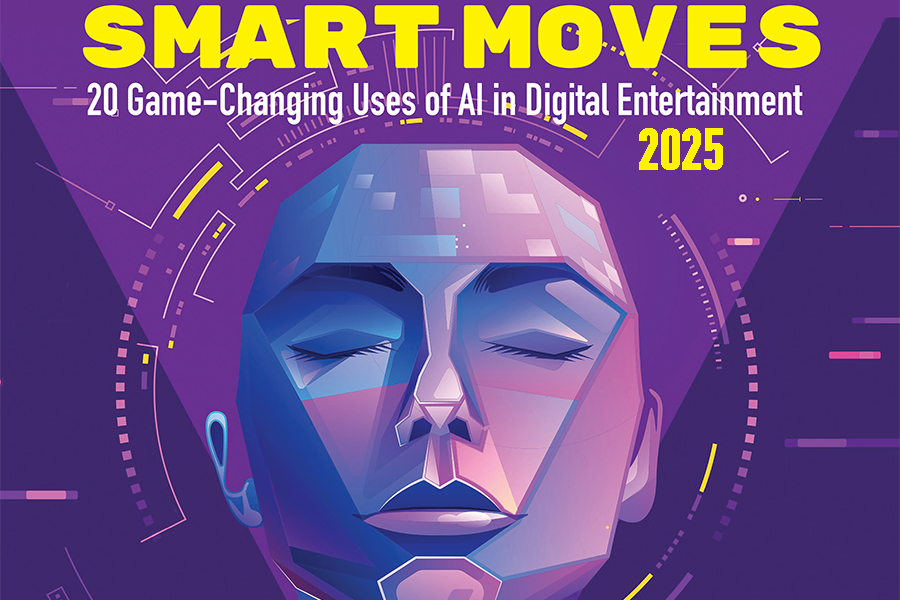
Smart Moves: 20 Game-Changing Uses of AI in Digital Entertainment 2025

Welcome to Media Play News’ second annual feature spotlighting the groundbreaking ways artificial intelligence and machine learning are reshaping the digital entertainment landscape. This year’s featured products and technologies cover everything from revolutionizing content creation, supply chain logistics and content discovery, to marketing that content and dubbing it for localization.

The top 20 selections were chosen by our editorial team, who carefully reviewed nominations submitted by our readers and then did hours of additional research to make sure we were spotlighting only the true standouts.

And then we asked ChatGPT to rank them — countdown style.

AI is clearly on the march, but consumers are wary.

In a Looper Insights study of 1,200 U.S. consumers and 48 streaming executives that was conducted Oct. 6-20, 56.8% of streaming executives said systematic AI training is already underway in their companies.

While executives rank AI-driven content creation (scripts, visuals, editing, localization) as the No. 1 most disruptive application of AI, seeing AI as a creative engine, audiences are divided on the concept, fearing a loss of authenticity compared with human storytelling. Only 22.8% of consumers see AI-created content as exciting, while 25.4% are skeptical and 24.5% are outright opposed.

Meanwhile, 38.3% of executives say AI assistants and interactive AI-driven storytelling have very high potential for the future of streaming, while consumers are, again, split. Only 27.1% of consumers in the survey said they would regularly use an AI assistant, and only 29.1% said they are excited about AI-driven interactive stories. A sizable portion would prefer no AI involvement at all.

Despite consumer concerns, the industry believes AI’s benefits outweigh the risks, with 42.7% of executives in the survey saying AI’s upsides (efficiency, cost reduction, personalization) outweigh the downsides, and only 13.8% believing the risks (job displacement, bias, loss of creative authenticity) outweigh the benefits.

While consumers may be hesitant, the industry is embracing AI as a key tool in the future of the entertainment industry. Here are the 20 initiatives from 2025 that our editors believe play the most significant role in pushing the industry into that future.

READ ALSO: AI’s Second Act

Subscribe HERE to the FREE Media Play News Daily Newsletter!

20. Chillfree TV —DotstudioPro

DotstudioPro this year launched Chillfree TV, what it bills as the world’s first AI-built OTT platform supporting 24/7 live FAST and AVOD content featuring more than 7,500 hours of content. The company also merged with independent supplier BayView Entertainment to add content.

Available cross-platform on iOS/Android, Roku, Apple TV and Fire TV, with Samsung, Vizio and LG launching shortly, Chillfree TV is a free ad-supported streaming service featuring classic and independent films across all genres, contemporary TV series, a 4K movie collection and more — built entirely by AI using tools such as Manus, Claude 4.0 and Cursor, and powered by dotstudioPRO’s API-first infrastructure.

What makes Chillfree TV unique is not just the way it was built but how the content was curated, according to the company. The platform’s launch slate draws from titles that have demonstrated strong monetization and engagement metrics across dotstudioPRO’s extensive third-party AVOD, TVOD and FAST distribution network. The platform features 24/7 live FAST channels with an AI-optimized program guide and personalized discovery through smart AI search and recommendations.

In addition, through the strategic merger with BayView, Chillfree TV has added more than 3,500 hours of content such as the genre film Skinamarink, and legacy releases Robot Monster and The Endless Summer. The catalog allows dotstudioPRO to scale faster into AVOD, TVOD and FAST.

Our editors say: An ambitious AI-built OTT service, but its impact depends on long-term traction in a competitive FAST/AVOD landscape, as well as its content lineup.

19. Roku Voice Assistant Upgrade

Roku in October updated its voice assistant with AI features that can answer questions about movies, shows and actors, as well as help consumers find something to watch next.
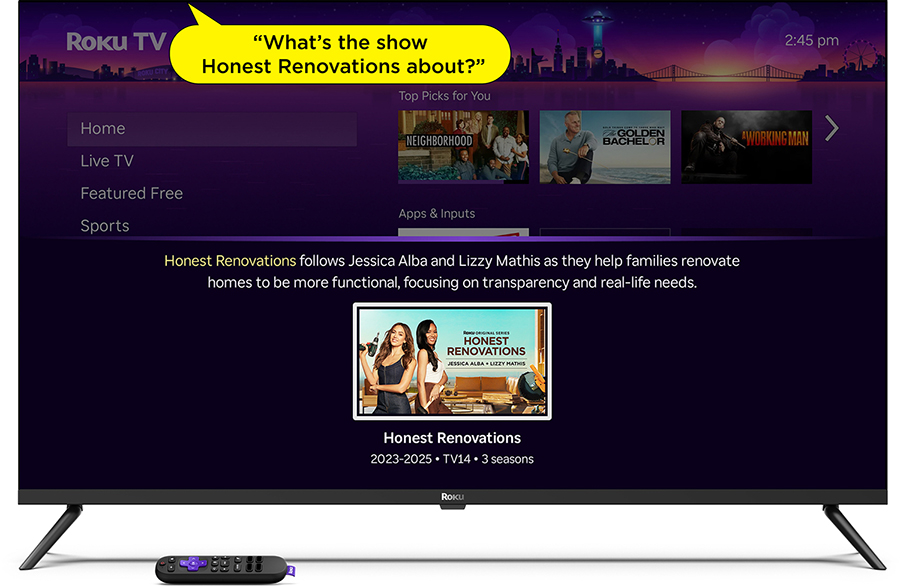


Now, instead of just following simple commands, Roku says its voice assistant can respond to questions such as “How scary is The Shining?” or “What kind of fish is Nemo?” or “What’s Barbie about?”

Roku Voice will display a text response on your screen, while also offering links to shows or movies relevant to the query.

Viewers can ask Roku Voice questions about movies, shows and actors, and see the answers on their TV. Viewers can also ask follow-up questions, and Roku Voice will keep up with the conversation, responding directly on the screen.

Our editors say: A useful enhancement to voice search, yet largely incremental in a space already crowded with similar assistants.

18. Home Page — Samsung TV Plus

Samsung TV Plus, the consumer electronics giant’s FAST service, in August unveiled an upgraded user home page with enhanced interface, navigation and AI-driven personalization, among other features. The upgrade aims to enable less scrolling and easier discovery of content for Samsung TV owners.

“With AI at the core and a bold new look, this is our smartest and most visually stunning update yet,” Salek Brodsky, SVP and global head of Samsung TV Plus, said at the time.

The key new features include a new design and interface simplifying navigation, with metadata and enhanced imager, and a personalized home screen based on personal viewing habits to bring the most-relevant channels, shows and genres to the forefront. The page now allows easier transition from linear programming to on-demand content, in addition to improved discovery for live content such as sports and breaking news. Samsung TV Plus carries more than 3,500 ad-supported linear channels in 30 countries, and is accessible on more than 630 million active devices.

The platform is the exclusive home of “Conan O’Brien TV” and “Letterman TV,” among other channels available worldwide. Samsung TV Plus is available on Samsung TVs, Galaxy devices, Samsung Smart Monitor and Family Hub.

Our editors say: An interface redesign with improved personalization that benefits users, but doesn’t fundamentally reshape content distribution or creation.

17. kAI — Kaleidescape

Movie platform maker Kaleidescape in August announced an AI-powered discovery feature, kAI, now available on the Web version of the Kaleidescape Movie Store. The new feature enhances the way movie enthusiasts find and explore movies, music concerts and television shows, making the discovery process smarter, more intuitive and personalized, according to the company.

“kAI represents our commitment to transforming movie discovery through cutting-edge AI technology,” Tayloe Stansbury, chairman and CEO of Kaleidescape, said at the time. “Kaleidescape continues to pioneer the future of premium home entertainment, and kAI marks a significant step forward in delivering smarter, more-engaging experiences.”

With the addition of kAI, Kaleidescape customers can harness the power of generative AI to find exactly what they’re looking for, when logged into the movie store and using the feature with natural-language prompts. For instance, a user can simply type “What’s the movie where the guy falls in love with the machine?” to get tailored results, or refine their search with more-detailed questions such as “Are there any that are set in space?” and “Are any of these appropriate for teens?” to find the perfect movie, according to the company. This new feature builds on Kaleidescape’s discovery features, which include its on-screen cover art shuffle that uses proprietary algorithms to bring similar movies together.

Our editors say: A strong natural-language discovery tool for a premium niche audience, but too limited in adoption to shift broader industry workflows.

16. Agentiv — LG Ad Solutions

LG Ad Solutions, a global provider of connected-TV advertising technology, in October unveiled Agentiv, an artificial intelligence platform developed to support the company’s suite of internal and external agents that enhance operational and data-driven efficiencies.

Agentiv is part of LG Ad Solutions’ broader efforts to incorporate AI tools into its advertising technology framework to improve workflow automation, collaboration and data accessibility. Currently, more than 20 intelligent agents operate within Agentiv, supporting various operational workflows. Internal applications include a media planning agent that produces feasibility reports based on campaign inputs, and a creative review agent that assists in managing ad-approval processes.

The initial phase includes a data collaboration agent that enables participating brands to combine their customer data with LG Ad Solutions’ insights in a privacy-compliant environment designed to inform audience identification and campaign evaluation.

Key features of Agentiv include:

  • Natural Language Query: Allows users to access campaign data through conversational interactions.
  • Persona-Based Permissions: Provides tiered access so advertisers, agencies, and partners can view relevant data securely.
  • Clean Room Integration: Supports privacy-focused data collaboration for shared insights.
  • Optimization Support: Enables data-driven assessment of campaign performance for timely adjustments.


Our editors say: Improves internal ad-tech efficiency through automation, but its effects remain mostly behind the scenes and operational.

15. Looper Insights’ AI Strategy Planner

Looper Insights’ AI Strategy Planner is a generative AI tool that transforms how content owners, distributors and streamers plan and measure digital merchandising.



Looper’s data provides visibility into where titles appear marketed across major connected-TV platforms, helping teams turn on-screen placement data into measurable value. Its new AI Strategy Planner elevates that intelligence by letting marketers generate instant, data-driven strategies through natural-language queries.

For example, users can simply ask, “I’m planning the launch of a new rom-com. Analyze relevant historical performance across our catalog and key competitors, and create a playbook that will maximize ROI across our priority U.S. platforms.” The AI then draws on Looper’s dataset to identify patterns, forecast outcomes and recommend the most impactful placements and creative approaches.

Looper Insights’ AI Strategy Planner helps marketers optimize visibility of content.

At the core of this capability is Media Placement Value (MPV), Looper’s proprietary metric that quantifies the visibility and commercial worth of every on-screen placement. MPV turns digital shelf space into media value, enabling accurate forecasting, benchmarking and demonstrable ROI.

Marketers can also inject their own data — combining internal knowledge with Looper’s intelligence.

Our editors say: Adds powerful intelligence to merchandising and windowing strategies, yet its impact is confined to marketing infrastructure.

14. Runway Incorporation — AMC Networks

AMC Networks in June announced a deal with Runway to incorporate the AI startup’s models and tools in AMC Networks’ marketing and TV development processes.

AMC Networks — home to such big subscription streaming services as AMC+, Shudder and Acorn TV — says deploying Runway’s tech has two big benefits. It helps creators and showrunners visualize, in advance, shows that have yet to be produced, allowing them to experiment with different visual directions without spending big money on sets and test shoots. Runway’s AI tech also lets marketers create stock images that can be used for promotional purposes, bypassing the need for expensive photo shoots.

Stephanie Mitchko, EVP of global media operations and technology at AMC Networks, said in June that “Runway’s cutting-edge technology is particularly exciting for its ability to streamline access to standout scenes for promotional use, support campaign ideation and even accelerate pre-visualization during development, blending AI innovation with creative collaboration. Our objective is always to use every tool at our disposal to help our creative partners fully realize the stories they want to tell. This partnership with Runway is the latest application of this longstanding commitment.”

On the company’s August earnings call AMC Networks CEO Kristin Dolan told analysts, “We’ve already begun using these tools to efficiently and quickly explore possibilities around certain storylines or locations, expanding the quality and volume of opportunity in these important areas.”

Our editors say: Accelerates marketing and pre-production workflows, but remains primarily an internal creative accelerator rather than a consumer-facing disruptor.

13. NBA Inside the Game — NBA and Amazon Web Services

The National Basketball Association and Amazon Web Services in October announced a multiyear partnership that will incorporate AI-powered technology into league games streamed on Prime Video and other digital channels.

“NBA Inside the Game, powered by AWS” will provide AI-powered stats to help fans dive deeper into the games, teams and players they follow. The new platform will be available across all NBA digital channels, including the NBA App, NBA.com and the league’s social platforms.

New AI-powered stats include “Defensive Box Score,” which uses AI algorithms to track which defender is responsible for each offensive player in real-time; “Shot Difficulty,” which assesses the difficulty of attempted shots by taking into account such factors as the shooter’s orientation and setup, court positioning and defensive contest details related to pressure, interference and positioning; “Gravity,” which showcases how certain players create advantages for teammates simply by being on the court, even without touching the ball; and “Play Finder,” a new tool that uses AI to analyze and understand player movements across thousands of games.

Future iterations of the software will allow fans to explore basketball strategy on the NBA App. This technology lays the foundation for future generative AI integrations built on player tracking data, moving beyond technical capabilities to deliver tangible insights fans can use to deepen their understanding of the game.

Our editors say: Enhances analytics and fan understanding of the sport, though its relevance is limited to live sports rather than the full entertainment landscape.

12. Data Enhanced Live Sports — Prime Video

Prime Video continues to leverage Amazon’s tech skills and resources to enhance the viewing experience for NFL fans with new AI-powered features for the 2025 Thursday Night Football season.

The streamer in August said the AI-powered Prime Insights will be introduced throughout the season on Prime Vision with Next Gen Stats, an alternative stream fans can watch in addition to the main feed. Prime Vision serves as a laboratory and incubator for new features that may eventually advance to the main feed.

Pocket Health is a proprietary AI model that instantly analyzes tens of thousands of data points across the offensive line throughout the play, generating dynamic on-screen visuals and statistics that illustrate threat levels affecting the QB’s protection in the pocket.

The End of Game Suite consists of three new tools that deliver insights surrounding crucial late-game scenarios and strategies for both teams: Path to Victory employs AI to predict remaining possession scenarios for trailing teams to map potential paths toward a comeback victory; Time Remaining Prediction features advanced game clock analysis that predicts how much time will be left on the clock if the defense can force a three-and-out; and Victory Formation identifies the right amount of time needed for a leading team to secure one final first down, and the ability to run out the clock.

Our editors say: Delivers innovative, predictive NFL insights for viewers, but remains confined to the live-sports vertical.

11. Netflix Ads Suite

Netflix advertising president Amy Reinhard at the streamer’s May 14 Upfront presentation in New York City unveiled a series of new ad tools energized by both data and AI for the Netflix Ads Suite.

With the Netflix Ads Suite, advertisers can incorporate their first-party data, either through LiveRamp or directly with Netflix, so clients can match data sets for behavioral insights and targeting capabilities against Netflix’s ads audience.

Netflix also opened third-party data access to such partners as Experian and Acxiom, and announced its own “clean room” strategy, with a safe, neutral space for data collaboration and partnerships.

Netflix also announced the development of new first-party measurement solutions, starting with a brand-lift capability tying viewing behaviors to consumer brand perceptions.

The company debuted a new modular framework for ad formats that leverages generative AI to instantly marry advertisers’ ads with its shows.

Reinhard unveiled the first capability with interactive midroll and pause formats that build custom advertising creative with added overlays, call to action, second-screen buttons and more to serve the right ad to the right member at the right time. These formats will be available by 2026 in all ad-supported countries, according to Netflix.

Our editors say: Transforms targeting, measurement and creative modularity for ad buyers, yet sits more on the business side than at the core of content transformation.

10. My Drama — Holywater

My Drama is a vertical streaming platform delivering cinematic, phone-first series. The core innovation is a closed loop between production, marketing and product, generating and localizing large volumes of creative concepts for every title and releasing hundreds of thousands of assets across multiple languages.
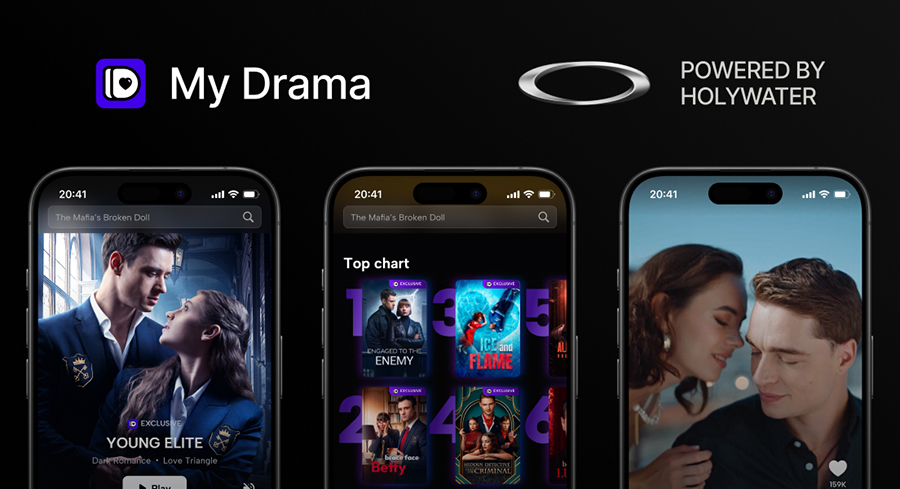
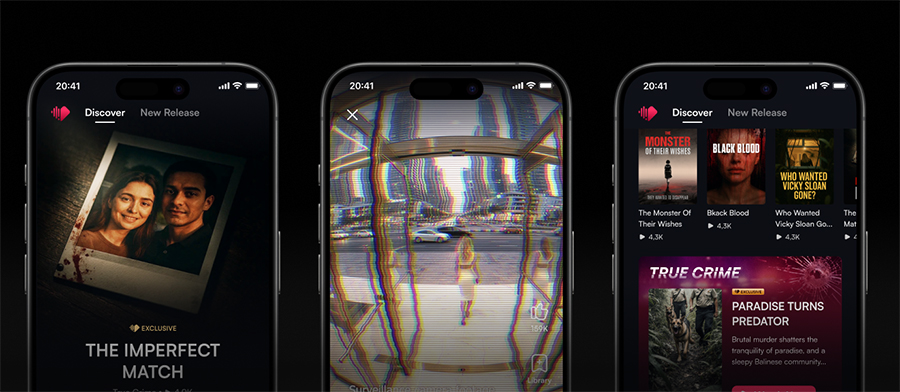

User acquisition teams run hundreds of multivariate tests daily through an AI-assisted workflow, while audience signals are shared back in real time with editors, producers and product teams. This technology allows hooks, pacing and positioning to be refined continuously, ensuring each title finds the right audience quickly and efficiently. Flagship series have reached up to 20 million views, and title campaigns have generated more than 7 billion social impressions.

With a custom AI tool, the marketing team can produce twice as many creatives while freeing up 50% of their capacity, according to Holywater. Organic growth teams amplify this with high-end content across Meta, TikTok, Google and YouTube, helping the My Drama channel reach 1 million followers and deliver billions of impressions.

This model enables global discovery of bite-sized cinematic storytelling and unlocks new creative and commercial opportunities for Hollywood and worldwide creators.

The workflow addresses a growing industry problem: Indie filmmakers and small studios struggle to reach global viewers without legacy-sized budgets. My Drama reduces the cost and time required to build an audience by pairing premium vertical content with AI-accelerated creative generation, rapid testing and global localization.

Our editors say: Enables scalable vertical-series workflows but remains tied to a specific content format with limited broader industry application.

9. My Muse — Holywater

My Muse is a streaming platform for vertical video series produced with the aid of generative AI. The platform solves an existential problem for creators, empowering them to produce, distribute and fairly monetize high-quality video series for as little as 10% of the cost of traditional production, according to Holywater. My Muse series are created, written and directed by humans, with AI tools used to assist with audience analysis, idea generation, storyboarding, production and distribution.

My Muse is part of the tech company Holywater, with more than 55 million users across a portfolio including My Drama, a Webby Award-winning vertical streaming platform, and My Passion, an e-book platform. My Muse was originally built as a script-testing tool to support My Drama, but when early AI series outperformed all expectations, it quickly evolved into a standalone product.

With plans to include all genres, My Muse currently focuses on crime, a massive genre that remains largely unexplored in the vertical space due to production costs, according to Holywater. The market opportunity is immense, according to Holywater, with vertical video projected to be a $14 billion industry by 2027.

My Muse is already home to several successful AI-supported series. As it scales, it aims to release 100 short series per month. The Distance Between Two Points of Me, an AI short film from Ukrainian filmmaker Illya Dutsyk, won two Gold Telly Awards and was a finalist at the 2025 Runway AI Film Festival, the world’s largest AI-powered film festival.

Our editors say: Demonstrates the power of AI-assisted vertical series, yet still operates mainly in emerging formats rather than mainstream entertainment.

8. Paramount+ Fan Frontier

Paramount+ in July launched “Paramount+ Fan Frontier,” an interactive, AI-powered social experience based on the “Find Your Mountain on Paramount+” campaign, in which hit shows are blended to create bizarre mashups (such as “Yellowjackets” with “Survivor,” or “Star Trek” with “SpongeBob SquarePants”).

The Paramount+ Fan Frontier stunt invited fans on Facebook and Threads to reply to prompts to showcase their fandoms, including “name your favorite Paramount+ series” and “share your dream vacation spot.” Select participants then were given custom “deeds” to their own unique plot of land on Paramount Mountain. The personalized plots could range from a beachfront Dutton-style ranch to a luxurious pineapple under a tree in Tuscany. Each deed featured the owner’s social handle and official plot name, a design inspired by their chosen genre and a visual of Paramount Mountain.

The Paramount+ Fan Frontier campaign leveraged Adobe Firefly’s generative AI technology to build the personalized deeds in real-time. The campaign debuted July 9, with a second iteration held later that month at Paramount+’s “The Lodge” during San Diego Comic-Con, where fans were invited to answer prompts while in line as a remote design team generated a digital deed based on responses. Fans could pick up their printed land deed scroll upon exiting The Lodge, and a digital copy was sent via text for online sharing.

Our editors say: A clever AI-powered marketing activation that could be a model for things to come.

7. An AI-Powered Movie Studio — Fairground Entertainment

Fairground Entertainment is a new studio and streaming platform that is focused exclusively on creating AI-generated TV series. The company’s launch was announced in May by Colin Petrie-Norris, a founder of FAST pioneer Xumo, who told journalists he has raised $4 million in seed money from a group of investors that includes programming advertising company Viant Technology, which was one of the founding partners of Xumo alongside Panasonic.

Fairground at the time said it will launch its journey into AI-generated entertainment with a curated slate of programming developed alongside hand-picked creators. These initial projects explore innovative reimaginings of popular public domain stories, involving such iconic characters as Dracula and Robin Hood, as well as officially licensed, widely recognized IP to reimagine popular franchises for modern audiences. Fairground’s vision is to expand and redefine the entire entertainment ecosystem, combining human creativity with the power of advanced AI to unlock new forms of storytelling.

The company will produce both short-form and long-form content and was supposed to unveil its first shows in the third quarter of this year, but there is no release information on its website, just a solicitation for creators. Petrie is speaking in January at CES in Las Vegas.

Our editors say: Bold in concept, but unproven until it successfully delivers and distributes end-to-end AI-generated long-form programming.

6. Helix — Whip Media

Whip Media’s Helix platform helps entertainment companies manage, distribute and monetize content by replacing manual workflows and inconsistent data with a coordinated AI-native pipeline.
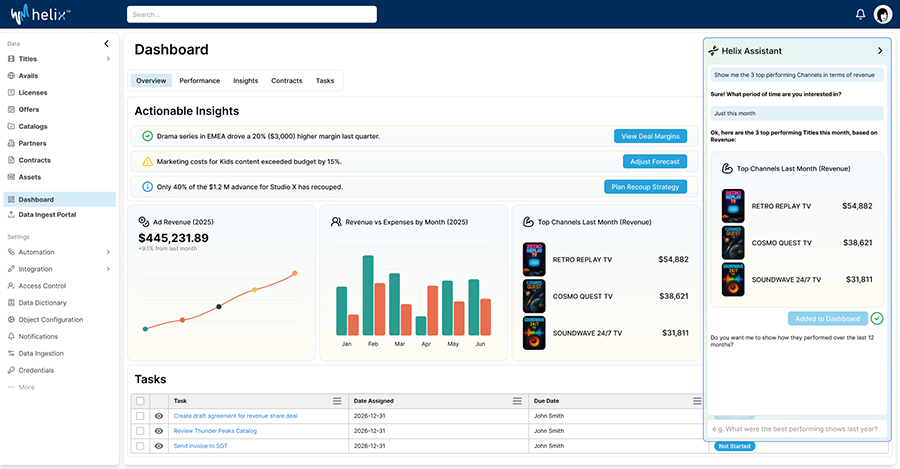

Helix includes:

  • Avails Ingestion and Normalization: Helix ingests avails from any partner and format (Excel, PDFs, feeds, APIs), validates and standardizes them, and maps them to canonical title records so availability decisions are accurate and repeatable.
  • Licensing and Contract Association: Once avails are selected, Helix supports licensing workflows end-to-end. Contracts can be managed natively or ingested and structured from external systems and documents.
  • Performance Data Integration and Insight: Helix ingests performance data from distribution platforms, unifies it against titles and surfaces it for reporting and analysis, supporting trend analysis, revenue assurance, programming optimization and renewal decisions.
  • The Agentic AI Pipeline: Helix is not simply “AI-on-top”; it uses agentic AI natively, coordinating specialist AI agents, each handling a distinct stage of the supply chain: Classification Agent determines data type and processing strategy; Extraction Agent identifies titles, windows, terms, pricing and metrics from structured and unstructured sources; Transformation Agent standardizes data to Helix’s schema using controlled vocabularies and enrichment; Validation Agent applies rule-based and predictive checks with anomaly explainability; and Mapping Agent matches products to known titles using semantic and metadata-driven similarity.


With its understanding of the business logic of rights, windows and revenue models, Helix turns raw data into operational intelligence, enabling faster partner and catalog onboarding, confident real-time availability and licensing decisions, revenue leakage detection, renewal and window optimization, and full data lineage and auditability. What once took days in the digital supply chain now takes minutes.

Our editors say: Reinvents the supply chain through agentic AI, providing deep operational value with industry-wide implications.

5. DreamMaker — Vobile

Vobile’s DreamMaker platform combines AI-powered video production with copyright protection and monetization solutions. Built on top of NVIDIA Media2 technologies and leveraging NVIDIA accelerated infrastructure, DreamMaker helps independent creators generate, compose and publish short video content while ensuring copyright compliance. Thus, creators can leverage the latest AI technologies to produce videos that respect existing IP, ensure copyright protection and generate revenue from their work.


Key features include:

  • Integration of Multimodal AI Models: Access to multiple generative AI models along with NVIDIA Media2 resources to create content.
  • Comprehensive Production Suite: A set of AI tools for video creation to streamline workflows.
  • Built-in Copyright Protection: Digital fingerprinting and watermarking technologies to ensure copyright compliance.
  • One-Click Monetization with the Vobile Max platform: Increased revenue opportunities for independent creators to focus on
    storytelling.
  • Production with NVIDIA-accelerated Infrastructure: Performance accelerated by Blackwell to boost revenue and profit for creators.


Vobile’s DreamMaker platform helps independent creators generate short video content without violating copyrights.

Vobile recently partnered with Immortal Studio to bring its technologies to a broader community of independent creators. Creators collaborating with Immortal will gain access to Vobile Max and DreamMaker platforms.

Our editors say: Empowers creators with comprehensive AI tools while integrating copyright protection, making it highly impactful for independent creation ecosystems.

4. Cinesearch — Cineverse

In today’s streaming era, viewers face endless choice, spending lots of time searching for something to watch, flipping through menus across disconnected apps. According to Gracenote’s 2025 State of Play report, 46% say it’s harder than ever to find what they want, and half would cancel a service if they can’t easily discover something new.
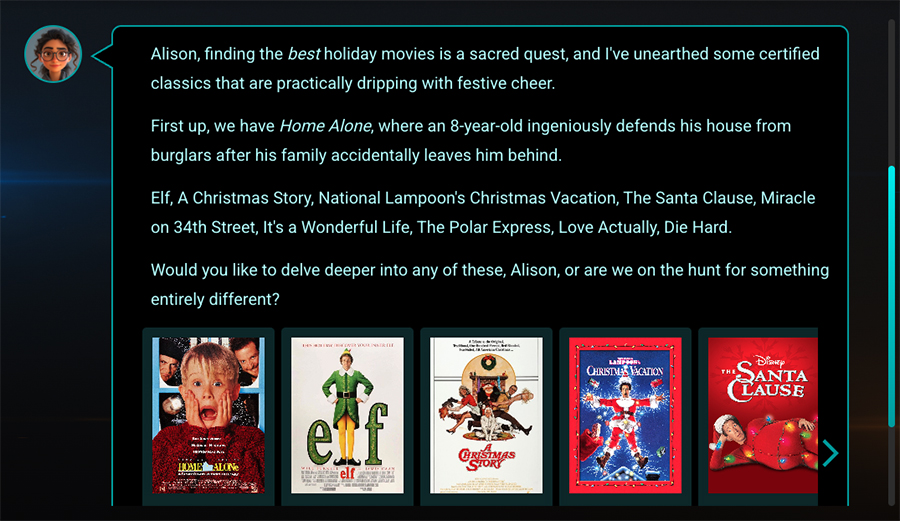

Cinesearch attempts to solve this problem by unifying content discovery across streaming services through AI that understands emotion, mood and context — turning “What should we watch?” into an intuitive, personalized answer.

For instance, when asked for best holiday movies (see screenshot below), Cinesearch understands intent and doesn’t rely on keywords, suggesting Home Alone or Die Hard. By comparison, Netflix suggests Captain Underpants: Hack-a-ween or Making It in Marbella with the same prompt. Cinesearch results are powered by Q-Points, an AI system that reveals how mood, setting, and sentiment drive each recommendation. This transparency builds trust and helps audiences understand why certain titles appear.

A screenshot of Cinesearch’s recommendations for best holiday movies.

Users can filter by genre or streaming service, instantly narrowing results to what’s available on their subscriptions. Biometric voice recognition personalizes results for every household member and learns individual preference. Privacy is foundational — data stays securely on-device and is never shared externally.

For viewers, Cinesearch reduces friction and replaces choice overload with clarity. For media partners and device manufacturers, it reduces churn, deepens engagement and extends viewing sessions by connecting audiences to what they love.

Our editors say: A breakthrough in AI-driven discovery that reduces churn and directly solves one of streaming’s biggest consumer pain points.

3. TrueSync — Flawless

TrueSync, developed by Flawless, is an AI-driven localization system that lets actors appear as if they’re naturally speaking any language without reshoots, CG replacement or 3D scanning. Combining 3D performance mapping, audio-driven facial activation, and neural rendering, TrueSync rearticulates an actor’s mouth movements to match new dialogue while preserving micro-expressions and emotional nuance from the original performance.

The system begins by capturing the actor’s unique facial motion in 3D, then analyzes the new dubbed audio to predict how that actor would naturally articulate each sound. Finally, neural rendering synthesizes these new movements directly into the original footage, frame-accurate and photorealistic. A preprocessing step called “dialog removal” isolates emotion from speech, creating a “blank canvas” for new languages without losing authenticity.

TrueSync integrates into standard post-production tools such as Avid, Nuke and Resolve, ensuring compatibility and scalability for films, series and streaming content.

Every localized version is tracked through Flawless’ Artistic Rights Treasury (A.R.T.) framework, ensuring consent and creative integrity.

The technology was used for Watch the Skies, the first theatrically released film to use visual dubbing.

Our editors say: A transformative advance in localization that preserves actor intent and emotional nuance, dramatically raising the bar for global distribution.

2. AI Integration — Disney+

The Walt Disney Co. CEO Bob Iger didn’t just tiptoe into the AI conversation during the company’s latest earnings call — he jumped in with both feet.

Calling AI “the biggest and most significant change to Disney+ since its launch in 2019,” Iger signaled that the streaming service is about to undergo a dramatic evolution, one that blends generative creativity, interactivity and deeper integration across Disney’s vast ecosystem.

According to Iger, the company is exploring AI-powered tools that would allow subscribers to create short-form, personalized content; experience game-like interactions inside Disney+; and move seamlessly between streaming, parks, games and commerce. In Disney’s view, AI isn’t just a technical upgrade — it’s a strategy to supercharge engagement and keep the platform sticky in an increasingly competitive streaming landscape.

But the bold vision sparked immediate backlash. Creatives and fans questioned whether AI-generated shorts and customized character interactions would dilute the craftsmanship and authenticity that built Disney’s legacy. Some accused the company of prioritizing algorithmic content over artists, prompting calls for subscriber pushback and even boycotts. Iger acknowledged those concerns, noting that Disney is in “productive conversations” to protect its iconic characters and franchises as AI adoption grows.

For Disney+, the road ahead is clear but precarious: AI may unlock powerful new experiences, but preserving the trust that defines Disney’s brand will be the real magic trick.

Our editors say: Represents a major strategic shift for one of the world’s most influential entertainment companies, blending personalization, interactivity and ecosystem-wide AI integration.

1. Ray3 — Luma AI

Ray3 claims to mark a turning point in how humans and machines create together. Built by Luma AI, it is billed as the world’s first reasoning video model, a system that doesn’t just generate footage but also understands visual intent, evaluates its own results, and refines them in real time.

Ray3 combines intelligence and fidelity, producing native 16-bit HDR EXR video suitable for film, advertising and game production. It can plan complex scenes, maintain consistent characters and motion, and deliver cinematic realism with the same dynamic range used in Hollywood pipelines.

With Draft Mode, creators can explore ideas up to 20 times faster, turning quick sketches into finished 4K HDR visuals while preserving composition and identity. This workflow mirrors how directors and designers actually think, according to Luma, allowing them to experiment first and polish later. Through partnerships with Adobe, Dentsu Digital, HUMAIN Create, Monks, Galeria and Strawberry Frog, Ray3 is being woven into the tools and studios shaping culture worldwide.

An image of an astronaut generated by Luma AI’s Ray3.

In Adobe Firefly, users can generate and refine video seamlessly between Ray3 and Premiere Pro. In Japan, Dentsu is using it to revolutionize ad production. HUMAIN is bringing Ray3 to the MENA region with cultural and ethical guardrails. Across agencies, creatives can now move from idea to broadcast-quality output in hours, not weeks.

By reasoning across words, images and motion, Luma’s system helps creators think visually in a process that is not automation, but collaboration. For entertainment, advertising and design, Ray3 offers AI that understands storytelling and brings it to life in cinematic form.

Our editors say: The most transformative because it introduces reasoning-based video generation with cinematic fidelity, fundamentally reshaping how visual storytelling can be created.

Subscribe HERE to the FREE Media Play News Daily Newsletter!


From Around the Web