



Chris McGurk arrives right on time for an interview at his reserved table at the Beverly Hills Hotel’s iconic Polo Lounge. It’s been his preferred meeting space for years, dating back to when he and his family used to live a few houses down Crescent Drive on the other side of Sunset Boulevard in the Los Angeles suburb of Beverly Hills.
 A tall, well-groomed man dressed in smart casual — premium denim jeans with a dark, patterned long-sleeve sweater — McGurk is the master of reinvention. He’s gone from running such major studios as Universal Pictures, Overture Films and MGM to building his own, Cineverse, a publicly traded company he’s headed since 2011 as chairman and CEO.
But Cineverse is not, as they say, “your grandfather’s studio.” It’s an entertainment and streaming technology company McGurk says he believes is built for a time when the traditional studio system that has ruled Hollywood for nearly a century is a shadow of what it once was, and delivering movies and shows directly to consumers over the internet is as lucrative and profitable as the old studio system was during the heyday of theaters.
Content distribution and technology, McGurk says, are “interlocked” at Cineverse. “It’s a true portfolio strategy. And what I love about it is that it completely changes the independent film model. Technology really underpins everything we do. It drives our 30 streaming channels, and it drives our advertising. We have our own advertising tech group and our own ad tech module. And that’s also the key to our theatrical business, where we’ve been opening movies and spending a fraction of the marketing dollars that our competitors spend because we’re using our whole network and system to market these movies in a much smarter way.”
Cineverse distributes content across all windows and platforms, from theatrical to digital to physical. The company has a rich library of more than 71,000 films, series and podcasts that it feeds to more than 50 million unique monthly viewers through a network of digital outlets such as Amazon, Peacock, Tubi and Pluto TV, as well as through movie theaters and physical media. Cineverse also owns more than 30 of its own streaming platforms and channels — subscription, ad-supported and FAST — including the horror media brand Bloody Disgusting and its flagship streaming service, Screambox.
Cineverse additionally has a thriving technology organization that it built alongside its content business. Matchpoint is the company’s core technology suite for delivering streaming content, an automated and workflow platform that prides itself on efficiency, and also provides tools for scalable app creation, analytics and predictive dashboards, and AI-powered quality control and metadata enrichment. Cinesearch is a consumer-facing content search and discovery platform that is powered by Matchpoint. Both are now being positioned not just for internal use, but also as commercial SaaS offerings for studios, streamers and other media companies that want to modernize their supply chains.
For his belief — which he puts into action — that streaming and theatrical are synergistic rather than cannibalistic, and that technology is the engine that allows our industry’s crown jewel, content, to shine brighter than ever, Chris McGurk is being honored with Media Play News’ 2026 Fast Forward Award. The award is given out each year to a person, technology or organization that moves the home entertainment industry forward.
READ — THOMAS K. ARNOLD: REINVENTING A STUDIO

Content Synergy
On the content side, Cineverse believes that streaming and theatrical can work very well together. For McGurk, there’s no bigger affirmation of this belief than the company’s experience with Terrifier 2 and Terrifier 3, two low-budget slasher films centered on the murderous Art the Clown. The “Terrifier” franchise was brought to Cineverse through its horror brand, Bloody Disgusting, whose executives told him they thought Art the Clown could be the next Jason Vorhees or Freddy Krueger.
Terrifier 2 was released theatrically in October 2022 and wound up grossing nearly $11 million domestically thanks to a viral marketing campaign centered on Bloody Disgusting and Cineverse’s own streamers. The company spent only about $250,000 on marketing, relying mostly on unused inventory on its own channels.
With Terrifier 3 in the fall of 2024, McGurk and his team used the same playbook, spending just $500,000 on outside marketing and using their own streaming properties as well as some recently acquired podcasts to drive consumer awareness. Terrifier 3 opened at No. 1 on the domestic box office charts and, with a gross of more than $54 million domestically and $90 million globally, ranks as the highest-grossing non-rated
film in U.S. history. Speaking at AFM in November 2024, McGurk said that with Terrifier 3, “we’ve established a new blueprint” for independent films with big viral fan bases.
“In our case, you know, we use our streaming channels to promote our movies without spending any money because we’re using the unused inventory,” McGurk says. “And what we’ve been able to do, because we have our own technology and the technology collects tons of information about what consumers are watching and what they like and what they don’t like, is assemble a huge database, particularly in horror, but also in independent film and in family, that really lets us know what people want and who the audience is.”
McGurk maintains Cineverse’s streaming network, “because it’s very focused on specific fandoms, is an incredibly efficient way for us to activate people to go see movies in theaters — and to see movies in home entertainment as well. So that’s the synergy that we think we’re really bringing to the table.”
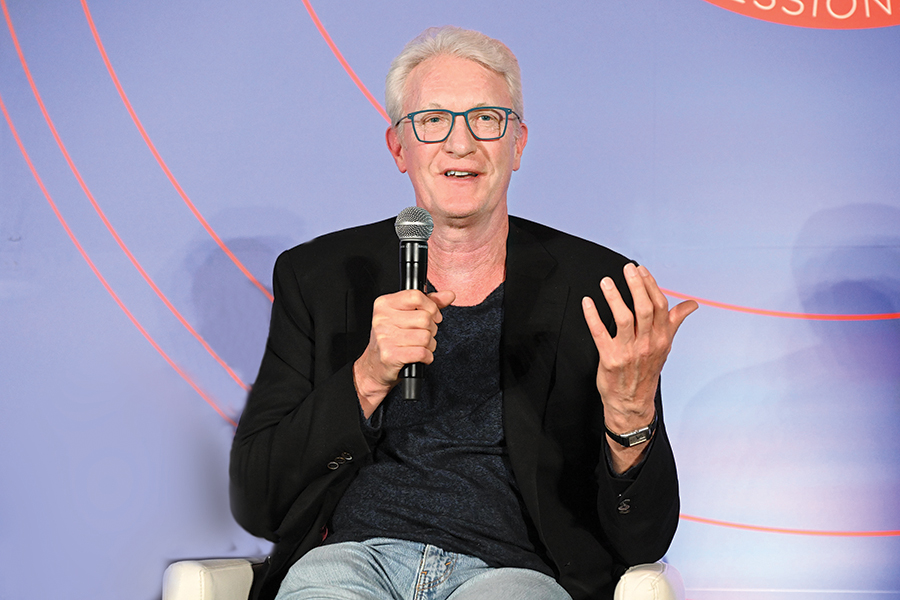
Emboldened by the success of the two “Terrifier” movies, Cineverse in May 2025 announced the creation of the Cineverse Motion Pictures Group, led by longtime executive Yolanda Macias, who was named chief motion pictures officer, a new position that replaced her previous chief content officer role. The first two big releases, remakes of 1980s cult hits The Toxic Avenger (starring Peter Dinklage of “Game of Thrones”) and Silent Night, Deadly Night (with Ruby Modine), only grossed a modest $3.5 million and $2.6 million, respectively, but McGurk says both have been extremely profitable thanks to post-theatrical TVOD sales and, in the case of The Toxic Avenger, a recent sale to Hulu.
“Both movies were profitable — very profitable,” McGurk says. “Toxic Avenger and Silent Night, Deadly Night didn’t do great at the box office, but because we spent so little on each one, they’re doing fantastic on home entertainment, so we’re getting a good return on investment on both of those films — well over 50%.
“If you go back and look at Toxic Avenger, we opened against two big studio movies, and I can guarantee you that we were the most profitable movie released that weekend. It’s the same thing with Silent Night, Deadly Night.”
Later this year, Cineverse plans to venture into the family market with a reboot of the “Air Bud” franchise, once controlled by The Walt Disney Co., and is also readying a theatrical run for Guillermo del Toro’s breakthrough film, Pan’s Labyrinth, to coincide with the 20th anniversary of the film’s original theatrical release. Also in the pipeline is a fourth “Terrifier” movie.
“What we’re trying to do, theatrically, is develop a portfolio of movies with known IP that we think we can acquire or produce and market with an all-in investment of less than $5 million,” McGurk says. “And when you’re doing that consistently, you’ve got great upside potential, as we saw on Terrifier 3, and also great downside protection.
“We’re still ramping up our release slate to try to get up to maybe six to eight films a year. We want to go to bat a number of times, knowing that by following our model, you can’t lose any money.”
Another theatrical release, the sequel Return to Silent Hill, was released in theaters Jan. 23 and earned more than $5.5 million domestically and over $42 million worldwide — including $18 million in China. The film is based on the popular “Silent Hill” video game franchise that has seen its latest installment, released a year ago, sell more than 2.5 million copies.
“So we know there’s a current fan base out there that we can activate,” McGurk says.
Also on the content side, Cineverse is moving into short-form video. Last August, the company announced a joint venture with Banyan Ventures, the venture arm of former ABC Entertainment Group and WME Chairman Lloyd Braun, for the pending launch of a studio and AI-based platform creating serialized, short-form (one to three minutes) “micro-dramas” for mobile devices specifically designed for modern viewing habits.
Subscribe HERE to the FREE Media Play News Daily Newsletter!

The announcement was made five months before The Walt Disney Co. made a similar move into short-form content distribution.
The new Cineverse studio, MicroCo, is headed by CEO Jana Winograde, a former president of entertainment for Showtime Networks, and chief creative officer Susan Rovner, former chairman of entertainment content for NBCUniversal television and streaming. The company’s original series will be designed for binge-watching, aiming to expand upon the currently available short-form social media content that has made vertical scrolling ubiquitous. It will span multiple genres, from romance to horror, and will feature both live-action and animated series.
“It’s interesting how so many of the micro-dramas that are currently out there have to do with undercover billionaires and werewolves,” McGurk says with a laugh. “We’re still exploring how we want to attack the micro-drama, which we think is going to be a huge business. We’re primarily looking at opportunities to leverage our technology in that business for our own venture, but possibly for others who are in that business too. We’ve got a real leg up in horror — obviously that’s an area that we can focus on — but we want to expand into other genres as well.”
One challenge is that while production costs are low — as little as $25,000 for 60 minutes of content — the platforms, particularly the ones owned by big Asian technology conglomerates, are spending up to $2 million a day on marketing and customer acquisition.
“And that obviously turns the economic model upside down,” McGurk says. “I’ve talked to a lot of producers in the business who are frustrated because, just like in the film business, they might hand a platform a $100,000 micro-drama, but then in order to make anything above and beyond their guarantee, they’re sitting behind $2 million in marketing. And they’ll never get that back.”
Another challenge, McGurk says, “is that there’s no ancillary market right now. They have a three- or four-week run and then it’s done. There’s no home video, no VOD, there’s nothing.
“We’ve had people come to us and ask us to piece these things together and put them out on DVD, but I don’t think that works, given the way they’re set up, where every episode is a one- to three-minute cliffhanger. So we’re trying to parse through some of the issues in the business right now.”

Technology in the Spotlight
Cineverse’s trump card is its technology, which is integrated into every aspect of the company’s products, services and inner workings. Under the auspices of Tony Huidor, president of technology and chief product officer, the technology division includes a 150-member engineering team in Calcutta, India, and accounts for about 70% of Cineverse’s total headcount.
McGurk says technology has played a key role in building up Cineverse’s own network of streaming platforms and channels as well as promoting its theatrical films. Going forward, the focus is on building a viable service business with outside clients.
“We’re very focused now on trying to leverage our technology and the AI components of that technology that we’ve built,” McGurk says. “We’re trying to leverage that in really smart ways to have a positive impact on the business. We’re looking to strengthen companies and address problems that exist in the business without having a negative impact on the creative side of the business, which everyone is so concerned about right now.”
One example, he says, is Cinesearch, a search tool for streaming that
Cineverse developed with Google. Cinesearch uses an AI avatar named Ava, “and she’s incredibly smart,” McGurk says. “We’ve got a database of hundreds of thousands of films, which she’s been studying for the last year and a half. And what Ava can do for you is if you have a connected smart TV, she can have a conversation with you and basically search everything on that TV across all platforms, establish a personalized relationship with you, and enable you to find the stuff you want faster than anything that exists right now.
“The current system of menuing that happens on these streaming platforms is archaic. It’s 20 years old. It generally takes somebody 10 minutes to find a film they’re looking for, and that’s not good for the customer. It causes churn because they get frustrated and leave. And that’s not good for the platform.”
Cineverse executives pitched Cinesearch at CES 2026 in early January in Las Vegas, “and we had a lot of promising conversations,” McGurk says. “We’re looking at licensing it to OEMs and smart-TV manufacturers, those types of companies. And we’re hopeful that we’ll have a couple of deals over the line soon. We believe we’re successfully addressing the biggest problem in streaming, search and discovery, with AI. Cinesearch can have a very positive impact on audiences, customers, platforms and the artistic community. And there are very few examples where you can point to AI doing all that.”

The latest big developments on the services front are two recent acquisitions. In January Cineverse bought Giant Worldwide, a global media services provider serving some of the entertainment industry’s leading Hollywood studios and streaming platforms. Giant has deep operational expertise in digital delivery fulfillment, Master QC, content localization and OTT content testing, along with Preferred Vendor Service badges for top streaming platforms.
Then, Cineverse Feb. 13 announced its acquisition of IndiCue Inc., a connected-television (CTV) monetization platform that provides streaming publishers and operators with the technology infrastructure to manage, optimize and grow their advertising revenue across FAST, AVOD and ad-supported streaming environments. The company’s integrated ad technology stack includes ad serving, supply-side platform (SSP), demand-side platform (DSP), and server-side ad insertion (SSAI) capabilities.
Both acquisitions will be integrated into Matchpoint and, McGurk says, “largely complete our strategy to build a comprehensive, scalable infrastructure solution for the entertainment industry.”
In Giant’s case, this integration will enable the company’s studio and streaming platform clients to benefit from Matchpoint’s automation and integrated AI capabilities — which include automated ingest, frame-by-frame AI-based Video/Audio QC, AI-generated enhanced metadata enrichment, fully transparent automated mastering workflow, and machine learning-driven delivery optimization — to reduce costs, eliminate human error, and scale content distribution to all leading video streaming platforms.
The addition of IndiCue into the Matchpoint ecosystem, meanwhile, completes a critical component of Cineverse’s platform strategy and vision, McGurk says. The combined companies now connect distribution, data and monetization into a single, unified solution, allowing Cineverse and its streaming partners to respond dynamically to performance signals, optimize ad placement, and improve ad yield across the highly fragmented CTV landscape.
The product and engineering teams from Cineverse and IndiCue will leverage Matchpoint technology to jointly develop new ad-tech products and advanced data capabilities designed to deliver improvements within the CTV advertising ecosystem that leverage the unique combined capabilities and expertise of the two companies’ technology teams.
Cineverse expects Giant Worldwide to contribute pro forma revenue of $15 million to $17 million, and pro forma EBITDA of $3.5 million to $4 million, in fiscal-year 2027. The majority of this revenue is recurring in nature, derived from ongoing service relationships with major Hollywood studio and streaming platform clients.
IndiCue is expected to generate approximately $38 million in revenue and $9.6 million in EBITDA in calendar year 2026, representing a 25% EBITDA margin and immediate accretion at close, reflecting the operating leverage of transaction-driven CTV advertising infrastructure.
Cineverse for the quarter ended Dec. 31, 2025, reported revenue of $16.3 million, down 60% from $40.7 million in the last three months of 2024, which included approximately $22.8 million of theatrical revenue from Terrifier 3. The company posted a net loss of $1 million, compared with a profit of $7 million in the prior-year quarter.
For its next fiscal year, which begins April 1, Cineverse expects the new acquisitions to help it achieve revenue of $115 million to $120 million, with technology platforms representing more than 50% of total revenue. Adjusted EBITDA is expected to reach $10 million to $20 million.

Looking Back — And Ahead
McGurk was born in West Springfield, Mass., “a little town that nobody’s heard of and people in Boston don’t even know exists.” After earning his bachelor of science degree in accounting from the Syracuse University School of Management, and an MBA from the University of Chicago Graduate School of Business, McGurk began his career at consultancy Price Waterhouse & Co. in Hartford, Conn.
He later enjoyed a six-year run at PepsiCo, where he held various sales, marketing and finance positions, before joining The Walt Disney Co. in 1988, where over the next eight years he held various progressively more responsible positions before ultimately rising to president of The Walt Disney Motion Picture Group.
“I got recruited at Disney, out of the blue, by Frank Wells and Michael Eisner,” McGurk recalls. “And they gave me this big speech about how, you know, come with us and we’ll be like the dynasty of the Yankees. So I moved out West — it was my third coast-to-coast move in three years — and my first boss was Jeffrey Katzenberg, who’s famous for saying if you don’t come in on Saturday, don’t bother coming in on Sunday. Luckily, my daughter was born on the 4th of July, so I could actually have a day off.”
After leaving Disney in 1996, McGurk subsequently served for three years as president and chief operating officer of Universal Pictures, where he brought in October Films, which evolved into Focus Features. In 1999 McGurk joined MGM, where he was the lead operating executive — and set up United Artists as an independent studio — until the company was sold for approximately $5 billion to a consortium of investors. From 2006 to 2010, McGurk was founder and CEO of Overture Films and CEO of Anchor Bay Entertainment, which distributed Overture Films’ product to the home entertainment industry.
It was quite a career—and quite an education, McGurk says.
“What I learned is that the big studios do things a certain way,” McGurk says. “It’s all about money.
It’s all about covering your ass and not making mistakes, which obviously doesn’t lead to great creativity. That’s why everyone’s so amazed at Mike De Luca at Warner right now, because he’s actually running production at a studio and he is actually not just 100% fixated on making money in franchises. He’s willing to break creative boundaries. And that’s what I liked about the independent side of the business.”

Cineverse, then called Cinedigm, was a small digital cinema company when McGurk took charge in 2011.
“We really were setting out to reinvent the company from what it was before, from a digital cinema company to a company that leveraged digital technology in the home,” McGurk recalls. “And we knew we had to get into the streaming business and we knew, when we looked at Netflix, that Netflix’s real advantage was the fact that they had proprietary technology and leveraged their tech.
“So we said, if we’re going to be a streaming company, we had better figure out a way to smartly control the technology and do it in a cost-efficient way. So we formed a joint venture with a company called Junction TV over in India that had been started up by these two engineers, one of whom had just taken a job at Apple as the head of network architecture, with 250 engineers working for him. And he was so good that Apple let him continue with this side business over in India where his partner was running it, who now runs it for us.”
Over time, McGurk says, “we developed a soup-to-nuts streaming technology with our partners. And then four years ago we bought them out and now we own the whole thing.
“The beauty of the tech, too, is that because we developed it in India, we didn’t spend hundreds of millions of dollars to develop the tech. We spent tens of millions of dollars over a 10-year period. And we think it’s as good as, or better than, anything out there. We really believe that. And we run the whole operation in India with 150 people and two offices for less than $3 million a year. Here, it would cost us $30 million.”
With the technology in place, McGurk and his team made it work for them.
“We were one of the first companies to get in the FAST business — I think we launched our first FAST channel in 2017,” he says. “And having this tech in place allowed us to save a lot of money, and now being able to actually license it as well is just huge for us. We don’t think there’s anything comparable to it. And when you think of the hundreds of millions of dollars some of the other companies spent, like Disney when they bought BAMTech … it’s ridiculous. And you know, in a lot of instances, their technologies are 20 years old, while we’re constantly refining ours and doing it in an incredibly cost-efficient way because it’s over in India.”
Technology aside, McGurk says he also likes the creative freedom that comes from running an independent studio outside of the Hollywood mainstream.
“Our model is so different, at least on the theatrical side, that we can really allow artists to do what they want without a lot of downside exposure, but a lot of upside exposure,” he says. “I think we’ve created a model that is counter to what everybody else is doing and can really support new ideas and creativity.”
Where does he see Cineverse, say, five years from now?
“Hopefully, three or four times as big as we are right now, having made a couple of smart acquisitions and having really grown our technology business quite a bit,” McGurk says. “I think we’ve got a leverageable technology, and we’ve got a great team in place that’s out selling. I think you might see us do some more acquisitions in the technology space like we did with Giant. I see our film business rounding itself out, so we’re doing like eight films a year and expanding into other genres besides, you know, just horror.
“But I see us as a much, much bigger company, lean and mean and with a set of assets that are really unique in this space. Nobody has a streaming network like we have, with 30 channels and 60 podcasts on top of that. We have more than 70,000 titles in our library, all powered by a technology and AI that we own completely.
“I look around and there’s nobody who really lines up competitively with us. And so I think if we’re not three or four times bigger, we’ve screwed it up somehow. But I think the other thing I feel really good about is that for a little company, a microcap company like us that’s been trying to make sure we pivot and stay ahead of the industry, we’ve really built a really great executive team. People like Erick Opeka, Tony Huidor, Michele Edelman, Yolanda Macias — this is a team that’s capable of doing a hell of a lot more, of running a much, much bigger company. And I just feel good that we’ve been able to attract a team in a real difficult time in the industry and retain them. They’re all motivated, and I just think the future looks really bright.”
Subscribe HERE to the FREE Media Play News Daily Newsletter!

























 Eddie Cunningham, after eight years of heading international, had just been promoted to president of the entire division, whose scope had been expanded to global. He was moving his family out from London to Los Angeles, and was shopping around for a house to buy in Hancock Park, so he clearly planned to stay awhile.






 Less than three months after the June 2006 launch of Blu-ray Disc as the next-generation physical media product, Apple’s then 3-year-old iTunes Store birthed the digital movie sales business.