


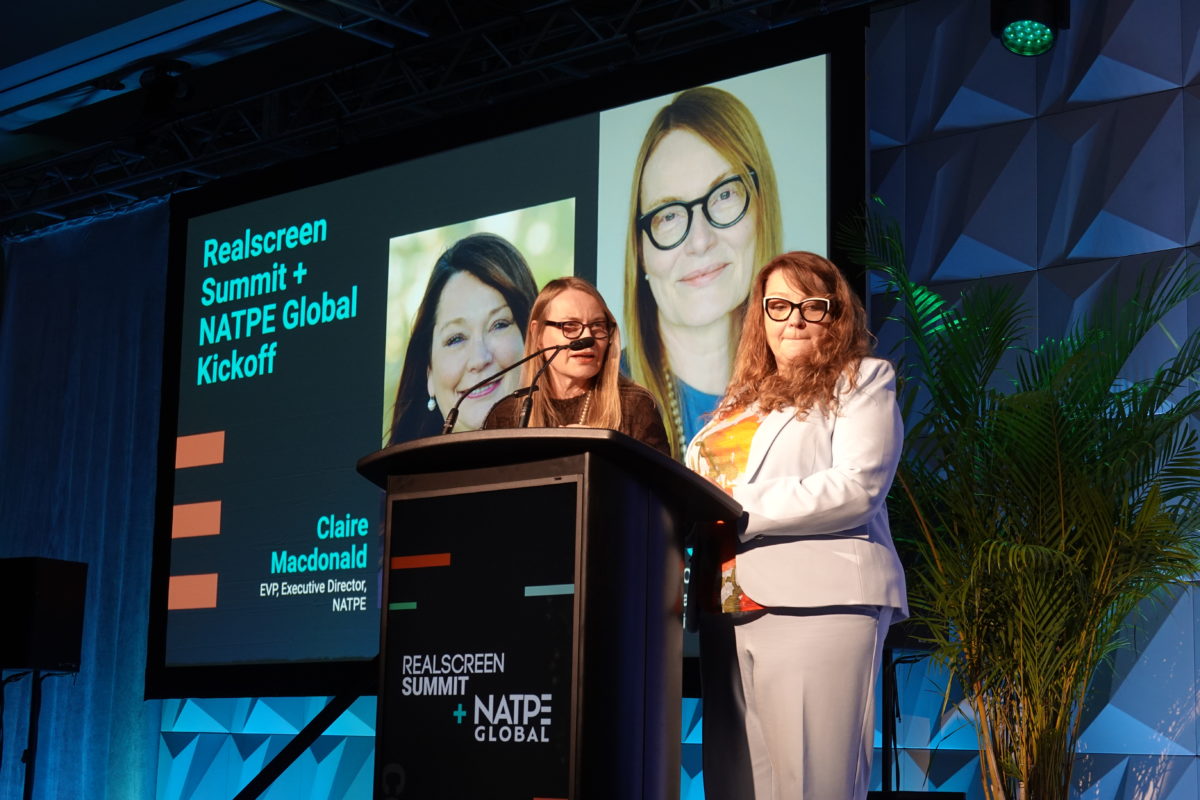
NATPE Global and Realscreen Summit 2026 Underline Convergence, Creators and New Content Economics

MIAMI — The 2026 edition of NATPE Global, co-located with the Realscreen Summit in Miami the first week in February, made clear that old boundaries are dissolving — between creators and legacy media, between traditional distribution and digital innovation. Delegates from across the production and distribution ecosystem upped the intensity of conversation from deal talk to strategic realignment, with a sharply pragmatic undertone reflecting an industry in transition.

The two events brought three major currents into focus: the growing influence of creator-led brands and platforms; the real-world use of AI to reshape production economics; and the ongoing search for sustainable distribution models across an increasingly fragmented marketplace.

Speakers on a panel on converging platforms said creators, brands and social platforms are converging with studios, streamers and broadcasters to change the way content is financed, produced, packaged and distributed.

“It feels like every day is new,” said Kim Larson, global managing director and head of creators at YouTube. “Every day something’s different, and we’re learning. I’ll tell you, some things are pretty constant when we think about audience behavior, and that is how passionate fans build community in a way that I don’t think everybody’s figured out how to financially unlock yet.”

As an example, Larson pointed to creator Markiplier, whose real name is Mark Fischbach.

“He had a passion project called Iron Lung,” Larson said. “It is a movie he made and self-financed. He spent $3 million on it. He literally went to these theaters and said, ‘Hey, will you show it for me?’ And his community, his installed base of 38 million followers, stepped up. He got in 4,000 theaters with a $21 million opening box office. Nobody thought that was possible. And I think that people are waking up to the power and the financial opportunity that comes with the community.”

In their respective keynote addresses, popular YouTuber Dhar Mann — whose studio’s short-form morality plays have driven massive engagement across social media platforms — and Bell Media President Sean Cohan highlighted the potential for collaboration rather than competition between creator studios and established media.

“There’s this conversation that’s happening that creators are eating traditional media players’ lunch or replacing them at the table,” Mann said. “I don’t believe that whatsoever. I think that there’s this bridge, and the folks who can create the bridge between these two islands are the ones that are going to really win in the long run.”

Mann was joined on stage by Dhar Mann Studios CEO Sean Atkins. The two pointed to value of blending Mann’s social media audience reach and real-time analytics with traditional storytelling expertise and distribution muscle, suggesting a hybrid model where creator content and legacy media can reinforce each other’s strengths rather than operate in silos. Dhar Mann Studios’ own deal with Fox Entertainment is the perfect example, Atkins said: “Our intellectual property is ours, we get to produce the content that’s great for us, we get to work with them on distribution and learn together, and they can exploit the assets on linear television and what-not that we don’t have the capability of doing on our own — it’s a win-win for both of us.”

Subscribe HERE to the FREE Media Play News Daily Newsletter!

Artificial intelligence emerged as both a tactical tool and a strategic imperative during the week. In discussions reflecting broader industry trends, executives such as Albert Cheng of Amazon MGM Studios and Jon Erwin of The Wonder Project framed AI not as a threat but as a partner in enhancing production efficiency, reducing costs, and expanding creative capacity.

“When it comes to all the film and TV series that we have in development, I’ll be sitting in these seats and going, ‘I wish we could green light all of these,’” Cheng said. “’How in the world can we do this?’ And the only way to do this is to figure out how do we lower the costs to make these — because the more we can reduce these costs, the more titles we can get on the service.”

Erwin likened AI to the emergence of digital cinema and CGI. “[It’s] a new set of tools that are very powerful,” he said, “and it’s a set of tools and a certain kind of intelligence that pairs incredibly well with human creativity and just amplifies and accelerates everything you do.”

Other sessions at NATPE focused on practical AI applications — from how studios can leverage machine learning to augment human creativity, to how brands and agencies can use data to tailor content to specific platforms and viewers. Rather than predicting the end of traditional workforce roles, speakers emphasized AI as a force multiplier, enabling smaller teams to produce more content, faster — crucial in a marketplace where the pace of delivery increasingly shapes competitive advantage.

While creator content and AI tools generated the most buzz, the traditional focus on distribution strategy, rights negotiation and monetization remained front and center as well. Distributors and buyers unpacked the escalating complexity of distribution terms — particularly as streaming platforms juggle SVOD, AVOD and FAST channels, and ad-supported tiers — in an effort to maximize reach without sacrificing profitability.

Global buyers at NATPE reiterated the importance of flexibility: the ability to structure deals that span multiple platforms and territories, adapt to shifting performance metrics, and integrate ancillary revenue streams such as FAST licensing or branded content integrations. Distribution execs also noted that linear and digital channels are no longer competing silos, but, rather, complementary components of broad strategies aimed at capturing audience attention where it naturally migrates.

Subscribe HERE to the FREE Media Play News Daily Newsletter!
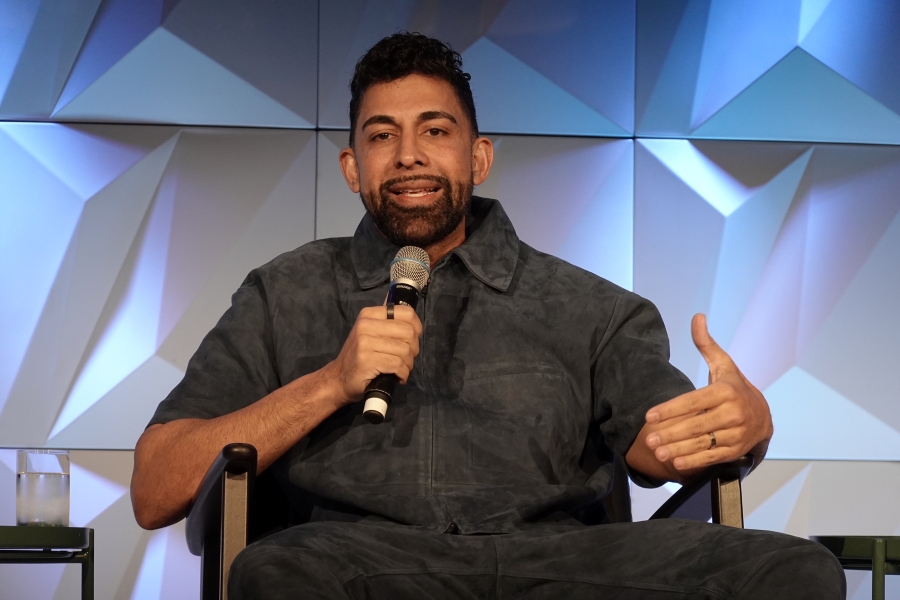
Dhar Mann: Creator Content, Traditional Media Can and Should Work Together

MIAMI — Creator content — of the sort popularized on YouTube, TikTok and other social media channels — and traditional media aren’t diametrically opposed to each other, as some might think.

Rather, they can be complementary and open new doors to each other, providing creators with new distribution opportunities and media companies with new content that is less expensive to produce and could help them reach the wave of Gen Z viewers who don’t watch traditional television or go to the movies.

That was the message YouTube sensation — and micro-drama pioneer — Dhar Mann and the CEO of his company, former MTV executive Sean Atkins, delivered during their opening-day keynote at NATPE Global, which opened in Miami Feb. 4 at the InterContinental Hotel.

Mann, of course, is the founder of Dhar Mann Studios, which is known for creating viral, moral-based, short-form scripted videos, most of them shot at its 120,000-square-foot production campus in Burbank, Calif. Mann and his company have more than 145 million followers, including 26 million on YouTube, and in January the company inked a programming deal with Fox Entertainment. Mann shorts will be hosted on the MyDrama app, part of the Fox family, with an initial rollout of 40 narrative videos. Subsequent distribution windows will be managed by Fox Entertainment Global.

“There’s this conversation that’s happening that creators are eating traditional media players’ lunch or replacing them at the table,” Mann said. “I don’t believe that whatsoever. I think that there’s this bridge, and the folks who can create the bridge between these two islands are the ones that are going to really win in the long run.”

Mann said that while content creation is his forte, he needed a legacy media veteran like Atkins, whose resume includes stints at MTV and Discovery, to develop and build his business.

Subscribe HERE to the FREE Media Play News Daily Newsletter!

“Sure, I could have gotten so far in building the studio, but I didn’t understand content syndication deals,” he said. “I didn’t understand how to have an OTT strategy and the difference between SVOD and AVOD and everything else. I didn’t understand how to do contracts with Samsung and Fox and Disney. I wouldn’t know how to go into vertical dramas and partner with Fox. I didn’t even understand the concept of budgets.”

Mann said he met Atkins “when he came in to buy my company.” But after talking with him for awhile, Mann said, “I said, Sean, instead of buying us, can you just come partner with me and join forces because I really want to do this for the rest of my life. On the due diligence calls, he’d be like, ‘Dhar, how do you decide what the budget is for a film?’ And I’d say, ‘I don’t know, but I can tell you we do everything we can to save money. For example, instead of renting a basketball court, we’d go to Costco, buy a basketball hoop, put it up in our parking lot and that becomes our basketball scene. I can’t tell you how that translates to ROI, but I can tell you we saved 500 bucks there, right?’”

Creative thinking, Mann said, “can go so far. But then bringing in a team of executives or even folks who have done this before definitely has lots of advantages.”

Content creators also bring a lot to the table. “The biggest change from the traditional model is that essentially development is gone,” Atkins said. “So because we can move so fast, because a creator owns distribution and marketing and is vertically integrated, it’s much more cost-effective and efficient just to basically make it.

“Now, obviously that’s not going to work if you’re trying to make Avatar — that’s a different level. But for us, to sit around and spend six months in development, bring in a bunch of writers, and throw opinions at each other. … It’s far more efficient to be, like, ‘I kind of have a notion, I think it’s important for our audience, and there’s some data telling us that they’re going to like it. So let’s just make some version of it because we can always iterate to better along the way.’”

Dhar Mann Studios, Atkins said, “can go from a notion to it’s on our channel in 60 days, accelerated as fast as 14 days. I tell a lot of my development friends, if you partner with Dhar Mann Studios, you’d probably spend the same budget for one traditional scripted series and we could probably make 40 for you.”

Creators also excel at grabbing the viewer’s attention early, beginning with the thumbnail.

“You have to create emotion; you have to create curiosity,” Mann said. “You know, our test is even without any text or context, you should have a good understanding of what that video’s going to be and what you’re going to get. And then the opening hook of the video should almost immediately deliver on whatever the promise of that packaging is. For instance, we did this video recently about kids buying a $200 house on Temu. And so, when you open the video, if you don’t see, within the first 30 seconds, kids talking about buying a $200 house on Temu, you’re almost immediately losing the audience’s interest because that’s what got them there in the first place.

“When we’ve sat down with the Netflixes and the Disneys and such, someone said to me, ‘It’s super important that within the first five minutes we grab their attention.’ And I’m like, ‘We have five minutes?’ Because I’m used to five seconds.”

Mann and Atkins also talked about the new partnership with Fox. “We don’t walk around with arrogance, saying because we are creators, we know everything,” Atkins said. “We know about our audience, we know about what we do very well, but there are things that we don’t know or that we might be more advantaged in having a partner.

“We’ve had very conscious conversations with some great media partners, where they came to the table and said, ‘Look, we don’t know about your world,’ and we’re like, ‘We don’t really know about your world.’ So what is the meeting of the minds that is going to make both of us a little uncomfortable so we can go create something new in a business model that’s new. And tons of credit to Fox Entertainment, because they came to the table and said, ‘We know that creators care about owning intellectual property. We’re not going to try to take that away from you.’ That’s a shocking thing to hear in transactional negotiations.

“So, the advantage to partner with someone who can bring something to the table … we don’t do international global television distribution. You know who does? Fox. And they do it really, really well. And so we’re able to work with someone where we get to do what we do. Our intellectual property is ours, we get to produce the content that’s great for us, we get to work with them on the distribution and learn together and they can exploit the assets on linear television and what not that we don’t have the capability of doing on our own — it’s a win-win for both of us.”

Mann shared with the audience his backstory. He was 30 and broke. He started making content on his couch, focusing on his personal failures, at what he concedes was “the lowest point in my life.”

“I had no money, I was two weeks away from eviction, and I was entering this new decade of life,” Mann said. “I felt like a complete failure, and for a long time I was just sad about my struggles. But then one day I decided to turn my struggles into stories, and so I started opening up about my failures. I realized there were so many people out there who could probably learn from the mistakes that I made in my life, and if I could help them avoid those mistakes and also feel like they’re not alone, then this was a worthwhile pursuit for me opening up about everything I had been through. So I turned on my camera one day and I started recording and I started just telling people like, ‘Hey, if your dreams haven’t worked out, if you feel like your life is not where you want it to be, don’t give up. That doesn’t mean that the future can’t be brighter. That doesn’t mean things won’t work out.’

“I kept recording those videos, one after another, in my small living room apartment, and nobody watched those videos for the longest time. I thought the algorithm was broken. I was like, if only I could get a hold of Mark Zuckerberg and fix my Facebook distribution issues, then everybody will be watching my content. But it turns out it wasn’t the platform, it was the storyteller. And as I kept trying to iterate, eventually instead of trying to give people advice, instead of telling them, I decided to show them. And so I evolved formats. I went from talking on camera to writing scripts on napkins. I asked friends and family members if they would step in as actors. And my studio apartment became my production studio for these two- to three-minute films that all taught some sort of positive life lesson.”

Over the course of three years, Mann said, he produced more than 300 short films. “And then eventually it caught on and now we have nine full-time film crews and over 200 team members. We put out about five hours of scripted content every week. So things have grown quite a bit. But it all started from a place of just trying to help people feel more connected and not alone.”

Subscribe HERE to the FREE Media Play News Daily Newsletter!

From Around the Web