



Network
February 15, 2026




4K ULTRA HD BLU-RAY REVIEW:
Street Date 2/24/26;
Criterion;
Comedy;
$39.95 Blu-ray, $49.95 UHD BD;
Rated ‘R’
Stars Faye Dunaway, William Holden, Peter Finch, Robert Duvall, Ned Beatty, William Prince, Wesley Addy, Beatrice Straight, Marlene Warfield, Arthur Burghardt, Kathy Cronkite.
That a film about the state of mid-1970s television would endure decades later as a prescient examination of society’s relationship with media speaks to the amazing staying power of Network.
It is a testament to the insight of screenwriter Paddy Chayefsky that the film can serve as both a time capsule of its era and a timeless examination of the human condition.
At its core, Network comes across as a biting and hilarious satire of television news. However, director Sidney Lumet would dispute that claim, asserting in a commentary for the film recorded for Warner’s 2006 DVD of the film that he and Chayefsky were simply showing the honest truth of how the television industry worked. To hear him tell it, the only thing depicted in the film that hadn’t actually happened in the 30 years since the film’s release was showing an actual murder on live TV for the sake of entertainment, which he contended was only a matter of time.
Lumet in 2006 equated most of the farcical elements of the film to the growing trend of reality TV. But he died in 2011, just as internet streaming was on the rise, sending the relevance of the film’s social commentary into overdrive.
In contemporary interviews to promote the film, Chayefsky spoke to the dehumanizing effect he believed television had, saying it made the United States look like a country of “hookers, hitmen and pimps.” He was especially critical of the way television could manipulate viewers by distorting the news cycle with selective soundbites, and anchors pushing their own interpretation of events on viewers. If ever the phrase “the more things change, the more they stay the same” would apply to a situation, this would be it.
Chayefsky himself wasn’t unfamiliar with the process, having contributed scripts to the initial boom of television in the early 1950s before breaking into the film industry. Indeed, much of Network serves as his outlet for venting his observational frustrations about not just commoditization of television, but also corporate power, the influence of foreign investment in American entertainment, and the generational decline of morality.
Network begins with an introduction to news anchor Howard Beale (Peter Finch), who is being replaced due to declining ratings. As he reminisces about his career with his longtime friend and colleague Max Schumacher (William Holden), president of the news division, Howard realizes his job was all he had left to live for, so in one of his final broadcasts he announces he’s going to kill himself on the air.
When Howard’s pronouncement sparks newfound interest in his news broadcast, the network bosses decide to keep him on the air. Drinking heavily and no longer caring about decorum, Howard turns his broadcast into a sermon about the state of the world, leading to the iconic scene in which he urges viewers to shout out the window “I’m mad as hell, and I’m not going to take this anymore!”
Languishing in last place and desperate for a hit show, the network becomes willing to air anything for ratings. The network’s soulless programming director, Diana Christensen (Faye Dunaway), seizes control of the news hour, turning Howard into “the mad prophet of the airwaves” by making him the centerpiece of a show that blurs the line between news and entertainment, stocking the program with populist pablum and giving segments to fortune tellers.
She also gives a show to a left-wing terrorist group hoping to seize upon the sensationalism of the homemade footage of their crimes (a precursor to the viral videos of today).
Max, forced out of the company by the network’s budget-obsessed corporate overlord (Robert Duvall), soon begins a scandalous affair with Diana, despite her orchestrating his ouster.
Meanwhile, freed from the burdens of self-censorship, Howard becomes an overnight sensation with his diatribes against corporate hypocrisy and the declining values of America. To Max’s chagrin, Howard’s bosses don’t care what he says or that he might be losing his mind. They only care that he remains the No. 1 show on television. So, when Howard’s commentaries begin to steer toward subjects that threaten the financial stability of the company, his “cancellation” is dealt with in a final business meeting that must be seen to be believed.
The film ultimately won four Oscars, three for acting and a well-deserved Best Original Screenplay trophy for Chayefsky. Dunaway won Best Actress, while Finch would win the Best Actor Oscar posthumously, having died during the film’s award-season campaign. Best Supporting Actress went to Beatrice Straight, who appears as Max’s wife in just two brief scenes for a little over five minutes of total screen time, the shortest duration for an acting win in Oscar history, but her speech lambasting her husband for his affair packs a wallop.
That Network didn’t win Best Picture or Best Director (losing out to Rocky) only shows how much stronger films were in the ’70s.
Subscribe HERE to the FREE Media Play News Daily Newsletter!
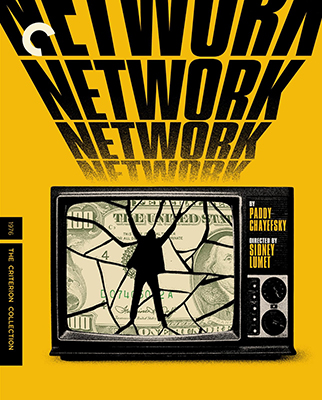
For Network’s 50th anniversary, the Criterion Collection offers the film with a new 4K digital restoration and uncompressed monaural soundtrack on both Blu-ray and 4K Ultra HD disc (the 4K combo pack includes both discs).
The 4K disc includes the film with Dolby Vision HDR and the Lumet commentary. The film looks remarkable, with a presentation that maintains the gritty cinematic quality of its 1970s aesthetic, which Lumet purposefully manipulated as the story progressed so that by the end it would feel as insincere as the television programming it was lampooning.
The Blu-ray Disc of the film also includes the Lumet commentary, plus additional extras such as the film’s theatrical trailer, and the hour-and-a-half six-part retrospective documentary made by Laurent Bouzereau for the 2006 DVD.
New to the Criterion edition is the excellent hour-and-a-half documentary Paddy Chayefsky: Collector of Words, a 2025 film by Matthew Miele that examines the screenwriter’s career using clips of his work and interviews from filmmakers, friends and acolytes such as Aaron Sorkin, Oliver Stone, Rob Lowe, James L. Brooks, Judd Apatow, Mel Brooks and more.
Bonus materials from the previous Warner DVD and Blu-ray that aren’t available with the Criterion version include a 1977 interview with Chayefsky on “Dinah!,” and a 2005 episode of TCM’s “Private Screenings” in which host Robert Osborne interviews Lumet.