



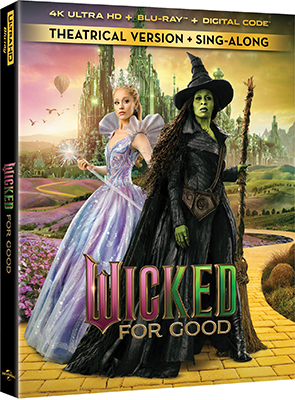
Wicked: For Good
January 17, 2026




4K ULTRA HD BLU-RAY REVIEW:
Universal;
Musical;
Box Office $342.6 million;
$30.99 DVD, $38.99 Blu-ray, $46.99 UHD BD;
Rated ‘PG’ for action/violence, some suggestive material and thematic material.
Stars Cynthia Erivo, Ariana Grande-Butera, Jonathan Bailey, Ethan Slater, Bowen Yang, Bronwyn James, Marissa Bode, Michelle Yeoh, Jeff Goldblum, Sharon D. Clarke, Colman Domingo, Bethany Weaver.
The decision to split the film adaptation of the 2003 Broadway musical Wicked into two parts was one born of cinematic practicalities. In addition to doubling the profit potential for the studio, spreading it over two films gave the story a better chance to breathe on screen, especially when surrounded by the sprawling visual splendor of a big-budget fantasy epic unbound by the inherent limitations of even the most lavish of stage productions.
Accordingly, the first film version of Wicked, dubbed “Part One” on screen, covers the first half of the stage musical, taking a look at the history of the witches from The Wizard of Oz and the friendship they developed before politics and prejudice tore them apart. Glinda (Ariana Grande) becomes a cog in the propaganda machine of the Wizard (Jeff Goldblum), while Elphaba (Cynthia Erivo) is dubbed a “Wicked Witch” because she realized he was a fraud and was leading Oz down a divisive path.
The first movie at least has the advantage of telling a cohesive story about rivalry and friendship set against the backdrop of shifting political winds, and could work even without the trappings of The Wizard of Oz (both the 1939 movie and the L. Frank Baum books). The second movie, Wicked: For Good, which covers the second half of the stage musical, is basically just a The Wizard of Oz version of Rosencrantz and Guildenstern Are Dead.
The film begins with Elphaba basically being branded as a domestic terrorist for her efforts to disrupt the Wizard’s agenda, even as she’s trying to bring the people of Oz to see the truth (though, as the Wizard points out in his “Wonderful” number, political labels are all a matter of perspective).
Soon enough, however, Dorothy’s house crashes into Munchkinland, and the film becomes more of a retelling of the 1939 Wizard of Oz film from the point of view of the witches.
Unfortunately, while the movie is doing everything it can within the constraints of copyright rules to connect with the audience through nostalgia for The Wizard of Oz, its plot twists only make sense by disregarding the narrative realities of the classic film, particularly when certain scenes from each are supposed to be taking place concurrently.
This aspect of the film exposes some paradoxical creative decisions on the part of the filmmakers, who have structured the duology as if it were self-contained enough to make sense on its own. While that’s not much of an issue for the first film, For Good is edited in such a way as to preserve the plot twists of the stage musical for viewers who may not have seen it, yet still seems reliant on people knowing the musical and having seen the 1939 movie to clear up any confusion over what is supposed to be happening. Even then, as with the play, trying to finish its own story while working around Dorothy’s adventures just makes Wicked: For Good feel rushed at the end.
Some of the issue may stem from how much Baum’s original “Oz” stories have been deconstructed over the years. The stage musical is a sanitized version of Gregory’s 1995 novel Wicked, which itself was essentially a raunchier reimagining of the land of Oz. So, while the play and, moreso, Maguire’s novel could be digested as their own thing having fun playing in the Oz sandbox, the “Wicked” movies show much more fidelity toward of previous versions of The Wizard of Oz.
Another problem for Wicked: For Good is that most of the stage musical’s best songs were in the first act. The second act has some notable numbers, namely the title tune, “For Good,” which sets the tone for a darker, more emotional story, but there’s nothing as majestic as “Defying Gravity.” To pad out the story, the sequel adds two more songs by Stephen Schwartz, who crafted the music for the stage version. There’s one for Elphaba called “No Place Like Home” in which she muses about why she still cares about a place that seems to hate her, and one for Glinda called “The Girl in the Bubble,” in which she realizes she’s tired of being the Wizard’s pawn and decides to stage her own coup.
The end result is essentially a five-hour movie version of a two-and-a-half hour stage play based on revisionist Oz fan-fiction that doesn’t really work as a proper prequel to the original story. But at least the songs are catchy, the music is good, and fans of the stage musical seem to enjoy it.
The massive success of the “Wicked” films has certainly fed into speculation about developing a continuation of the franchise, possibly based on the myriad books Maguire wrote as sequels to his original novel.
Subscribe HERE to the FREE Media Play News Daily Newsletter!
The Wicked: For Good home entertainment presentation comes loaded with self-aggrandizing behind-the-scenes material. The same slate of extras is offered on both the 4K and regular Blu-ray discs in the combo pack, and with the film’s digital offering.
These include the sing-along mode with on-screen lyrics, a solo commentary from director Jon M. Chu, and five featurettes, led by the 51-minute “Making Wicked: For Good,” which offers a general look at the entire production. The six-minute “The True Wizard” delves into Chu’s directorial vision, while the six-minute “Kiamo Ko” explores the production design of Elphaba’s castle. There are also two six-minute featurettes about the new songs in the film: “More Than Just a Place” takes a closer look at “No Place Like Home,” while “The Girl in the Bubble” delves into the filming of Glinda’s character pivot number.
There are also six deleted scenes, although the 4K and Blu-ray discs only have four of them (“Brick Making,” “Glinda Train Tour,” “Friendship Montage” and “The Wizard Is Sentimental”), running about six minutes total. The other two (“Even You, Fiyero” and “Return to the Governor’s Mansion”), running four minutes, are digital exclusives. The two-minute “Friendship Montage” might get the most attention from the film’s intended audience, as it depicts a picnic by the main characters that erupts into a game of one-upmanship between Jonathan Bailey and Ethan Slater over a shirtless display of abs. However, the other deleted scenes offer more-interesting insights into the film’s actual narrative.