



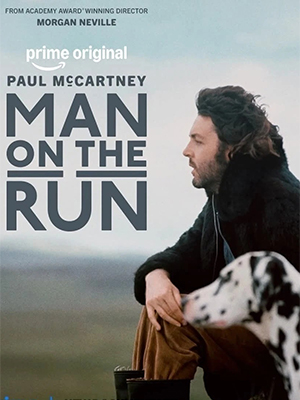
Man on the Run
March 1, 2026




STREAMING REVIEW:
Prime Video;
Documentary;
Rated ‘R’ for language.
Narrated by Paul McCartney.
Director Morgan Neville’s new documentary Man on the Run is not just another retrospective of a musical icon; it is an intimate study of a man navigating the wreckage of the biggest breakup in history. Neville, known for his keen ability to strip away the celebrity veneer to find the human ache beneath, approaches the 1970s not as a triumphant second act, but as a grueling period of survival for Paul McCartney.
The film skillfully clarifies the messy reality of the Beatles’ final days, moving beyond the public narrative that painted Paul as the villain. It was John Lennon who first walked away, famously mentioning in the film, “It’s kind of exciting. It’s like telling someone you want a divorce.” In the immediate wake of that collapse, Paul began to spiral, falling into a dark, heavy period of isolation and drinking as the foundation of his life disintegrated. It was his wife, photographer-turned-musician Linda Eastman, who became Linda McCartney, who became his inseparable partner in family, work and life — a grounding force who provided the steadying love he needed to save him from a total descent. Together, they sought a radical refuge from the industry pressures of London, retreating to the quiet, rugged hillside of a remote farm in Scotland to start over. There were even months of rumors regarding Paul’s death since he vanished from public view.
It was within this newfound domestic peace that the legal battles took center stage. With the help of the Eastman family’s legal prowess, Paul fought to liberate himself from the suffocating grip of manager Allen Klein — a man McCartney deeply mistrusted — while John remained an ardent supporter of Klein’s. Because Paul was the one forced to litigate to protect his creative future, the public backlash fell squarely on his shoulders, blaming him for killing the band he once thought would last forever.
The tension was exacerbated by the shift in their bond; what had begun as a pure teenage friendship had calcified into a fraught business partnership, and the strain of the Beatles’ dissolution threatened to cause a schism. They were divided by the influence of Klein, with each holding deeply entrenched views. Yet, as Sean Lennon deftly states in the film, their chemistry was so profound because “it was like they were two halves of the same person — a kind of mirrored genius that couldn’t exist without the other, even when they were trying to tear each other apart.” Man on the Run poignantly reveals the eventual thawing of that tension: John eventually acknowledged that Paul had been right about the business, and Paul shares how deeply meaningful it was to reclaim his friend before John’s life was tragically cut short.
What sets this film apart is that it never feels like a curated puff piece or a piece of manufactured truth; it feels startlingly real. Neville allows the edges to show, and even Paul is candid about the humble, experimental beginnings of his solo career. Reflecting on the transition from the world’s biggest band to his early solo efforts, Paul admits in the film, “Wings wasn’t exactly Sgt. Pepper, we were just playing around.” It’s this self-deprecation that gives the film some of its soul.
One of the most compelling takeaways is the psychological unraveling that followed. The film suggests that Paul’s legendary workaholism wasn’t just blind ambition; it was a form of running from the trauma of losing his mother at age 14. He sought refuge in the studio, in songs, because it was the only place he felt understood and secure. As Paul reflects on that period of transition and the public perception of his culpability, he admits, “My only plan is to grow up.”
The documentary gains significant emotional weight through Sean Lennon’s participation. His presence acts as a bridge across time, offering a perspective that feels both objective and deeply empathetic. Reflecting on the complex bond between his father and Paul, Sean adds, “They were like brothers who had been through a war together, and no one else could really understand that except for them.” Sean also provides the necessary grace regarding Paul’s famously awkward “it’s a drag” comment following John’s assassination, contextualizing it not as coldness, but as the reaction of a man in deep, paralyzing shock.
Watching this, one realizes that the Wings era was less about topping the Beatles and more about Paul simply learning to stand on his own two feet. The climax, framed by the raw power of “Live and Let Die,” captures that exact moment of letting go — a farewell to the ghost of the band and an acceptance of his own future. By the time the credits roll, Neville has successfully peeled back the layers of the myth to show the man behind it. It is a portrait of a class act, someone who lived through profound loss — enduring both the bitter collapse of his closest bonds and a cold displacement from his own life’s work — only to emerge on the other side by burying his grief in the only thing he knew how to do: create. Ultimately, this film is a reminder of why McCartney is likely the greatest songwriter of all time — not just for the hits, but for the resilience he wove into every measure.
Subscribe HERE to the FREE Media Play News Daily Newsletter!