
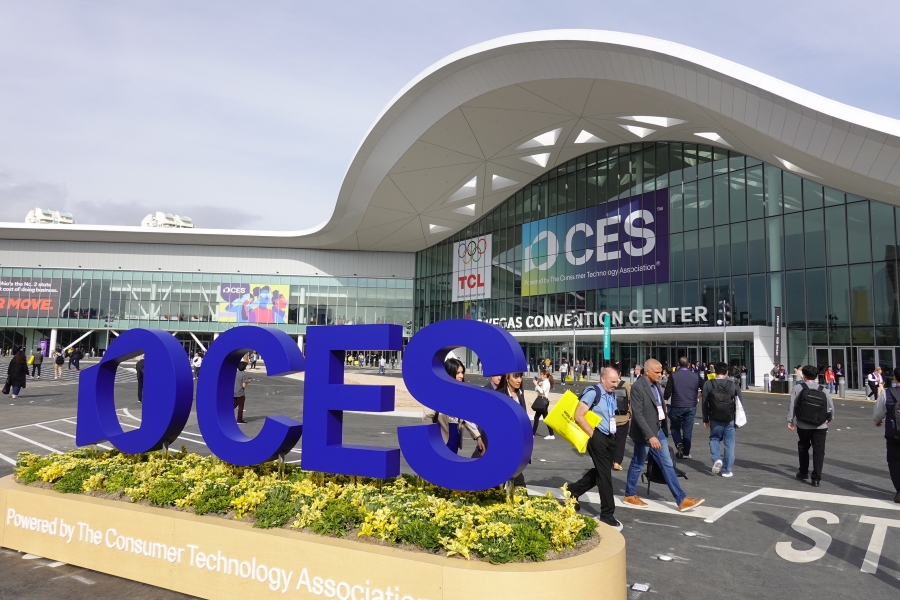
The new entrance to the renovated Las Vegas Convention Center. (Photo by Media Play News staff)



January 6, 2026




LAS VEGAS — A year after the CES adopted a new logo, the entire show has a flashy new look, thanks to an expansive $600 million renovation of the Las Vegas Convention Center.
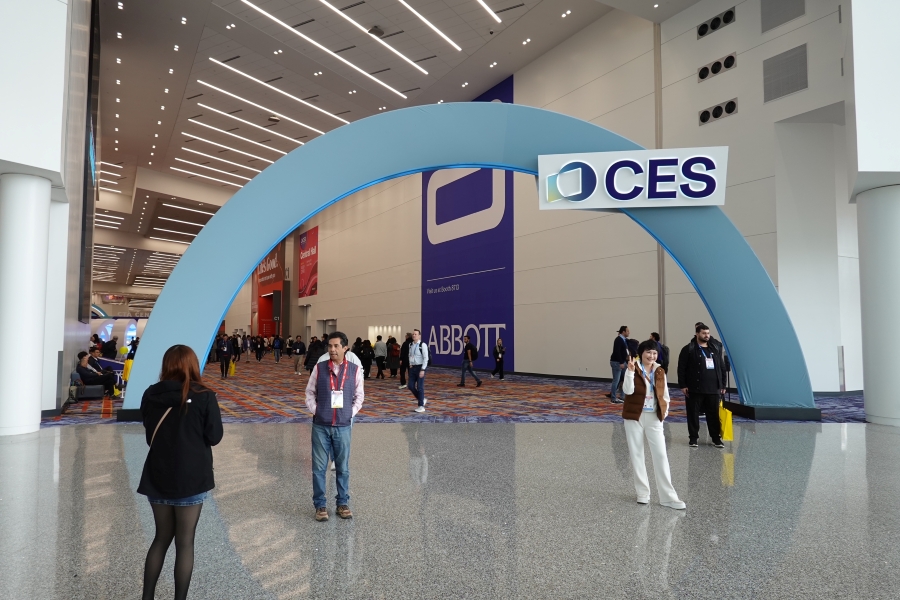
 The now year-old logo is prominently displayed at the stylish new entrance, and the once-dreary central lobby has been widened and brightened, prompting a significant number of opening-day attendees to pose for selfies on Jan. 6.
On the show floor of the central hall, the traditional home to entertainment products, smart glasses are generating quite a buzz. Produced by companies such as Rokid, Solos and Lenovo, the devices — compatible with users’ corrective prescriptions — act as wearable AI companions, answering questions, giving directions, taking photos or videos, and translating conversations.
On the TV front, television technology is in the spotlight, with consumer electronics companies pushing the boundaries of not just picture quality, size, and design, but also intelligence.
As one observer put it, “smart TVs have never been smarter,” thanks largely to widespread adoption, and integration, of AI.
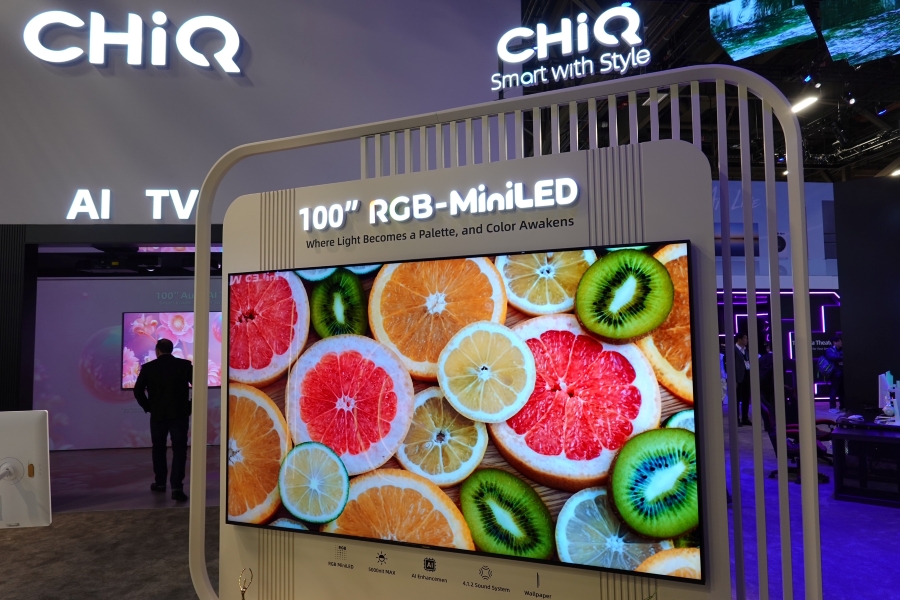
Very evident across the show floor was the rise of Micro RGB display technology: an evolution of LED backlighting that use individually controlled red, green and blue LEDs as the light source instead of standard white or blue LEDs filtered into colors. The result: significantly deeper color accuracy and brightness than traditional LED models.
Virtually every brand, big and small, from Samsung to China’s ChiQ, rolled out their latest Micro RGB displays, including — in Samsung’s case — a 130-inch Micro RGB flagship that blends massive scale with next-generation color engines and AI-driven processing to enhance contrast and realism, even under bright ambient light.
Hisense is taking the Micro RGB push a step further, showcasing a massive 163-inch RGBY Micro LED display with a fourth yellow subpixel to fill the critical spectral gap between 500nm to 600nm, a range where Hisense maintains conventional Micro LED displays fall short and often mute a content’s intended look.
OLED remains a major pillar of premium TV innovation at CES 2026. LG’s showcase included upgraded OLED evo models offering brighter panels, ultra-low reflections, and smart AI picture enhancements powered by new processors — alongside ultra-thin “Wallpaper” TVs that mount almost invisibly against walls for seamless integration into living spaces.
TCL is touting what it calls SQD alongside its RGB and other TV models. SQD stands for Super Quantum Dot Mini-LED — a specific implementation TCL developed to aim for wider color gamut, high brightness, and minimal crosstalk without using discrete RGB LEDs in the backlight.
Samsung’s broader lineup spans 4K OLEDs, Neo QLEDs, and expanded Micro RGB sizes from mid-range to ultra-large screens, with advanced AI features like Vision AI for picture optimization and smarter content recommendations.
Beyond picture technology, design trends also are evolving. Sylvox introduced a frameless outdoor TV with high brightness and durability for patios and outdoor living areas, while art-oriented screens like Amazon’s Ember Artline bring smart art display modes to living rooms.
The opening day crowd was able to fan out due to the enlarged convention center entrance, but observers eyeing the flow into the convention center shortly after the show floor opened at 10 a.m. predict a significant jump in CES 2026 over last year, when an independent audit identified 142,465 attendees.
The pre-COVID high was in 2018, when the show attracted more than 182,000 attendees.
Elsewhere on the show floor, attendees will see lots of what is being called “physical AI” — machines, devices and systems incorporating AI. This includes autonomous vehicles, smart robots, AI-powered appliances, and embedded AI in everyday gadgets.
Robotics are generating a big buzz, particularly Hyundai-owned Boston Dynamics’ humanoid robot, Atlas, which in a live demo appearance showcased fluid, lifelike movement.
Also big are companion robots — from pet-like AI pets to humanoid assistants.
And on the mobility front, fully autonomous cars and robotaxi concepts are being shown by Uber as well as carmakers.
NVIDIA unveiled the NVIDIA Alpamayo family of open AI models, simulation tools and datasets that the company says enable the development of vehicles that perceive, reason and act with humanlike judgment — enabling developers to fine-tune, distill and test models that unlock greater safety, robustness and scalability.
Both Dolby and Xperi, parent of DTS, showed off car models utilizing their latest sound innovations. The two are rivals, competing primarily in audio codecs and immersive sound formats.
Subscribe HERE to the FREE Media Play News Daily Newsletter!