
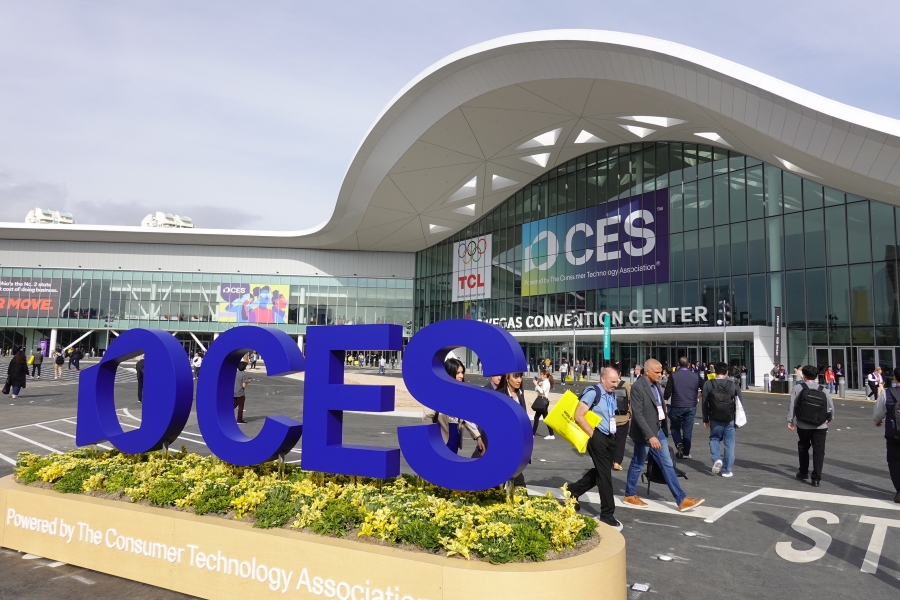
The new entrance to the renovated Las Vegas Convention Center. (Photo by Media Play News staff)



January 14, 2026




CES has long been a signal for where technology and media are headed. CES 2026, however, marked a clear turning point for the media and entertainment industry.

This year was not about bold promises or speculative roadmaps. It was about delivery. For many media executives, the most meaningful conversations did not take place on the show floor, but in meetings, panels, and side discussions in and around the Aria, where the focus shifted decisively from vision to execution.
Across conversations with studios, FAST platforms, distributors, and technology partners, one message was consistent. The industry is no longer rewarding ambition alone. It is demanding proof.
Below are my five key takeaways from CES 2026.
1. The “Trust Me” Era Is Over. Practical AI Is Now the Standard.
For the past several years, simply saying “we are using AI” was often enough to generate interest. That moment has passed. At CES 2026, executives were asking sharper, more practical questions:
AI fatigue is real. Investors, customers and partners are no longer impressed by aspirational language or long-term promises. They want evidence of value that already exists.
This has created a clear divide between theoretical AI and practical AI. Theoretical AI focuses on what might be possible in the future. Practical AI focuses on what is deployed, trusted and measured today.
Media executives are increasingly skeptical of broad “agentic AI” claims that are not tied to specific workflows. The most credible discussions centered on narrow, well-defined use cases with clear accountability, human oversight, and transparent decision logic.
In media, AI often touches sensitive areas such as rights data, revenue reporting and licensing decisions. In those environments, explainability matters as much as capability. Black-box systems introduce risk, not confidence.
The takeaway is simple. AI adoption in media is no longer about ambition. It is about accountability and measurable impact.
2. FAST Is Shifting From Expansion to Optimization
FAST remains an important distribution model, but CES 2026 made it clear that the market is maturing.
Conversations with platform operators and companies that build and monetize FAST channels suggest the industry may have reached, or is nearing, peak channel proliferation. The focus is increasingly on the 20% of channels that drive 80% of revenue.
FAST platforms are becoming more selective. Publishers are finding it harder to secure carriage unless a channel brings recognizable branding, an existing audience, or clear marketing support.
In short, FAST platforms are trimming the fat.
This shift signals a move away from land-grab strategies toward optimization, where performance, brand equity, and monetization efficiency matter more than raw channel count. For publishers, the bar is rising, and data-driven decision-making is essential.
3. Consolidation Is Accelerating Across the Media Ecosystem
While industry headlines often focus on mega-deals involving major studios and Big Tech, CES 2026 highlighted that consolidation is happening at every level of the media ecosystem.
Mid-sized and independent media companies are combining to gain scale, improve leverage, and survive in a more competitive environment. Portfolio strategies are replacing single-brand strategies, and operational efficiency is becoming a requirement rather than a differentiator.
As companies merge, complexity increases. Content libraries expand. Rights portfolios overlap. Legacy systems collide. Manual processes do not scale in this environment.
For many organizations, consolidation is less about strategy and more about operational readiness. Those without modern, flexible platforms will feel the strain first.
4. Future-Proofing Now Means Measurable Progress
One of the most common questions raised at CES this year was, “What are you doing to future-proof your business?”
The most credible answers were also the most practical.
Future-proofing today means building systems that adapt as distribution models evolve, data architectures that can absorb acquisitions, and AI that evolves alongside business rules. It also means investing in teams that continuously learn, rather than assuming transformation is a one-time event.
The industry is moving away from static transformation projects and toward continuous optimization. Media companies that treat AI, FAST or automation as check-the-box initiatives risk falling behind just as quickly as those that delay adoption altogether.
5. Scale Alone Is No Longer a Growth Strategy
A recurring undercurrent at CES 2026 was the recognition that the traditional media playbook is reaching its limits, especially for the largest global players.
Simply adding more channels, more content or more distribution partners is no longer a reliable growth lever. In many cases, major platforms are now competing with each other for the same audiences, the same creators, and the same advertising dollars.
The next phase of growth will require moving beyond what worked in the last decade.
That means taking a more disciplined, intentional approach to emerging growth vectors such as the creator economy, short-form video, podcasts, live sports and gaming. These are not side experiments or marketing add-ons. They are becoming core pillars of audience engagement, discovery and monetization.
It also means preparing for new content experiences and form factors, including immersive and spatial formats that extend storytelling beyond traditional screens. As new devices and interfaces enter the market, the opportunity will favor companies that can adapt content and business models without fragmenting their operations.
For global media companies, the challenge is not just access to scale. It is finding differentiated growth without crowding into the same plays as everyone else. CES 2026 made it clear that the next winners will be those willing to expand the playbook, not just optimize the existing one.
Final Thought
CES 2026 did not feel like the beginning of an AI revolution. It felt like the moment the industry matured. The hype cycle has cooled. Expectations have sharpened. The mandate is clear. Deliver, measure and explain. From AI to FAST to consolidation, the message from Las Vegas was unmistakable. Show us what works. Do not just tell us what might.
Welby Chen is CEO of Whip Media, a SaaS company powering the media and entertainment industry.