Super Bowl LX, 2026 Winter Olympics, and the New Battleground for Live Sports

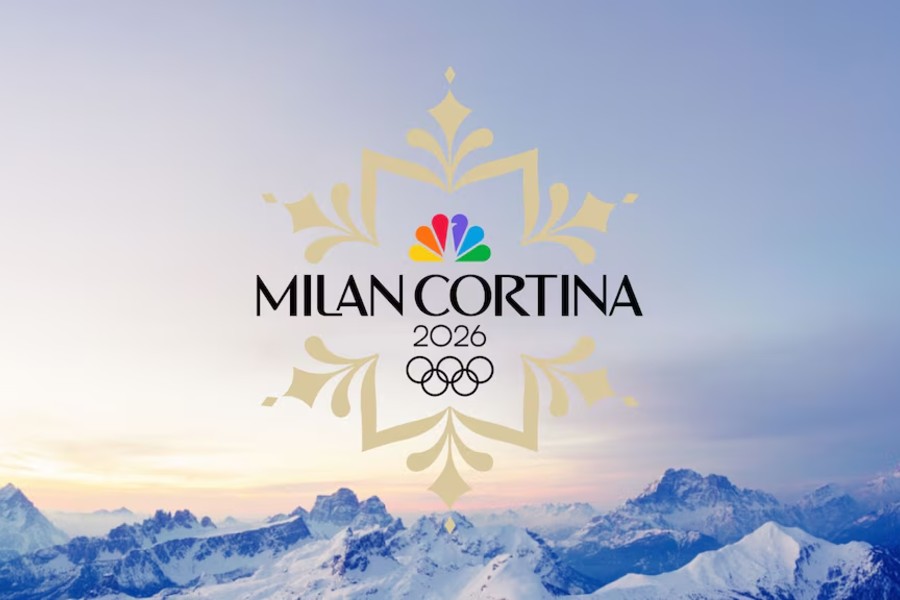
Live sports have been steadily moving to streaming, but Feb. 8 may mark a decisive shift. On that day, NBC and Peacock will broadcast both Super Bowl LX and the 2026 Milano Cortina Winter Olympics. For an industry that has long debated whether streaming can support the biggest live sporting events at scale, this month will serve as a real-world, high-stakes test.

Francesca Pezzoli

For Peacock, this moment represents more than a programming milestone; it is an opportunity to validate its ambitions in live sports.

The stakes are high. Live sports viewers are less forgiving than on-demand audiences; even minor issues with access, discovery or technical performance can quickly erode trust. However, the rewards are substantial if Peacock delivers a seamless experience.

Success will not be measured only by subscriber growth or viewing time. It will be defined by visibility, consistency and execution: how often Peacock appears on the home screen, how effectively it surfaces live moments, and how intuitively it guides viewers between events, highlights and replays. In a crowded streaming environment, winning sports isn’t just about having the rights; it’s about owning the digital shelf.

CTV: The New Battleground for Attention

Connected TV (CTV) is becoming increasingly important as live sports viewing shifts to this platform. Currently, 80% of U.S. CTV users stream live sports, according to the “LG Ad Solutions report: Stadium to Screen,” making the TV home screen a critical gateway to reach fans.

On Feb. 8, the competition will extend beyond Peacock versus other streaming services. It will be a visibility contest across Roku, Fire TV, Samsung, LG, and other platforms, where device-level discovery determines which audiences see first. Which apps and live events are featured on home screens, and which platforms successfully convert viewer intent into action, will ultimately determine success.

For viewers, the experience will feel simple: turn on the TV and watch. Behind the scenes, however, the CTV merchandising strategy will play a disproportionate role in determining who wins attention during one of the most competitive live sports days of the year. This is the turning point where home-screen visibility becomes as valuable as the rights themselves.

The Paris 2024 Olympics set viewership records across linear, digital and social platforms. The 2026 Winter Olympics are expected to be even more multichannel. Fans will move between live broadcasts, streaming apps, highlights, social clips and second-screen experiences. For Peacock, this means alignment across content strategy, CTV execution and device-level partnerships.

Last year’s Super Bowl on Fox and Tubi was the most-watched Super Bowl and telecast in U.S. history. Tubi provided a top-tier streaming experience for free, a key message highlighted in their most prominent placements across Samsung TV, LG TV and Google TV.

To achieve success this year, Peacock needs to secure premium advertising environments, establish dominant home-screen placements, and ensure effective promotion across CTV devices, including Roku, Amazon Fire TV, and smart TVs.

Why This Matters

February will be an important case study for sports streaming. In addition to the Super Bowl and Olympics, Peacock will air the 2026 NBA All-Star weekend. It will show how audiences behave when major live events are available on streaming platforms, how well CTV environments facilitate discovery, and whether the execution can meet expectations under such demanding live conditions.

Francesca Pezzoli is VP of marketing at Looper Insights, a company that helps major Hollywood studios, global streamers, local broadcasters, and entertainment platforms understand how content is promoted across connected TV and digital storefronts and how that visibility translates into audience engagement and viewership.
Netflix May Buy the IP, But Who Owns the Digital Shelf?

Recent headlines about Warner Bros. Discovery, from the accepted deal with Netflix to a hostile bid by Paramount, have focused on libraries, IP valuation, and the future of individual services. But here’s the question almost no one is asking: if Netflix controls the IP, does that automatically translate to more visibility for Warner Bros. titles across the CTV home screen?

Francesca Pezzoli

Underneath the deal speculation lies a more consequential battle: who owns the digital shelf where that content is merchandised in the CTV ecosystem?

In a linear world, owning a studio meant owning a catalog, and distribution followed a relatively predictable path. In today’s CTV-dominated landscape, control is far more fragmented and arguably more valuable. With streaming, what matters is not simply what you own, but who controls the “front door” of discovery across devices, platforms, and operating systems.

The New Home Screen Power Brokers

Smart TV platforms and connected TV operating systems, including Roku, Fire TV, Google TV, Samsung and LG, now control access to audiences at the moment of choice. They determine which title is promoted, where it appears on the home screen, which carousel it surfaces in, and which franchises receive premium placement.

Owning the IP is one aspect; managing visibility is an entirely different challenge. Owning HBO doesn’t automatically translate into owning the HBO slot on Samsung. Even if Netflix were to acquire Warner Bros. Discovery, the visibility of their titles on Samsung devices or Fire TV homepages would still need to be negotiated inside the merchandising economics of those platforms.

The High Stakes of Premium Real Estate

Premium placements on home screens are already dominated by a small number of global players. Independent CTV visibility data shows that week after week, the same companies capture a disproportionate share of high-impact merchandising slots. This imbalance is likely to grow, not shrink, as consolidation increases.

In that context, the Netflix-WBD deal is about more than bringing beloved franchises under one roof. It’s about controlling more opportunities to surface that content across third-party operating systems, especially as those platforms continue to build their own advertising, promotion and merchandising businesses.

Why This Matters

Even the biggest studios today do not control their promotional destiny across the CTV ecosystem. They depend on platform relations teams, merchandising spend, and retail-style negotiations to secure shelf space.

And that’s what makes the WBD case so interesting: studio ownership doesn’t guarantee on-screen visibility. Visibility is rented, not owned. No matter who controls the IP, the studio still has to compete for placement inside the merchandising architecture of Roku, Samsung, LG and others.

The Industry Question No One Is Asking Yet

As consolidation accelerates, the strategic question becomes: If content ownership shifts, does merchandising power shift with it? The short answer is: not automatically.

Owning a studio doesn’t necessarily mean owning the most valuable promotional real estate in the ecosystem. That belongs to the devices, the OS layer, and the merchandising engines that shape what audiences see first.

If WBD is acquired, the fundamental challenge remains the same: what percentage of the CTV shelf do they really own and at what cost?

If the future of streaming is being decided on the home screen, visibility is the currency everyone now has to measure. And as M&A reshapes the competitive landscape, the winners will be the companies that understand not just the value of their IP, but also its discoverability across the devices audiences use every day.

Subscribe HERE to the FREE Media Play News Daily Newsletter!

How Streamers Can Win Thanksgiving Week: What CTV Promotions Reveal About the Next Big Battle for Attention

Every November, the entertainment industry hits its version of the Super Bowl.

Francesca Pezzoli

Thanksgiving week is no longer just a retail battleground. It’s one of the most valuable media windows of the year, where live sports, blockbuster streaming premieres, and Black Friday subscription deals converge on the biggest screen in the home: television.

According to Samsung smart-TV viewership data, streaming activity jumps 11% during Thanksgiving week compared with average non-holiday weeks. With audiences off work, on the couch, and primed to browse, the Thanksgiving window has become a high-stakes promotional moment for streamers, studios and sports leagues.

To understand what actually worked in 2024 and what will shape a competitive advantage in 2025, Looper Insights analyzed promotional activity on major connected TV platforms, evaluating thousands of placements using its MPV (Media Placement Value) metric, which measures on-screen visibility, and $MPV (Dollar MPV), which assigns an equivalent media dollar value based on placement prominence.

Our “Thanksgiving 2025 Playbook” report reveals a new truth about streaming success during peak windows: Visibility is currency. If audiences can’t see the content title, they can’t click, stream, rent or subscribe.

The NFL Dominated the Screen

Thanksgiving has always belonged to the NFL, but on connected TVs, the league didn’t just win viewership; it won real estate.

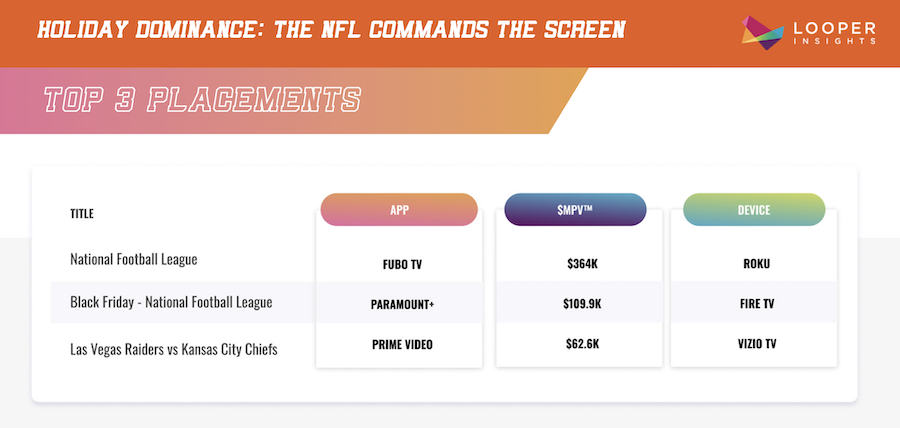
Looper’s analysis shows that the top three NFL promotional placements across Roku, Fire TV and Vizio each achieved the maximum MPV score of 24, ranking them in the top 2% of all U.S. connected-TV promotions during the week.

Those three placements delivered a combined $536,000 in $MPV, led by Fubo TV’s “Turkey Day Football” takeover on Roku.

What made them so effective? Fubo TV’s “Turkey Day Football” on Roku used festive Thanksgiving visuals to spark excitement; Fire TV paired NFL action with other sports in a dynamic Black Friday split-screen offer; and Vizio highlighted the “Raiders vs. Chiefs” matchup with bold rivalry imagery and a strong call to action. Together, these placements show how tailored creative and premium placements drive standout visibility during one of the NFL’s biggest viewing weeks.

And the NFL didn’t stop at the games. Spin-offs such as Madden NFL, NFL Icons and NFL Slimetime carried that momentum into other formats, ranking among the week’s highest-performing secondary promotions. Even during tentpole moments, the league used its IP to stay visible before, during, and after the games.

Black Friday Becomes a Streaming Holiday

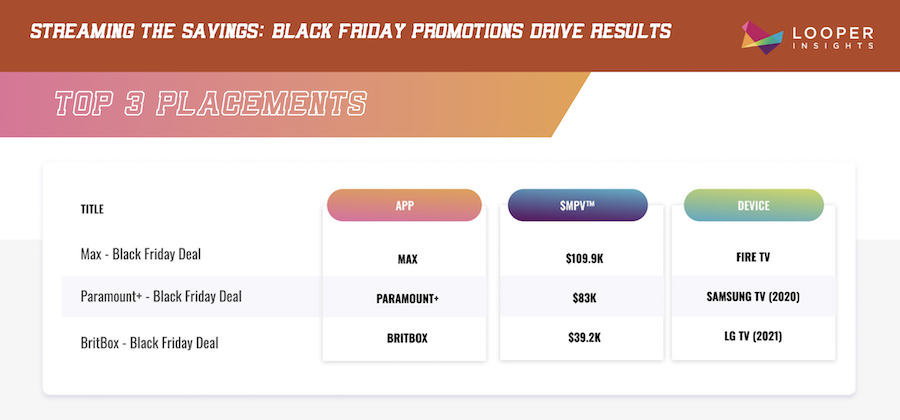
Black Friday has become just as important for streaming services as it is for retail, with major platforms using the holiday to promote subscription deals aggressively. However, the results showed a surprising trend: a longer offer duration is more effective than a deeper price discount. Both Max and Paramount+ had the same subscription price, but Max provided a longer promotional window and ultimately came out on top.

The New Rules of Holiday Streaming

Our analysis surfaced five clear strategies for Thanksgiving 2025:

  • Put your marquee IP in the most premium placement and surround it with supporting content. The properties that dominated Thanksgiving didn’t just appear on the homepage; they owned the hero units, full-width banners, and the top position in rotators. When you anchor your priority title with supporting spin-off content, you extend engagement beyond the main event and multiply visibility hours.
  • Control the platform, control the outcome. Streamers who control the distribution environment (device OS, app store, or app UI) can guarantee top placement when it matters most. Placement is not a creative choice; it’s a competitive advantage.
  • Longer offer windows beat deeper discounts. Our data shows that the duration of a promotional offer drives more conversions than the size of the discount. Viewers are more likely to start a trial when they feel they have time to enjoy the content, not when forced to decide under time pressure.
  • Match the CTA to the device for simplicity to win. On mobile and app-store environments, flexible CTAs like “Subscribe at a discounted price” outperform price-specific messaging because users are already in transaction mode. On CTV home screens, performance improves when CTAs focus on immediate action, such as “Watch Live” or “Stream Now.”
  • Always-on repetition beats a one-day splash. The best-performing campaigns didn’t rely on a single takeover tile; they used multiple recurring placements across rows and carousels to stay persistently visible throughout the week. Frequency drives familiarity, and familiarity drives clicks.


The Bottom Line

Thanksgiving week is no longer just a ratings race. It’s a visibility race.

In a world where more than half of users decide what to watch from the CTV home screen, the titles that win the screen win the week. And as films and franchises such as “Stranger Things,” Wicked: For Good, and multiple NFL matchups will compete for audience attention this Thanksgiving, streamers will need every advantage they can get.

Francesca Pezzoli is VP of marketing at Looper Insights, which specializes in providing granular, real-time analytics and insights on the promotional impact of content on connected TV platforms (CTV). 

From Around the Web